Work is a Blessing

We were in the woods every winter cutting down trees when I was a young lad in the 1940s and 1950s on the 238-acre farm outside of Seneca in the heart of Crawford County. After morning chores and breakfast, Dolly and Prince were hitched to a sleigh wagon, two runner blades in the front and two in the back, loaded with axes, cant hooks, hammer mall, wedges, crosscut saw, and away we go would to the woods, Dad, my two brothers, Phillip and Bob, and me. That’s a two-man crosscut saw I’m talking about, no chainsaw on the Scheckel farm.
Dad showed us how to make a notch on the side of the tree we wanted the tree to fall. We would pick a spot that was as clear of other trees as we could make it. We didn’t want a tree “hung up” in another tree. That could be dangerous. When the tree started to fall, Phillip, Bob, and I would yell “timber” to warn anybody that was nearby. Of course, there wasn’t anyone except the four of us and Browser, the dog, and we made sure he was out of the way. We did not have hardhats or any protective steel-toed shoes. We boys took great delight if the tree fell where we chose. A big tree would yield a log or two, fence posts, and firewood.

As soon as the tree was down, two of us attacked the top of the tree with axes, cutting off the ends and stacking the brush. Two others would use the crosscut saw to cut logs and fence posts. Long limbs about 10 to 12 feet were stacked up or loaded up on the wagon. These would be taken to the farmstead to await the “buzz” saw and cut up to burn in the basement furnace.

We’d take a breather now and then, deep in the woods and sit on tree stumps and drink water from quart jars that we brought along. Sometimes we packed a few sandwiches.

Dad would tell a few stories of his past. A man was working in the woods with him when he was a boy. They were felling trees and a dead limb hit him on the head. The man got a bad bruise but kept right on working. At noon, they went home to eat dinner. The man laid down on the couch to rest awhile and died. Dad thought that a blood clot had gone to his brain.

Dad talked about the importance of paying your debts, honesty, and frugality. More than a few times, he would pontificate, “Boys, work is a blessing.”  We would think, “Yah, bullshit.” But of course, Dad was right. We boys just didn’t see it at the time.

There’s that wonderful scene in Season 3 Episode 8 of the original 1978-1990 All Creatures Great and Small television program airing on February 16, 1980. The Yorkshire vet, James Herriott, and his partner, Siegfreid Farnon, are attending Dolly, an ageing horse belonging to an elderly milkman, Herbie Hinchcliffe.

Herbie and Dolly have been delivering bottled milk to the Darrowby townsfolks for decades. Dolly has come up lame and can barely stand or walk. The vets deliver the sad news to Mr. Hinchcliffe, who can’t afford another horse and must now suspend his milk route. Both milkman and horse are out of work. Siegfried turns to James and loudly exclaims, “James, we are the lucky ones, apace, apace, work, work, oh, she wears a beautiful face.”

The value of human labor goes back to Biblical times. In Genesis 3:19,  God said to Adam, “Ye shall earn thy bread by the sweat of thy brow.”

Paul’s second letter to the Thessalonians says that when we do authentic work of whatever kind, we participate in God’s ongoing creation and providence. We should see our daily labor, however humble, as part of God’s plan to bring us joy. Paul knew about hard physical labor. Paul was a tentmaker, not easy work, and lots of drudgery.

Work affirms our dignity and self-worth. It is a social activity that draws us together in a common enterprise. Work produces something of value for others to consume. In a real sense, work is a form of prayer.

Posted in Uncategorized | 1 Comment

Airplane Struck by Lightning

What happens when an airplane gets struck by lightning?

Lightning strikes on aircraft are quite common, but also quite harmless. According to the FAA (Federal Aviation Administration), on average, every airliner gets hit once a year. Of course, some planes get hit more than once, and some not at all. Yes, indeed, that adds up to a lot of struck planes.

Geography has a lot to do with it. Thunderstorms and lightning are more prevalent near the equator because of convection currents created by warm air. There’s an average of 100 thunderstorms a day in Florida, but only 10 on the West Coast.

Aircraft are most frequently struck by lightning just after take-off and just before landing. In order words, when the plane is close to the ground and between 5,000 and 15,000 foot altitude. Planes are rarely struck above 25,000 feet or at cruising altitudes in the 30,000 feet and higher range. Almost all strikes occur when the aircraft is in clouds.

Planes are made of aluminum, which is a very good conductor of electricity. The lightning flows over the skin of the plane and off into the air. Lightning could damage very sensitive electronic instruments on board, so built-in lightning protection systems are required.

Lightning most often hits planes in a protruding part, such as the nose or wingtip. When flying, you might see those metal rods sticking out of the trailing edge of the wing. These static wicks dissipate charges caused by lightning during a flight.

More and more aircraft these days are made of a mix of composite materials and aluminum. The Boeing 787 Dreamliner is 50 percent composite by weight, including the fuselage. The Airbus A350 is a tad more than 50 percent composite. Those carbon fiber laminate composites do not conduct electricity. The manufacturers take extra measures to protect strike- prone areas.

The last time a commercial airplane crash was blamed on lightning was in 1962, when lightning struck a Boeing 707 that was in a holding pattern over Elkton, Maryland. The lightning spark ignited vapors in a fuel tank, causing an explosion and killing eighty-one people on board. The very next week suppressors were installed in aircraft.

In 1967, 23 people died when a Lockheed jet flown by the Iranian Air Force was brought down by lightning. The probable cause was listed as “lightning-induced ignition of the fuel/air mixture in the no. 1 reserve fuel tank with resultant explosive disintegration of the left outer wing and loss of control.”

Pilots do try to avoid thunderstorms, not only because of lightning, but because the high shear winds (updrafts and downdrafts) can tear an aircraft apart. Also, if a jet engine ingests a huge amount of water, the engine will quit (flame out). In addition, an airplane flying into a cloud that has built up an electric charge can actually trigger a lightning stroke.

A Boeing 777 carrying British Prime Minister Tony Blair to a meeting with President Bush in March 2003 was hit by a lightning bolt as it approached Andrews Air Force Base outside Washington, D.C. Lightning hit the left wing. There was no damage to the plane or passengers.

Please send comments and questions to: lscheckel@charter.net

Posted in Uncategorized | Leave a comment

Late Summer in the Hill Country

The summer season is stunning here in Monroe County in southwest Wisconsin. Timely and plentiful rains along with sunny and hot days have insured a corn, soybean, oats, and hay crop that is more than promising.

             A bicycle ride on Friday from Tomah to Camp Douglas along the back country roads of Highway 131, County A, Grosbeak Ave, and ET yields sights of the wild country, a term coined by Tomah writer Tom Muench.

             The corn is developing ears. The soybeans are a lush dark green. The Amish have much of their oats threshing done and second crop hay is being cut and baled or chopped for silage.

            The soybean and corn fields are practically free of any weeds, a far cry from crops planted 30 years ago, when weeds could choke out the desired crop. The use of GMO (Genetically Modified Organisms) seeds and plants may be controversial in some quarters, but Round Up Ready corn and soybeans had insure weed free fields. 

            The blue chicory and white Queens Anne’s Lace is seen along most every roadway. It’s a shame they mow those beautiful flowers. Kills ‘em right on the spot. There has never been a more beautiful crop of black-eyed-susans along Wisconsin I-90 from Tomah to La Crosse.

            Sandhill cranes, wild turkeys, and deer, can easily be spotted, especially with the slow going of bicycling. There’s a big crop of red-wing blackbirds this year, warbling a distinctive song and sporting a red feather patch bounded on the bottom with a tuff of yellow.

Posted in Uncategorized | Leave a comment

The 1100 th Ask A Science Teacher Column


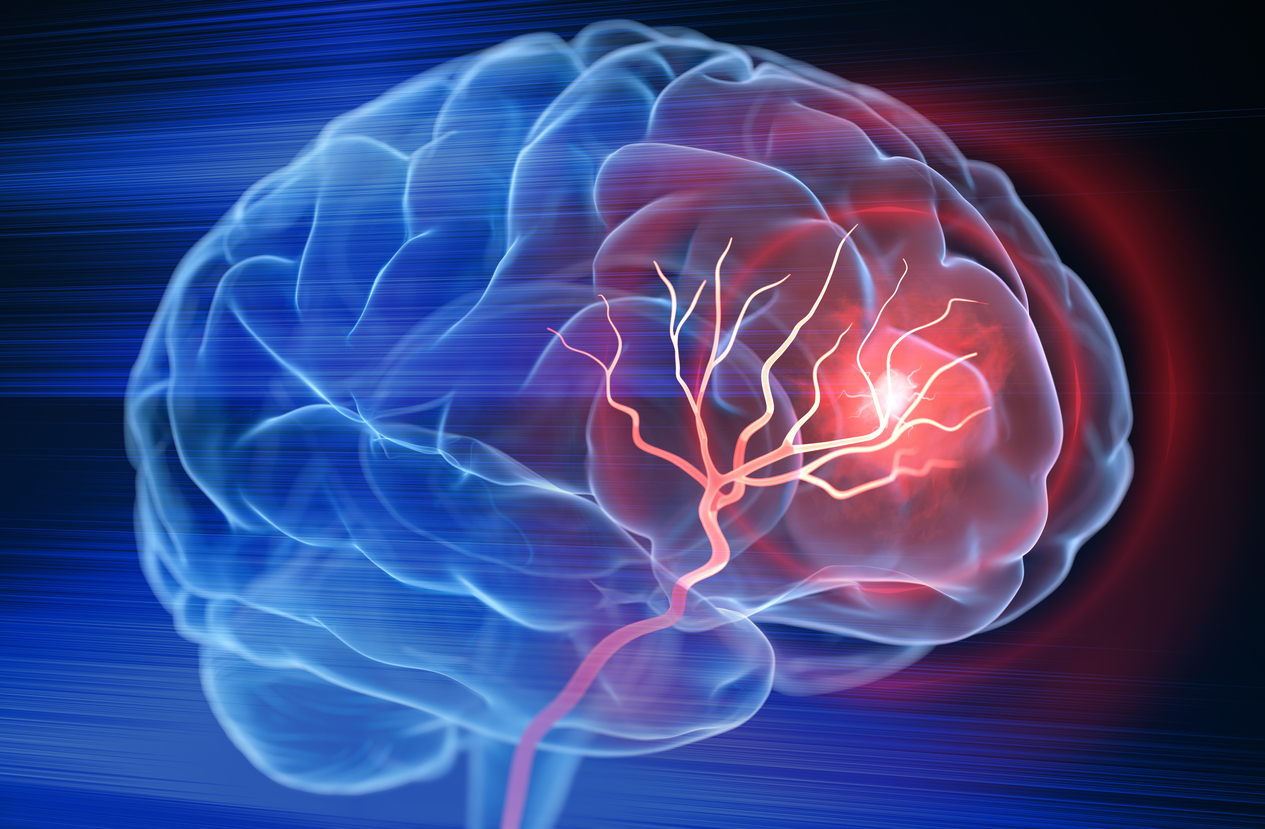
X- Ray illustration of brain stroke – 3d Illustration

The brain has forever been referred to as gray matter. Truth be told, the brain is pinkish fleshy in color. The very center of the brain is an off-white shade. The brain is very soft tissue having the consistency of tapioca pudding.

The brain uses about 20 percent of the total oxygen intake. Oxygen is used to make glucose, which is the brain’s source of energy. If the brain’s oxygen is cut off, permanent brain damage occurs after about four minutes. Hypoxia means low on oxygen and anoxia is total lack of oxygen.

A whole slew of things can go wrong with the brain. Heart attack, suffocation, drowning, high altitude, and head injury or blunt trauma can all put a damper on a healthy brain.

A stroke is caused by a disruption of blood flow to a certain part of the brain. An aneurysm happens when an artery wall in the brain is weakened. The damaged area can swell and apply undue pressure to the surrounding tissue. Tumors are growths caused by run-away cell division. Malignant, or cancerous tumors, invade surrounding tissue causing massive damage. Benign, or non-cancerous tumors, do not spread or attack other tissue, but they can apply pressure to adjacent brain tissue.

The abuse or misuse of legal and illegal drugs can damage nerve cells in the brain which leads to permanent brain damage.

Dementia is a general term that describes a wide range of brain declines, such as memory loss, demise of thinking skills, and the inability to perform everyday activities. Alzheimer’s Disease account for about 75 percent of cases.

There are three main parts to the brain: the cortex, the limbic, and the brainstem.

The cortex handles the most complicated things, such as thinking, making decisions, recognizing sights, words, sounds, and sensations. We depend on the cortex for playing sports, playing music, and for writing.

The limbic is involved with survival. The limbic lets us know when we need to eat, drink water, and put on a coat when we get cold. The limbic warns us of dangers and makes us aware of threats. The limbic also is where we experience pleasure and happiness.

The brainstem connects the brain to the spinal cord that runs down the backbone. The brainstem controls heart rate, breathing, and other vital organs. If the brainstem is badly damaged a person can lose consciousness and lapse into a coma. The cortex needs the brainstem to keep it alive. The brain weights about three pounds and has a volume of the 1300 cc (cubic centimeters) or 5.5 cups, or 1.4 quarts. Brain weight and volume varies with the size of the individual.

                Don’t read any further. Reader discretion advised!

Sometimes a medical examiner or coroner will order an autopsy of a body. The reason, of course, is to establish cause of death. As part of most autopsies, the brain is removed. The medical examiner uses an electric saw, called a Stryker saw, to make a round cut through the top of the skull. The cap of the skull bone is removed. The medical examiner employs a scalpel to cut the tissue that connects the brain stem to the spinal cord. The brain can be pulled out, stored in a solution, and is now available for further examination.

Albert Einstein’s brain was removed within a few hours of his death in April 1955. It is well worth reading about the journey his brain took in the next 50 years.

OK, the gruesome part is done, and you can start reading again!

The brain is a wonderful instrument. Our brain is who we are. Our body is just along for the ride, so to speak, and quite utilitarian. The brain is so complex, it has been referred to as one of the last frontiers of the unknown. Outer space and the deep ocean have also been put into the categories of “last frontiers.”

Each of the 100 billion neurons in the brain has about 1,000 connections to other neurons, creating a huge network of 100 trillion synapses. These synapse connections are “on” or “off”, like electronic switches in a mega computer.

Our brain is so magnificent and exquisite that it behooves us to take good care of it, for no other reason than it is the only one we will ever have. Realize that it is not wise to endanger our brain by drug or alcohol misuse, or failure to wear cycling helmets or seatbelts. And like muscles, we know we should exercise the brain by lifelong learning.

Sources: www.hopkinsmedicine, WebMD, Mayo Clinic.

Posted in Uncategorized | Leave a comment

Lake Tomah

Update:  December 2022 saw a warming trend, and Lake Tomah was mostly ice free for several weeks. A cold snap refroze the Lake on December 18, 2022. Several ice shacks are up and a dozen or so tents set up every day.

Lake Tomah froze over on Friday, November 18, 2022. We have kept track of the dates Lake Tomah froze and thawed since we moved to Tomah in 1973. We have a picture window view of the  north end of Lake Tomah, just across from Butts Park; a view of the old hospital, the dam, and the steeple of St. Mary’s Catholic Church.

In the nearly 50 years that we have lived in Tomah, the earliest Lake Tomah froze was November 8, 2019, and the latest was December 21, 2001.

As for thawing: The earliest thaw was March 6, 2000 and the latest thaw was April 26, 2013.  The year 2007 was a strange one. Some really warm days thawed the ice out on January 6, but the Lake dutifully refroze on January 11.

There were a few years following the mid-August 1990 flood when there was no Lake. The dam and levee gave way.


Posted in Uncategorized | Leave a comment

Lake is ice-free

A sure sign that Spring is here, and Summer beckons, is when the ice goes out of Lake Tomah. It was April 4 this year. We live on Parkview Drive across the road from Butts Park and have a good view of the Lake. We can see the Lake, of course, but also the former Tomah Hospital, Winnebago Park across the Lake, St. Mary’s steeple, and the dam. We’ve kept track of the date the Lake freezes and the date the Lake is ice-free. Same little book that we keep track of oil changes and foot race results and the first robin spotted. The earliest that Lake Tomah thawed was March 6, 2000 and the latest Lake Tomah was ice-free was April 26, 2013.


Posted in Uncategorized | Leave a comment

Tulips are coming up

The tulips are coming up. Ann and I celebrated a 55+1 wedding anniversary at Taphouse Twenty (formerly Ground Round) last August. We requested “no gifts.” But one dear friend presented us with a small sack of 50 tulip bulbs, which I dutifully (wife’s demand request) planted around the yard light pole in October. The first few poked through the ground on March 23, but the cold weather has kept the rest from rising. This Thursday morning,  I counted 23 breaking ground. I’ve been checking every day. It’s one of those added anticipations of Spring, along with watching the ice go out of Lake Tomah and the swelling of the buds on the maple trees in the back yard and watching the robins hopping around.

Posted in Uncategorized | 2 Comments

Visit to Branson

We go to Branson, Missouri each year about the middle of November to take in the Christmas shows. It’s a magical place with a great concentration of musical talent. We have our favorites: Dixie Stampede, Daniel O’Donnell, Presley Family Jubilee, Shepherd of the Hills Chuckwagon Dinner, Clay Cooper, Hughes Bros, and several shows at the Little Opry Theatre.

A must stop is the Branson Belle Showboat dinner cruise on Table Rock Lake. Another is the Sight and Sound theatre with the Jesus production with large, lavishly furnished sets, and stunning choreography.

The locals are friendly, courteous, and helpful. Traffic is doable, as most tourists come by bus at this time of the year. It is refreshing to arrive at the theatre, have a seat, and strike up a conversation with the person sitting next to you. Typically, it’s a retired farmer from Iowa, Minnesota, Nebraska, or Illinois, whose younger family has taken over the operation of the farm.

Branson knows how to honor military veterans. Every show MC asks veterans to stand and be acknowledged and accept thanks for serving our country. We also like drive the Skyline that overlooks Branson and visit the College of the Ozarks, also knows as Hard Work U. Students work 15 hours a week, with a portion of the expenses covered by gifts and scholarships. They graduate debt-free.


Posted in Uncategorized | Leave a comment

Cow and Calf

I write a weekly Q&A science column for local newspapers. A question was asked, “In a large herd of cows and calves, how does the mother cow know which one is her calf?”

I harken back to my 1950s days on the Seneca farm, so I’m appending a bit from the Seneca Seasons: A Farm Boy Remembers book.

“Most of the time our cows would freshen and have a calf in the barn. But sometimes if the cows wandered into the woods bordering the pasture, we would have to go look for the calf. The knoll field was a pasture that had extensive woods bordering the tillable field. The half-acre knoll was close to the farm buildings and had an outcropping of rock among a dozen tall oak trees. The spot provided an ideal location for us to play hide-and-seek or crack walnuts for making home-made fudge. It also served as a refuge for a farm boy who just wanted to get away from siblings and sit and talk with his pet dog.

Once when we brought the cows in for milking, one of them turned up missing. Phillip, Bob and I were sent off to find it. My brother Phillip was a year older than me, and Bob was a year and half younger.

Even though we yelled, “Here cow, here cow,” we did not get a response. We held a pow-wow. We pretended to be cows and tried to think like one. We imagined where we would want to hide if we were bringing a little calf into the world.

Phillip thought of the deep woods below the old potato patch. “There’s a lot of sumac there, just the place for a cow to give birth.”

Bob said that he’d search the woods over by the Cruzan fence line. I headed for the woods below the big cottonwood trees.

We searched for about 20 minutes before Phillip yelled, “She’s over here.” Cows keep places like this, among the sumac, a secret and do not like anyone knowing where they’re hiding.

The cow was licking her newborn calf, a ritual that we had witnessed many times before. We knew that the calf should start nursing very soon and helped it get its footing. The Hereford’s brown and white fur was soft and silky. But when I reached toward its mouth, the calf licked my fingers with a tongue that felt like sandpaper.

Bob said, “Let’s call her Patches,” because of the brown fur on her white forehead.

Phillip and I could not argue with that. Patches started to nurse, and the bonding between mother and infant began. We waited ten minutes before we herded them back to the barn. Patches wobbled slowly, so Phillip picked her up and cradled her in his arms. The mother trailed close behind. I am still amazed at how soon a calf can get up and walk after it is born. Whereas most humans take about a year, calves are up and about in less than an hour.”


Posted in Uncategorized | Leave a comment

Our New Book

            Our latest book has just come out with a publish release date of November 1, 2021. Country School Days: True Tales of a Wisconsin One-Room School  is an account of one-room schools in Crawford County with emphasis on Oak Grove School that I attended from 1948 to 1956.

            The book is for sale at Ft. Crawford Museum in Prairie du Chien, Knowlton House in Prairie du Chien, PaperMoon in McGregor, Iowa, Johnson’s One Stop Shopping Center in Seneca, Viroqua Public Market, Dregne’s in Westby, J&R Variety in Tomah, and more to come.

We’ll be putting books in libraries for checkout to readers.

            Ann and I will be giving book talks with a PowerPoint presentation followed by a Q&A session. We already have five lined up and booking more. It is so good to get out and give book talks following a general shutdown due to COVID. We did many on Seneca Seasons: A Farm Boy Remembers and Murder in Wisconsin: The Clara Olson Case.

Posted in Uncategorized | 3 Comments