Cutting Oats on the Scheckel Farm

We’ve been looking back to the 1940s and 1950s days of cutting and shocking oats and wheat on the Scheckel 238-acre farm, in the heart of Crawford County, two miles northwest of Seneca.

We’re ready to take the binder to the field. I loved the smell of binder twine.  Binder twine came from sisal, a plant from Mexico.  We’ve seen those big round rolls of used binder twine, some standing taller than a man.  Somebody is always trying to get into the McGinniss World Records with the “World’s Largest Roll of Binder Twine.”

I was particularly intrigued to learn of an annual Binder Twine Festival held in Kleinburg, Ontario, Canada. Kleinburg is a bit north of Toronto.  It started when farmers in the late 1800’s, would come to town to buy binder twine for binding sheaves of wheat. One enterprising merchant offered food and drink on Binder Twine Night, and that was the beginning of the Festival.

Kleinburg, population 5,000, has a Binder Twine parade, Binder Twine Queen contest and a quilt raffle. The Queen contest requires contestants to demonstrate their abilities in cow milking, hog calling, and log sawing.  Right off, I knew this was the kind of festival I could support!  An additional event is always planned and kept secret so the ladies cannot practice ahead of time. Held right after Labor Day, the Binder Twine Festival draws about 25,000 people a year.

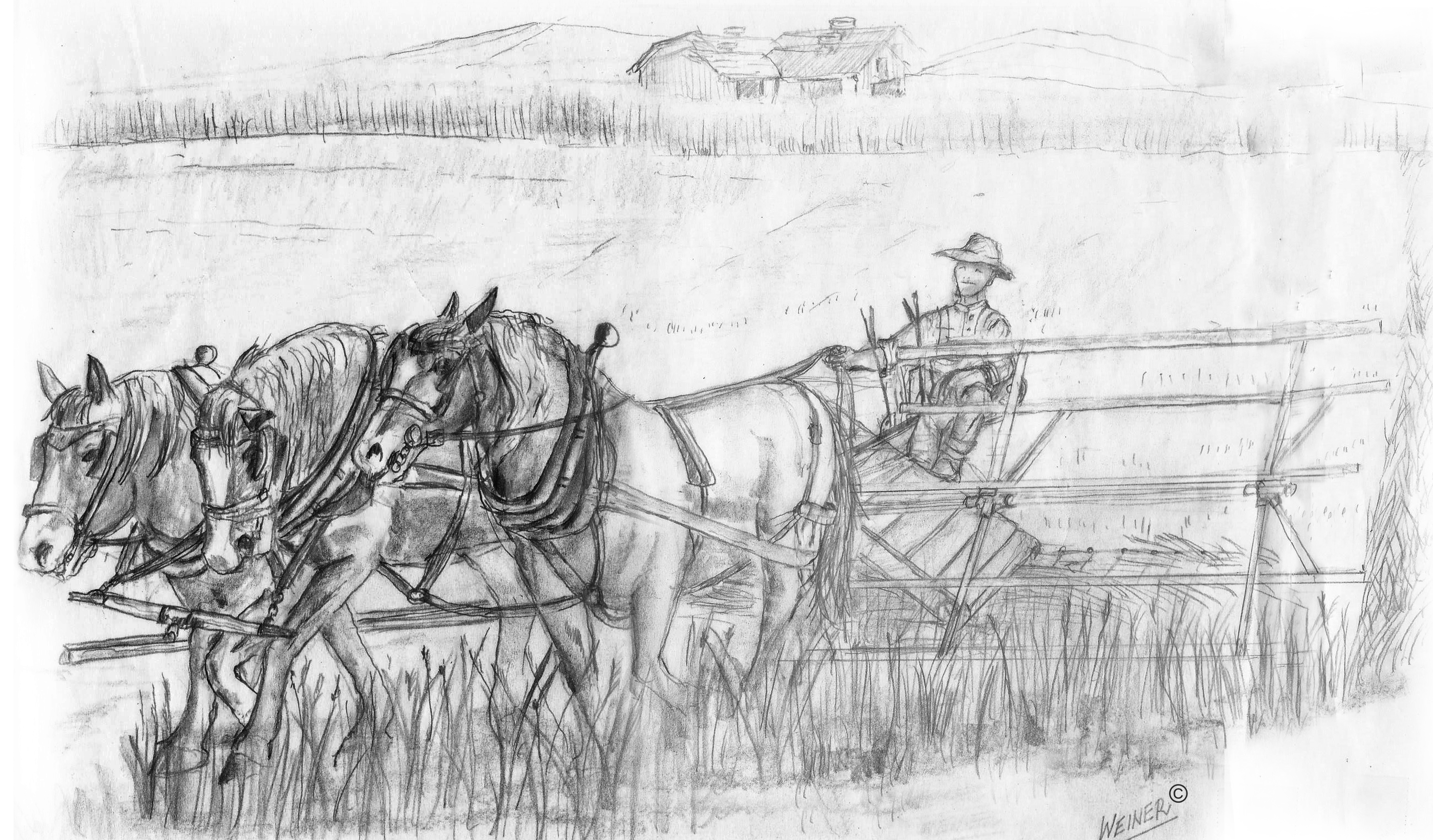
The binder, as it was used in the field, was too wide to pass through farm gates and narrow lanes.  There was the binder machine plus an eight foot cutting platform deck.  So the field-ready machine was about 15 feet wide.  That was certainly too wide to travel on the gravel road running through the Scheckel farm on Oak Grove Ridge.

The binder was mSK 10 Getting a drinkounted on two removable transport wheels permitting it to be pulled lengthwise out to the field.  The two steel trolley wheels were used only to get the binder to the field.  I didn’t realize this as a kid.
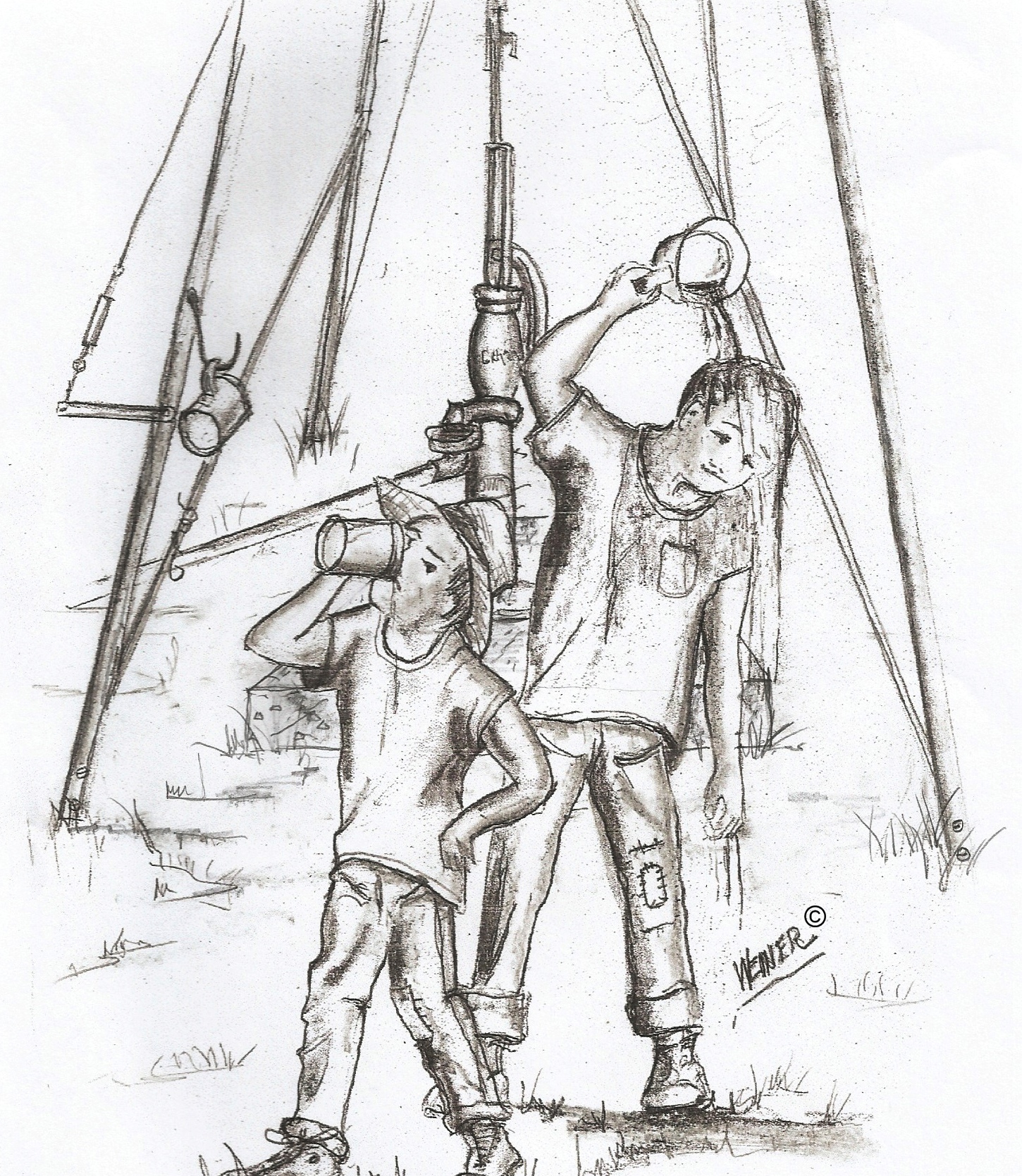
Out to the field we would go, Dad driving the horses hitched to the tongue that extended out from under the outer edge of the cutting platform.  The Scheckel boys, Phillip, Bob, and I tagging along.  Sometimes we begged to drive the horses. Our sisters Catherine, Rita and later Diane, would bring a quart canning jar filled with cold water and ice cubes. Near the farm buildings we would take a drink from the windmill that brought cold water from several hundred feet down.

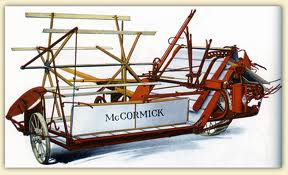
The trio of faithful work horses, Dolly, Prince, and Sam, were unhitched from the tongue. The platform had to be raised up so that the tongue could be unlatched.  The big bull wheel, about four feet in diameter and one foot wide, was cranked down.  The large bull wheel supported the main part of the binder, which contained the heavy metal working parts.  It was the bull wheel that powered the entire machine, the cutting bar, the big reel in front, the rollers that moved the canvas, the knotter and the mechanism that kicked out the bundles.  All moving parts got their marching orders from the bull wheel.

The bull wheel was cranked up sufficiently to raise the two smaller transport wheels off the ground so that they could be disconnected.  The two wheels were rolled off to the side and parked along the fence row or under a shade tree.  The next time they would be used was to transport the grain binder to another field.  The front transport wheel was positioned up and off the ground.

Next, a tongue was latched into position on the front of the binder.  A short tongue if the Massey Harris ’44 was used, or a long tongue if Dolly, Prince, and Sam were the chosen three.  Then the McCormick Deering eight-foot grain binder was ready to go to work.

Cutting oats could now begin.
Posted in Uncategorized | Leave a comment

Getting the Grain Binder Ready

We’re getting the McCormick Deering grain binder ready to go on the Scheckel 238-acre farm, in the heart of Crawford County, two miles northwest of Seneca. The golden fields of oats

are ready for cuttingSK 6 Grain Binder in the field.The next step needed to get the binder field-ready was to install the three canvases. Each canvas was stretched over two wooden rollers. Narrow hardwood strips were riveted about every ten inches on one side of the canvas. The canvas was hemmed on all four sides to keep it from tearing or ripping. The strong canvas was three feet wide, but varied from 10 feet to 20 feet in length. Each canvas had three or four canvas straps on one end and metal buckles on the other end.

The reel canvas was the long one and conveyed the cut grain stalks sideways to the end of the platform. The two elevated canvasses moved in opposite directions. They were at a slant and raised above the big bull wheel. The grain stalks from the horizontal reel platform were grappled by the two slanted elevator canvasses and carried up to the tying deck. The grain sheaves dropped off the canvas and were collected into a bundle for tying.

Those canvasses were a pain to install and they had to be put on correctly. The metal strap buckles must lead in the direction the canvas turned. Then the thick straps were threaded through the metal buckles and pulled tight. Not too tight and not too loose.

That canvas was heavy material and expensive. Farmers took good care of their grain binder canvas. At the end of the day, the canvas was taken off, especially if there was a threat of rain. Which meant, of course, that the canvas had to be restrung and tightened the next morning before cutting grain.

Mice and rats liked to chew on that canvas. Most farmers would roll up the canvas, bundle the canvas up with binder twine, and store them in gunny sacks. The gunny sacks were suspended from the rafters in mid-air with baling wire or binder twine. Mice could not get at the canvas.

One year my Dad did not get that done very well. Grain cutting time came around and down came the canvas bundles. The canvas was rolled out and inspected. Then came the swearing. The mice had a very good winter, gnawing away at the canvas and straps. We boys heard every ‘God Damn”, and “Son-Of-A-Bitch”. Dad would swear, but his boys were not allowed to. Dad was not a happy farmer for a few hours.

The thin hardware laths would wear and break. Canvas was attached to the wood slats by copper rivets.  Under the stress and strain, the rivets would pop. Old rivets had to be removed and replaced by new ones.

The last step to getting the grain ready for action was to install bales of binder twine. Dad bought rolls of binder twine from Johnson’s in Seneca or in Prairie du Chien or Viroqua.  The round bin on the grain binder held two spools. Each spool of twine came in a black paper wrapper.

We’re ready to take the binder to the field.


Posted in Uncategorized | Leave a comment

The Grain Binder

It’s the middle of July, and my mind goes back to life on the Scheckel 238-acre farm, in the heart of Crawford County, two miles northwest of Seneca.

No sooner was first crop hay “put up” and it was time to “shock grain”. We could see it coming, a sea of green oats slowly turning to a duller, lighter green, then toward a yellow hue. The oats were ripening. It was a beautiful sight to see, the undulating fields turning golden yellow.

Dad would walk out intoGrain Binder the oat fields. He would reach down and pull a few grains from the stalks. Then he would shuck the grains in his hand and open up the husks, inspect the fullness of the pods, and shake a handful of oats for heft. Dad would announce at the supper table, “Tomorrow, we get the grain binder out.”

The McCormick-Deering 8-foot grain binder was stored in the east wing of the granary. The east wing held the tractor, grain binder, and oats fanning machine. The west wing stored the corn binder, drags, disk. Both provided good hiding places for hide-and-go-seek.

The next morning, Dad and his three sons, Phillip, Bob, and I would slowly pull the grain binder out of the shed and start getting it ready.

We could tell that Dad was excited about getting started. Most of the neighbors were combining oats by the time I was about 10 years old. The Scheckels did not have a combine. We had a grain binder and threshing machine. That meant “greasing her up”, unwrapping the canvas that moved the grain through the machine, and sharpening the sickle bar.

The 8-foot sickle bar was pulled out of the cutter bar and clamped in a vise. The triangular knife sections were sharpened with a file. Loose blades were repaired by shearing off the two soft rivets holding it to the bar. New rivets were installed. New blades replaced old and worn blades.

There were zerts to be greased, oil cups filled, and oil squirted in holes made for that purpose. Dad had a manual for the McC-D grain binder, but I suspect he did not pay much attention to it.


Posted in Uncategorized | Leave a comment

Long Days of Summer

The long, hot, lazy days of summer, middle of July, bring back fond memories of life on the Scheckel 238-acre farm, two miles northwest of Seneca in the heart of Crawford County.

Haying season started in early June and just seemed to last all summer. In between the first and second crop, we cut and shocked oats. After the second crop, threshing was done. Following threshing, we often put up a third crop of hay.

This is a 1948 IHC McCormick Deering Side Delivery Rake and Tedder.Purchased 4/29/2007 for the amount of $100.00.

This is a 1948 IHC McCormick Deering Side Delivery Rake and Tedder.Purchased 4/29/2007 for the amount of $100.00.

The Scheckel family “put up hay loose”, as the expression goes. No baler on the Scheckel farm. We would cut the hay down, let it cure for a few days, and bring in the side-rake to windrow the hay.  Then the hay loader and wagon were moved in, both pulled by horses. It was hard, dirty, back breaking work, in often hot and or humid weather. Today, only the Amish put up hay this old-fashioned way.

Dad had a No. 9 McCormick-Deering Enclosed Steel Gear Mower. The No. 9 was advertised to “take less power to pull and last a lifetime”. The sickle on the No. 9 ran faster than the older type mowers. These No. 9 mowers were made from 1939 to 1951. They had a 5 foot sickle bar.

Closed gears were a big improvement in the McD No. 9 mower design, or so says the company. The gears ran continually in oil so as to endure less wear and damage to gears and bearings. The mower had a sickle bar that bore serrated triangular knives that moved back and forth horizontally. Guard teeth in front of the blades helped hold stalks upright and protected the sickle bar teeth.

If you drive past old farmsteads in the Midwest, you may see a lot of these steel-wheeled horse drawn mowers. Many sit in a patch of weeds, but you may also see them in Amish farms.

Timing was everything during the haying season. Ideally, the hay, made of clover, alfalfa, timothy, and grass, was cut close to full maturity.

The best conditions for drying and curing hay are clear, cloudless, sunny, dry days, with a breeze. Curing would take two or three days. Humid weather or rain was not good for getting the fullest nutrient levels.  In those conditions the stalks become woody and leaves are lost.

Then the side rake would come through and put the hay into windrows, followed by the hay loader and wagon.

The curing hay has a wonderful smell. If you could bottle it, you could make a mint, call it “Essence of Alfalfa”.

The Scheckel kept the hay fields relatively weed free. We had to pull yellow rocket and white weed. That yellow rocket might be the same as yellow mustard. We used both names.


Posted in Uncategorized | Leave a comment

Summer Days in Wisconsin

It is this time of year, late June and early July, that bring back fond memories of life on the Scheckel 238-acre farm, two miles northwest of Seneca in the heart of Crawford County. Long, hot, lazy days of summer.

Before we were old enough to do farm work, we ran barefoot all summer. Oh, I do believe we put shoes on to go to Church! The bottoms of those feet got toughened up pretty fast, running over plowed ground, gravel, thistles, and solid (hopefully) cow pies.

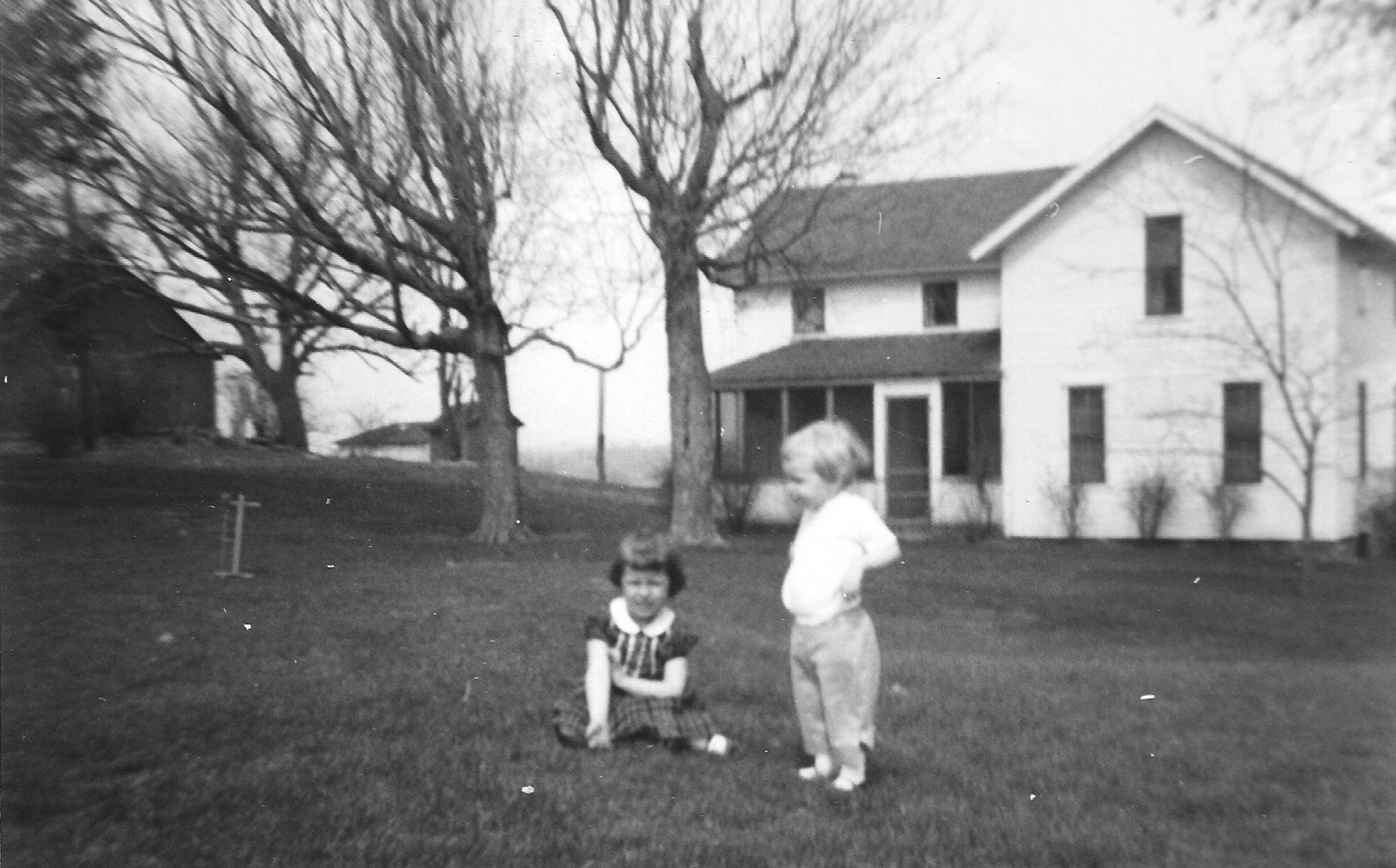
Games of tag, hide-and-seek, Captain May I, and kick-the-can. Cap guns, and wind-up caterpillars, if they lasted from Christmas to summer. And our favorite; corncob fights. A small corncob thrown at your opponent, Phillip or Bob. If you got hit, you were “dead”.Farm House

When two of us were “goners”, the game started over. Those small corncobs were harmless; a direct hit to the head, if it ever happened, might “smart” a bit, a worst case scenario. Each of us had our favorite ambush; crawl under the cows in the barn, hide out in the hay mow, conceal behind the hen house. We learned to duck down among the calves in the open pens and move along beside them, maneuvering around for an advantageous throw. We picked up that technique by watching the movie High Noon with Gary Cooper. Best Western ever made, with the possible exception of Shane with Alan Ladd.

The skies in southwest Wisconsin was the most beautiful blue, with puffy white cumulus clouds. We argued over the figures, usually animals we saw in the clouds. “That one is a sheep”, declared Phillip, “the head is over there and it has only three legs right now.”  “No, that ain’t a sheep”, retorted Bob, “it’s more like a cow”. I claimed it was a horse. We jumped to a different cloud and the arguments continued.

Well, the skies weren’t always blue. We had vicious storms move across the farmland on some hot summer nights.  Lightning, thunder, driving rain. The thunder shook the old white framed two-story farmhouse, rattled the windows, and scared the daylights out of us boys. We hid under the covers, sweltering even more. A few times, Dad and Mom would call for us to come downstairs into the living room to wait out a storm. Dad with read the newspaper and doing a crossword puzzle and Mom would be working those rosary beads. Seemed to work every time. Storm over, all the buildings standing, and back to bed we would go.

Posted in Uncategorized | Leave a comment

Life is Good


I got a teaching job in Tomah in 1972. The next year our young family moved from French Island near La Crosse to Tomah. That summer, I joined the Knights of Columbus slow-pitch softball team. We played twice a week in the summer season from late May to the middle of August.  Our pitcher and sponsor, was the owner of Southside Lumber, Stan Zdrojowy.

Stan passed away this last Sunday, age 86. His obit runs a full two columns detailing his military service in the Korean War and the many civic organizations in which he invested many hours, much effort, and had great success.

Ann and I have been attending quite a number of funerals lately. Gets one thinking about life, death, mortality and how short and fleeting is our time on Earth. At the same time, it is useful to ponder how fortunate we are.

Thus far we have enjoyed good health and health is everything. Yes, we are mindful that situations can change in an instant. We have paid off debts early and saved for retirement. So life is “pretty good” right now. We don’t live in a perfect world, what with our political mess, national debt, and terrorist threats. If we lived in a perfect world, I would be president, you would all be millionaires, and the Dodgers would win the World Series every year. LOL.

We retired 6 years ago and those years have slipped by very quickly. We have been quite lucky to travel a bit, bicycle, fly our club Cessna, jog, visit children and grandchildren, be involved in church activities, write a few books, and some columns for newspapers and magazine. I’m learning how to fly RC, Radio Control, planes but I keep smashing them up.

We joined a pinochle club with 13 other couples but haven’t won a round yet. I continue to go to 5 retirement homes and play guitar and sing?? at noon. They are eating and talking and there are kitchen sounds and they don’t hear too good and I don’t play and sing too good, so it works out just fine. They haven’t thrown anything at me, yet.

Today, (Wednesday as I write this) I was at Liberty Village, three story assisted living place here in Tomah. Talked to a couple that arrived there just a few weeks ago. I’ve known them for years and they did live just down the street from us.  He is 95, sharp as a tack, she is about 92, and they will celebrate their 75th wedding anniversary in early fall. He bought a new Chevrolet Cruz a month ago, and they go to McDonalds for coffee every morning. She had a stroke some time ago, but you couldn’t tell by looking and talking to her. Life is good.


Posted in Uncategorized | Leave a comment

Stealing A&W Root Beer Mugs

We finished our drive from Tomah, Wisconsin, in Monroe County, through Vernon County, and into Crawford County where I grew up on a farm 2 miles northwest of Seneca.

We have been on Highway 27, the Black River Road, which runs down the spine of the Crawford County, from Sparta, to Viroqua, and down to Prairie du Chien. In the mid 1800s, Seneca was an overnight stagecoach stop between Prairie du Chien and Black River Falls.

We’re in Prairie du Chien, Wisconsin right now, having motored through Rising Sun, Fairview, Mt. Sterling, Seneca, Eastman, and dropping down from an elevation of 1140 feet to 600 feet into the Mississippi River Valley by way of Mondell Hill.

Prairie is the second oldest city in Wisconsin and founded by French voyageurs in the late 1600s. Named for “dog’s prairie”.PDC

My brothers, Phillip and Bob, and I were typical teen boys.  We were lucky in many ways, as I look back over those years.  We were isolated out there in farm country.  There was no chance to have beer parties, or illicit drugs, and or wild women.  There were no wild women. They were all farm girls who worked as hard as we did.

Bill Boland was probably our best friend. We went to dances at the Quonset hut type building called the Checkerboard in Prairie du Chien on Sunday nights.

At about this time, in the mid1950s, go-carts were just coming out. Someone came up with the bright idea of putting a lawn mower engine on a platform that was three inches off the ground.  Prairie du Chien put in a go-cart track. Those machines were loud, smelly, and belched fumes.  With such low center of gravity, there was no way to tip them over. They were expensive to ride, but we did it a few times. Ran into each other and into the car tires that lined the track.

Baseball pitching machines were also new. It was something else to separate a farm boy from his money. We just had to try those new amusements.

Conoco gas stations gave out dishes, which were displayed in cases between the pump aisles. The more gas you bought the bigger the prize or award one could pick out. They gave away dishes, drinking glasses, towels, boxes of tissue and cereal.  After the dance, pitching machines, or go-carts, we would go to one of the teen hangouts for snacks. A favorite was the Stop N Bop Restaurant just off the main drag in Prairie du Chien.  The Stop N Bop had a jutebox,10 cents for a song or three for a quarter.

Sometimes we patronized the A&W Root Beer stand.  A young lady, usually a high school student, would come over to the car. We would roll down the window and do our ordering. Chili dogs and a Root Beer was the standard order for the Scheckels and Bolands.

That was not the end of it. The young lady returned and we would order two more Root Beers.  Root Beers are served in a heavy glass stein with a handle on the side.  She might return several more times, we ordered several more. She removed a few empty glass steins.

In all this ordering and reordering, she was confused about how many total steins were brought out. In the process, we usually ended up taking a stein home.  Somehow we didn’t see that as stealing, but it probably was and another venial sin to confess. I believe we put that in the same category as stealing watermelons in late Summer or early Fall. Sort in that gray area of right and wrong.


Posted in Uncategorized | Leave a comment

We’re in Prairie du Chien

We’re in Prairie du Chien, Wisconsin right now on our virtual drive through Crawford County in Southwestern Wisconsin from Rising Sun to Prairie du Chien following the Black River Road now known as Highway 27.

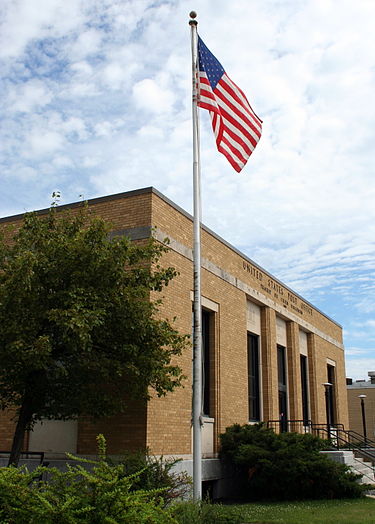
The Post Office in Prairie du Chien had a Postal Savings program in the 1940s and 1950s. Some people didn’t trust the banks. Besides John Dillinger and Bonnie and Clyde didn’t hold up post offices.Prairie_du_Chien_Post_Office

They took your money and paid 2 percent interest. Once a year Dad would take Phillip, Bob, and me with our piggy banks and climb the many steps to the Post Office. Each of us had a little booklet with a record of deposits and withdrawals. Of course, all we had was a column of deposits.  No need to withdraw any money. Our folks would not allow us to take money out. The whole idea was to establish a habit of savings. Start the kid saving money when they’re very young! Continue reading

Posted in Uncategorized | Leave a comment

Traveling Thru Crawford County

We’re in Eastman, Wisconsin right now on our virtual drive through Crawford County in Southwestern Wisconsin from Rising Sun to Prairie du Chien. St. Wenceslaus Church stands tall out on the edge of Eastman. That’s where Ann and I were married August 14, 1965. My brother Ed, and brother Phillip, we also married at St. Wenceslaus.

Father Baer was the parish priest for many years. He was a chaplain in WWII. He died in 1973 , age 71, and buried in the Church cemetery with a simple military marker. Heavy Irish descent here with names of Becwar, Boylan, Check, DuCharme, Garvey, Morovits, Mezera, and Kramer.

Two uncles and St Wenceslausaunts, Arnold and Clara Scheckel, and John and Helen (Scheckel) Feye are buried here as well. My wife’s parents, Leonard and Loretta Martin are here. A good friend and classmate, excellent athlete, and student at Seneca High School, Bob Slama, died way too young at age 45. Bob was the manager of the Power and Light company in Richland Center when he passed away in 1987. He married Charlene Walker, who was a Wauzeka, classmate of my wife, Ann. Graduating class of 1964.

A good web site to use, by the way, is findagrave.com. Very helpful if looking up family history, or where a friend or acquaintance might be. You certainly don’t want to find your own name there! Better to remain above the sod, if you get my drift.

Fr.  Nobert J. Wilger was the presiding priest at our Aug 14, 1965 wedding. The interior of the church as changed little since that time. Fr Wilger was at various parishes in the La Crosse Diocese, but spend the his last 40 years at St. Mary’s in Altoona, where is pasted away in 2011 at age 87.

Ann and I went out east for our honeymoon. Across Illinois, Indiana, Ohio, Pennsylvania, Washington DC, Gettysburg, Williamsburg, Va, Norfolk and Atlantic Ocean. We walked up the stairs to the top of the Washington monument. Took the elevator down. We were young and foolish.

In Williamsburg, we visited the church that George Washington attended. The church was not quite open for tourists that early in the morning. Very few people were around. We went in and sat in George Washington’s pew. It was roped off and we weren’t suppose to sit there. But we did anyway and took a picture. The docent arrived and “kicked” us out of there. Like I say, we were young and foolish.


Posted in Uncategorized | Leave a comment

Driving Through Eastman

In this series of weekly blogs we are driving down through Crawford County, taking Highway 27, from Viroqua to Prairie du Chien. Seneca is perched in the heart of Crawford County and our Scheckel farm was 2 miles northwest of the former stagecoach stop.

We’re in Eastman right now. St. Wenceslaus Church out on the edge of Eastman. That’s where Ann and I were married 50+ years ago.

Pelock’s Gas Station was on the corner. Turn east and you’re motoring out on Shanghai Ridge, which will eventually join up with Plum Creek Road and take you right into Wauzeka, Wisconsin.

Diagonal from Pelock’s was the small house of Willard and Betty Ray. Both were teachers and very good ones. Betty Ray was my 5th and 6th grade teacher at Oak Grove School and Willard was there for my 7th and 8th grade. They raised a large family of seven kids. Will, Judy, Connie, Linda.  Twins Tim and Tom were 1.5 years old when Willard died in 1961. David was born after his father passed away. He had just signed a contract to be principal at the newly built South Elementary School. They are buried in the National Cemetery on the south edge of Eastman.

The impressive brick, two story Eastman elementary school has been torn down. There’s a new handsome water tower on the site. There are no motels in Eastman, but the churches do outnumber the taverns two to one. No gas station, no grocery store, no library, no school, no airport, no trains. Eastman is a quiet town with 400+ wonderful people.

My aunt, Helen Feye, ran the Post Office in Eastman for many years. When our family went through Eastman, her husband, John Feye, could be seen sitting on the porch or steps of the Eastman Post Office. My brothers, Phillip and Bob, and I wondered out loud if he ever did anything. Stony silence from our Dad. Helen Feye was his sister.

Any famous people come out of Eastman? Barbara Bedford, actress featured in over 100 (mostly silent) films from 1920-1945, was born in Eastman. She was born as Violet May Rose in 1903 and passed away in 1981, aged 78.Fr Baer 2

For many years, Father Baer was the priest at St. Wenceslaus Catholic Church. Next week, we’ll talk about St. Wenceslaus Church out on the edge of Eastman. That’s where Ann and I were married 50+ years ago. I will share all the details of our honeymoon!


Posted in Uncategorized | 2 Comments