What happened to that great big plane from Europe?

  That great big plane is the Airbus 380, the largest passenger jet plane in the world. A double-decker, offering extraordinary comfort and stability, private flat-bed suites, lounge and cocktail bar, and a personal mini-bar at each seat. Some had shower spas on board. An escalator takes you from the first-floor deck up to the second-floor deck. The A380 maximum one-class capacity is 868 people.

Some 300 A380s were built, half sold to the Dubai-based Emirates. Airbus thought they could compete with the Boeing 747. The Boeing 747 was unveiled in September 1968, long before the A380 came on the market. The A380 came late to the party. Boeing was flying over 800 747s before the A380 lifted off the runway. The last Boeing 747 rolled out of the Boeing factory in December 2022. There’s lots of Boeing 747s flying today, both passenger and freighters.

The A380 was in production for 12 years, but there were problems from the git-go. The Airbus 380 had structural troubles. The plane is huge, and the airframe developed cracks more frequently than other aircraft. The A380 needed to be inspected frequently, driving up maintenance costs. The wingspan was 50 feet wider than the Boeing 747, so wide that most airports did not have ramp space for such a large plane. It would not fit into the normal gates.

The A380 has four engines, but the technology has evolved with a new generation of super-efficient, twin-engine planes such as Boeing’s 787 Dreamliners and Airbus’s own A350. Fuel is the biggest operating cost for an airliner, and four engines are thirstier than two engines. The A380 takes on 85,000 gallons of petrol. Those tanker trucks we see on the Interstate hold about 10,000 gallons of something.

Before these new twin-engines planes came along, twin engine planes were not allowed to fly over oceans. A plane could not be more than 60 minutes from a diversion airport. Ocean-hopping required four engines. Twins are more efficient and easier to fill up with passengers. There’s only a handful of high density, long-distance routes for an A380 to operate at a profit.

Airbus had trouble filling up planes. A half-full A380 is about the same number of passengers as a full Boeing 777, but costs twice as much to fly. Those smaller, but full, planes pilfered all the sales from the A380. German Lufthansa sold six A380 back to Airbus, claiming they were unprofitable. Australian Qantas cancelled its last A380 and announced they will switch to Boeing 777X. France retired all ten A380s and went with A220s and A300s.

Airbus is a joint France and Great Britain venture, heavily subsidized by their governments. The R&D (Research and Development) for the A380 was paid by European “launch subsidies.”  These monies must be paid back if the plane reaches a certain level of commercial success. If the A380 isn’t successful, and it wasn’t, the money does not have to be paid back. It wasn’t, so Airbus plowed their dough into the A350, which made them tons of money. The EU taxpayers picked up the tab.

The last A380 rolled out of the factory in Toulouse, France in September 2020. The headline in a newspaper read, “The Last A380 Just Rolled Off Airbus’ Production Line. It May Never Fly A Single Passenger.” As of November 2024, half of the A380s are scrapped, in storage, or in maintenance.

Today, Airbus has been very successful with their A320, A330/A340, and A350 series of planes.

They are competing nicely with Boeing’s 777 and 787. Both are wide body, twin-engine, over-the-oceans aircraft.

One Airbus executive boasted, “We are going to build something bigger than the 747, no matter what the market projections say.” Well, Airbus lost their shirt on that one. They also lost another shirt on the SST (Super Sonic Transport) Concorde. A British official said, “Why should Airbus be concerned when the taxpayers are bailing you out.”

Sources: forbes.com, www.airbus.com, http://www.cnn.com


Posted in Uncategorized | Leave a comment

Why are humans smarter than animals?

When the frontal lobe of the brain developed an estimated 100,000 years ago, it signaled a quantum leap in human adaptation and development. The function of the frontal lobe allows us to grasp the consequences of our actions, to choose between good and bad decisions, to curb unacceptable social responses, and to filter differences and similarities between events and actions.

The frontal lobe is used to retain long-term memories. It enables us to recall events that happened months or decades ago. The frontal lobe is crucial for verbal and math skills. One could call the frontal lobe the CEO of the brain, because that is where the organizing and planning takes place. It’s the part of the brain that allows us to think about our place in the universe. Scientists say that the frontal lobe is what separates man from beast.

It is a different matter when we ask these questions: Where does each individual receive their own intelligence? How much of our intelligence has been shaped by our genetics (nature) and how much by our experiences and the way we were brought up (nurture)?

This nature versus nurture question has been going on since the days of John Locke and René Descartes in the 1600s. Many scientists reach their conclusions by studying identical twins that have been separated at birth. These identical twins had the same genes (nature) but were reared in different families (nurture).

The Minnesota Twin Registry was started in 1983 to catalog and interview all identical and fraternal twins born between 1936 and 1955. Lately, they have added twins born from 1961 to 1964. It is a huge longitudinal study following these twins over many years, using questionnaires to probe their personality, interests, marital status, leadership abilities, finances, and substance abuse, to name a few.

The Twin study has shown that identical twins raised apart show remarkable similarities in lifestyles, interests, attitudes, chosen professions, IQ, and just about every other facet of living. Their conclusion is that genetics accounts for about half of what we are as humans.

The Minnesota Twin Family Study also concludes that environment does make an important contribution to intelligence differences throughout life, and especially in early childhood. Specifically, deprivation in early childhood can stunt the development of intelligence just as it can stunt physical growth.

An IQ test determines a person’s general problem-solving ability and concept comprehension. An IQ test consists of memory recall, spatial, logic, and math abilities. Students in the U.S.  take the SAT or ACT. These tests are not billed as IQ tests but are considered one of the best indicators of success in college. That’s why admissions people look primarily at ACT/SAT scores and class rank in determining who gets into colleges and universities.

            Keep in mind that being “smart” or having a high IQ is just one aspect of a person’s being. An IQ test does not measure creativity, empathy, kindness, or even motivation. Talent cannot be measured accurately by IQ tests, especially in the areas of music, art, dance, writing, social skills, or people skills.

Posted in Uncategorized | Leave a comment

Why doesn’t the Moon rotate?   


       Whenever a body, such as the Moon, revolves around another larger body, such as the Earth, strong gravitational forces cause tides. Those tides slow down the rotation of the Moon, so after eons of time, the Moon keeps the same face towards us. The Moon rotates at the same rate as its orbital motion. It’s called tidal locking.

As an aside, sometimes the definition of revolving or revolution, and rotation gets mixed up. Revolution is the going around another body. The Earth takes about 365 days to revolve around the Sun. Rotation is the spinning of a body on its axis. It takes one day for the Earth to rotate.

 Yes, the Moon rotates, but it does so much more slowly than Earth does. A “moon day” is around 29.5 Earth days.  In other words, whereas Earth completes one rotation every 24 hours, the Moon experiences a rotation in that 29.5 days. If it did not rotate, we would see all sides of the Moon over a period of one month. If you lived at any one place on the Moon, you would have about 14.5 days of daylight followed by 14.5 days of darkness.

In fact, the orbit and rotation aren’t perfectly matched because the Earth actually travels in an oval-like elliptical orbit, allowing us to see an additional 8 degrees of its surface.   

            The tides, water washing up and down the beaches, continues to slow the Earth’s rotation. Every year our planet Earth is spinning slower on its axis, a rate of about 1.4 milliseconds every century. A millisecond is one-thousandth of a second. No need to reset your clock! The result is that the Moon is moving away from Earth 1.48 inches per year.

            How is that possible? It’s called Conservation of Angular Momentum. We’re familiar with the dancer or ice skater spinning. When the rotating person brings their arms in, they spin faster. Move the arms to the outside, away from the body, the performer spins slower. Slower rotation of Earth, the Moon moves away.

            Earth-Moon system of rotation and tidal locking is found elsewhere in the Solar System. The Sun and Mercury are locked into a 3:2 orbital phenomena. It’s a bit complicated. But what happens is that Mercury rotates 3 times on its axis, for every 2 times around the Sun. Pluto and its moon, Charon, are tidally locked.

On early Earth, when the Moon was newly formed, days were five hours long, but with the Moon’s braking effect operating on the Earth for the last 4.5 billion years, days have slowed down to the 24 hours that we are familiar with, and they will continue to slow down in the future.

We can see some evidence of the slowdown in the fossil records of some creatures.

By looking at the daily growth bands of corals we can calculate the numbers of days that occurred per year in past periods, and from this we can see that days are getting longer, at a rate of 19 hours every 4.5 billion years.

Posted in Uncategorized | Leave a comment

Accidental Science Discoveries

There are quite a few. Penicillin, X rays, Teflon, the Rosetta Stone, vulcanized rubber, nylon, the laws of gravity, quinine, the electric battery, dynamite, the Dead Sea Scrolls, vaccination, the Big Bang, radioactivity, saccharin, the microwave, Play-doh, Corn Flakes, Super Glue, and Velcro are just a few.

A more accurate and better description would be to use the term “serendipity.” These were chance discoveries that led to momentous scientific developments. We should not discount the efforts and genius that went into these discoveries. Louis Pasteur said, “Chance favors the prepared mind.” Careful observation, curiosity, a sense of timing and history, and just plain good luck are all involved.

Let’s pick Teflon. On April 6, 1938, a young Ph.D. from Ohio State was a newly-hired Du Pont chemist. Roy J. Plunkett and an assistant, Jack Rebok, were working on trying to develop a new nontoxic refrigerant.

Dr. Plunkett opened a tank of tetrafluoroethylene (TFE). No gas came out. The two young scientists could have thrown the tank out and pulled out a new one to continue their experiment. But they were curious. They knew the valve was not defective because they could run a wire into the opening.

They sawed the tank open and looked inside. They found a waxy white powder clinging to the inside walls of the tank. They knew enough chemistry to realize that the gas had combined with something to form a solid material, a new polymer.

The waxy white powder had some neat properties. It was not affected by acids, bases, or heat, and no solvent could dissolve it. It had extremely low surface friction, i.e. it was slippery. They called it Teflon.

The scientists working on the first atomic bomb in the early 1940s needed a material for gaskets that would resist the very corrosive gas, uranium hexafluoride, used to extract the Uranium-235 needed to build the first atomic bomb. The Dupont company molded Teflon into valves and gaskets for this purpose. The public did not know anything about Teflon until after the war.

The first Teflon-coated muffin tins and frying pans came out in 1960. Results were not that good. It was difficult to get the Teflon to bond to metal surfaces, and too many people used scouring pads that they had traditionally employed on their metal cookware. Off came the Teflon. DuPont finally hit the Teflon jackpot in 1986 with their new generation Silver Stone Supra that was twice as durable.

We might know Teflon for cookware, but Teflon is also one of the few substances that the body doesn’t reject. Teflon is used on heart pacemakers and sections of material used to take the place of the aorta. Teflon is used for artificial corneas, substitute bones in the chin and nose, hip and knee joints, ear parts, heart valves, sutures, dentures, and bile ducts.

Teflon is applied to the outer layers of space suits.  Nose cones and space fuel tanks are coated with Teflon.  Spacecraft that traveled to the Moon and beyond had wiring and cables insulated with Teflon. Teflon can resist the ultraviolet radiation of the sun.

In 1951, Roy Plunkett gave a talk to a scientific convention in Philadelphia detailing his accidental discovery. Attendees were given a Teflon-coated muffin pan to take home. Plunkett retired from DuPont in 1975, was inducted into the Inventors Hall of Fame in 1985, enjoyed fishing and golfing near his home in Corpus Christi, and died in 1994 at age 83. His greatest joy, he said, was getting calls and letters from people who were alive because of a Teflon pacemaker or aorta.

Sources: sciencealert.com, history.com

Send questions and comments to: lscheckel@charter.net.


Posted in Uncategorized | Leave a comment

Does the Moon rotate?

This question was asked by Tom, one of my six faithful readers. And it’s a good question. Whenever a body, such as the Moon, revolves around another larger body, such as the Earth, strong gravitational forces cause tides. Those tides slow down the rotation of the Moon, so after eons of time, the Moon keeps the same face towards us. The Moon rotates at the same rate as its orbital motion. It’s called tidal locking.

As an aside, sometimes the definition of revolving or revolution, and rotation gets mixed up. Revolution is the going around another body. The Earth takes about 365 days to revolve around the Sun. Rotation is the spinning of a body on its axis. It takes one day for the Earth to rotate.

Yes, the Moon rotates, but it does so much more slowly than Earth does. A “moon day” is around 29.5 Earth days.  In other words, whereas Earth completes one rotation every 24 hours, the Moon experiences a rotation in that 29.5 days. If it did not rotate, we would see all sides of the Moon over a period of one month. If you lived at any one place on the Moon, you would have about 14.5 days of daylight followed by 14.5 days of darkness.

In fact, the orbit and rotation aren’t perfectly matched because the Earth actually travels in an oval-like elliptical orbit, allowing us to see an additional 8 degrees of its surface.

The tides, water washing up and down the beaches, continues to slow the Earth’s rotation. Every year our planet Earth is spinning slower on its axis, a rate of about 1.4 milliseconds every century. A millisecond is one-thousandth of a second. No need to reset your clock! The result is that the Moon is moving away from Earth 1.48 inches per year.

How is that possible? It’s called Conservation of Angular Momentum. We’re familiar with the dancer or ice skater spinning. When the rotating person brings their arms in, they spin faster. Move the arms to the outside, away from the body, the performer spins slower. Slower rotation of Earth, the Moon moves away.

Earth-Moon system of rotation and tidal locking is found elsewhere in the Solar System. The Sun and Mercury are locked into a 3:2 orbital phenomena. It’s a bit complicated. But what happens is that Mercury rotates 3 times on its axis, for every 2 times around the Sun. Pluto and its moon, Charon, are tidally locked.

On early Earth, when the Moon was newly formed, days were five hours long, but with the Moon’s braking effect operating on the Earth for the last 4.5 billion years, days have slowed down to the 24 hours that we are familiar with, and they will continue to slow down in the future.

We can see some evidence of the slowdown in the fossil records of some creatures.

Posted in Uncategorized | Leave a comment

Mourning Dove

A Mourning Dove has been trying to build a nest in our garage, atop the mechanism that opens the garage door. There’s a motor in that housing, as well as a radio receiver, and two light bulbs that come on when the garage door opens or closes. Continue reading

Posted in Uncategorized | Leave a comment

A Good Week

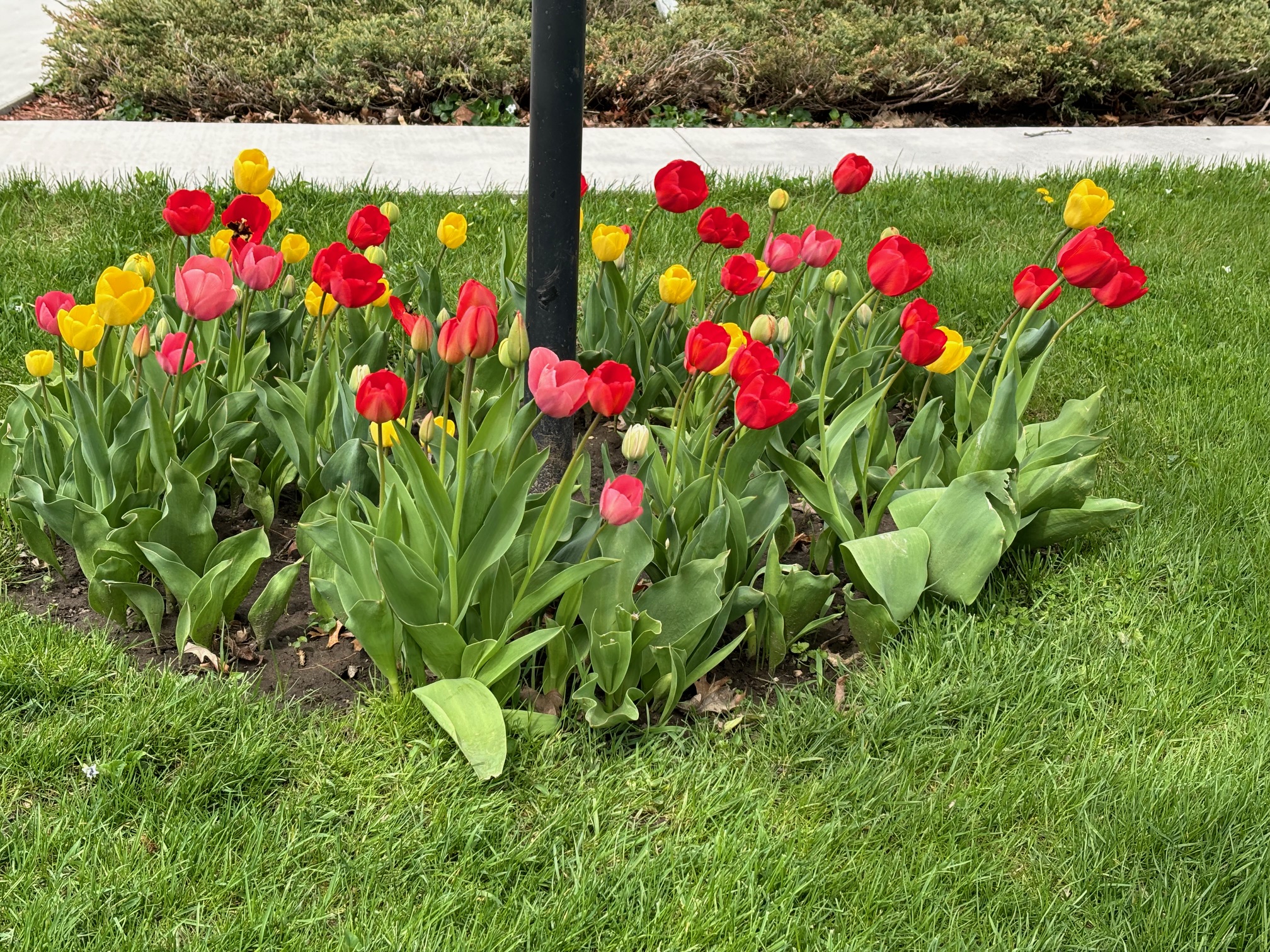
It’s been a good week here in Tomah, Wisconsin. The tulips around our yard lamp are just gorgeous. The 50 bulbs were a gift from a family friend, Lynette, presented to us some four years ago at our 55+1 wedding anniversary. We couldn’t publicly celebrate #55 because of COVID. We added some new bulbs last fall.

The whole countryside is greening up nicely, thriving on generous rains. Some oats and soybeans are in the ground, but not much corn. Beautiful flowering trees abound. The lilacs should be blossoming soon.

Last Saturday, Ann and I motored up to Viroqua to participate in the Ridges and Rivers Book Fair. Excellent venue and well organized. We gave a talk about one-room country schools at the Vernon County History Museum and sold and signed about 15 books.

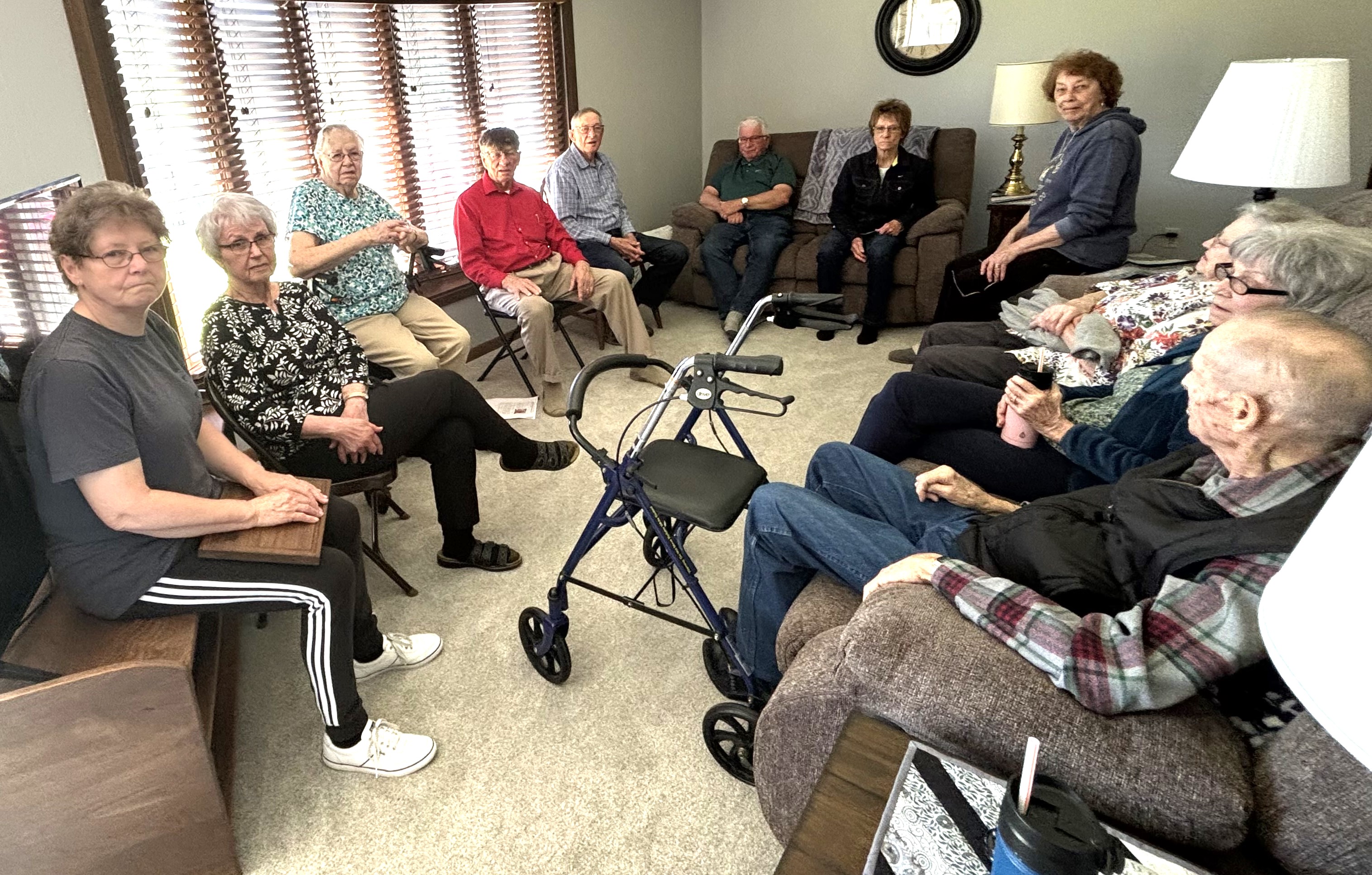
We were down to Janesville on Tuesday for the semiannual Scheckel family reunion, hosted by my favorite sister, Catharine. A brother has passed away, but the remaining eight all made it. The oldest is 91 and the youngest is 74. As might be expected, some of us are not in the best of health. At any such Scheckel reunion, we realize that it could be the last time we are all together. Family is everything. Don’t spread this around, but all five of my sisters are my favorites!


Posted in Uncategorized | Leave a comment

Catching Rooster

Not all roosters are created equal. Once every few years a regal bird, so much bigger and haughtier than any other rooster, came on the farm.  I was twelve years old when one such specimen developed out of our 300-rooster flock. This rooster strutted around the buildings, wearing a big bright red comb with a drooping wattle.  The wattle is that fleshy piece of skin hanging down under the beak and combs.  It helps cool the rooster by redirecting blood flow to the skin.

Oh, we kept our eye on this rooster! He was high entertainment for us six youngest Scheckel kids living on that 238-acre farm near Seneca, in the heart of Crawford County.  We simply called him “Rooster”, and Rooster ruled. Other roosters moved out of his way. Hens cowered when Rooster appeared.  My dog Browser wouldn’t go near Rooster. Rooster was invincible. Or so he thought.

It was a Saturday in August 1954, and the family was gathered around the morning breakfast table. The usual routine was to get out of bed, do chores, milk cows, and come in for breakfast, and subsequently, the farm day work began.  Mom announced that we needed a hen or rooster for Sunday dinner.

Brother Bob said, “Rooster.” It was time for Rooster to become a Sunday meal. Rooster was big enough to feed six kids and two adults. Imagine the size of his wishbone. That would be a real prize!  We gulped down our last bit of Oatmeal, bacon, and homemade bread.

There was a problem. Before Rooster was to become Sunday dinner, he had to be caught. That would not be easy. Rooster was fast. Rooster was cunning. We had our work cut out for us. Phillip went to the garage to fetch the chicken catcher. It was a tool with a wooden handle on one end and a hook on the opposite end.

We spread out and walked around the barnyard, hen house, hog house, and corn crib.  We were quiet and stealthy. Bob hid the chicken-catching-tool behind his back, lest Rooster was smart enough to figure out what was going on.

Phillip spotted Rooster between the red hen house and the corn crib. He was majestically scratching the ground.  Phillip put out the call, “I’ve found him.”  There was an alley of about 10 feet wide between the corn crib and hog house with a fence on one side and hen house on the opposite side.

We talked strategy.  Bob had a plan. “Phillip, you stay here on this side, and Lawrence and I will go to around the chicken house and come in on the other side, and we’ve got Rooster trapped between us.”

That sounded like a good arrangement.  Phillip was bigger than Bob and I, much more agile, faster, and agile.  Surely this plan was foolproof. Our two teams closed in. Rooster stopped scratching and raised his head.  He sensed danger. The two teams approached slowly, quietly, keeping Rooster between us.

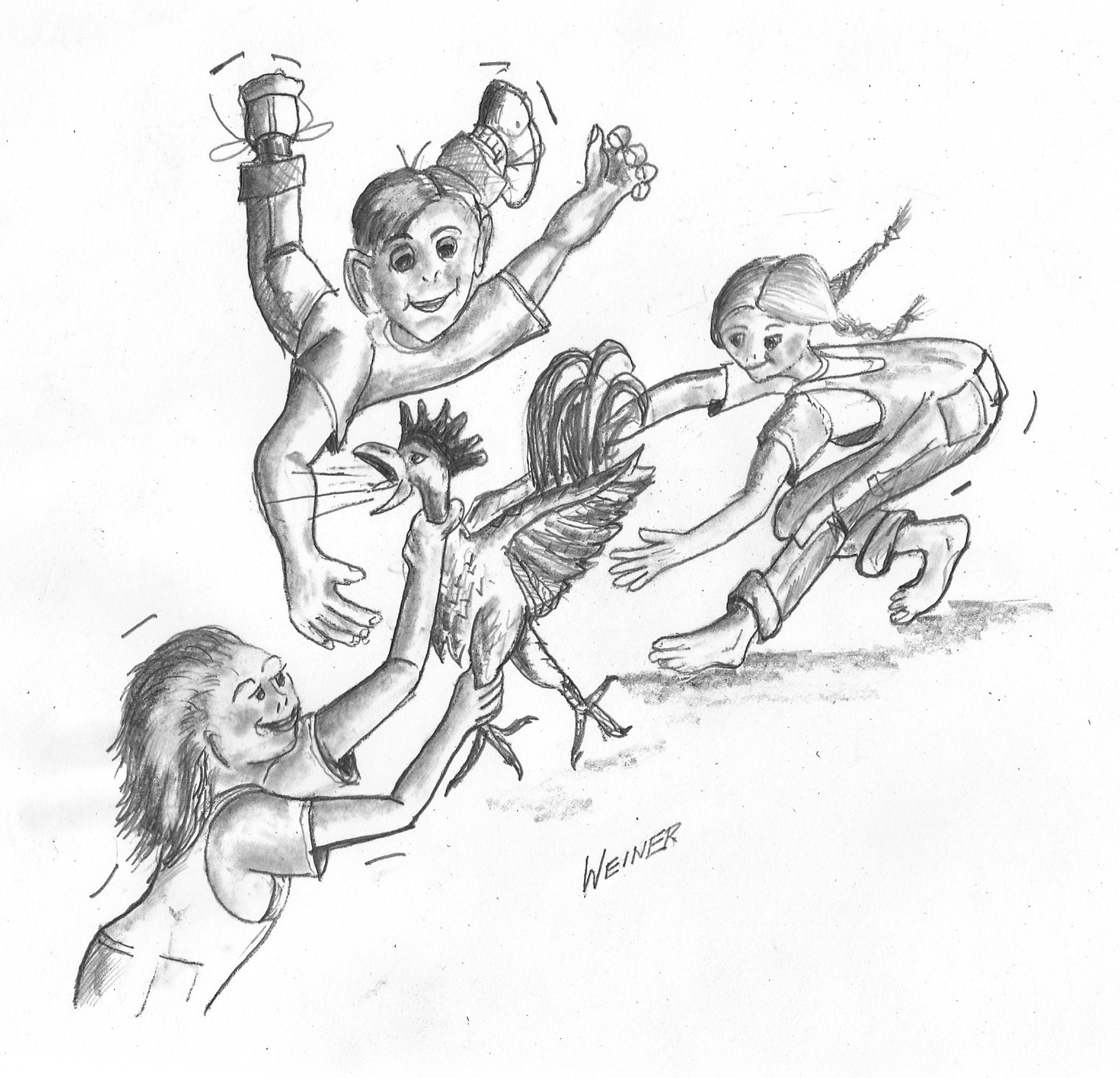
Each team was about five feet from its quarry.  But wily Rooster would have none of this.  He jumped up, squawked loudly, wings flapping and went right between Bob and me.

Phillip yelled, “You let him get away”. Of course, we knew that. Oh, the shame of it all!  We had a plan, a good plan, but Rooster overwhelmed Bob and me and made an escape. Now the chase was on. All three of us boys, and we’re now joined by our sisters, Catharine, Rita and Diane. Certainly, six Scheckels could outthink, outsmart, outrun, and finally capture Rooster. We all wanted Rooster to be the centerpiece for our Sunday dinner.

We thought we had Rooster cornered several times. Each time Rooster rose up, flapped his wings wildly, squawked loudly, and escaped.  We lost sight of Rooster several times.  But with six pairs of eyes, he was quickly spotted.

Now it was plan two or perhaps it was plan three or four.  Phillip and Catharine would chase Rooster around the hen house.  Bob, Rita, and I would stay put and hide around the corner. When we heard Rooster approaching, we’d jump out in Rooster’s path and one of us would grab him.

Aw, it worked to perfection. Bob caught the wing of Rooster who put up a desperate struggle.  But the rest of us closed in and finally got hold of his two feet, at which time the bird was doomed. Even on death’s doorstep Rooster put up a fight. I do believe he raised his head just in time to see the axe blade coming down. That Sunday meal was one of the best we’d ever had.


Posted in Uncategorized | Leave a comment

It’s the Right Thing to Do

A farm kid asked his mother, “Where is Dad?” The mother replied, “He’s plowing over at Jensen’s.”  The farm kid inquired further, “Why is he doing that?” To which the mother responded, “It’s the right thing to do.”

            It’s always been that way in rural America. Farmers helping farmers, neighbors helping neighbors. If a farmer gets sick, or hurt, or tragically passes away, neighbors pitch in to sow the crops, milk the cows, care for the livestock, cut wood, do butchering, harvest the crops, and give aid and comfort.

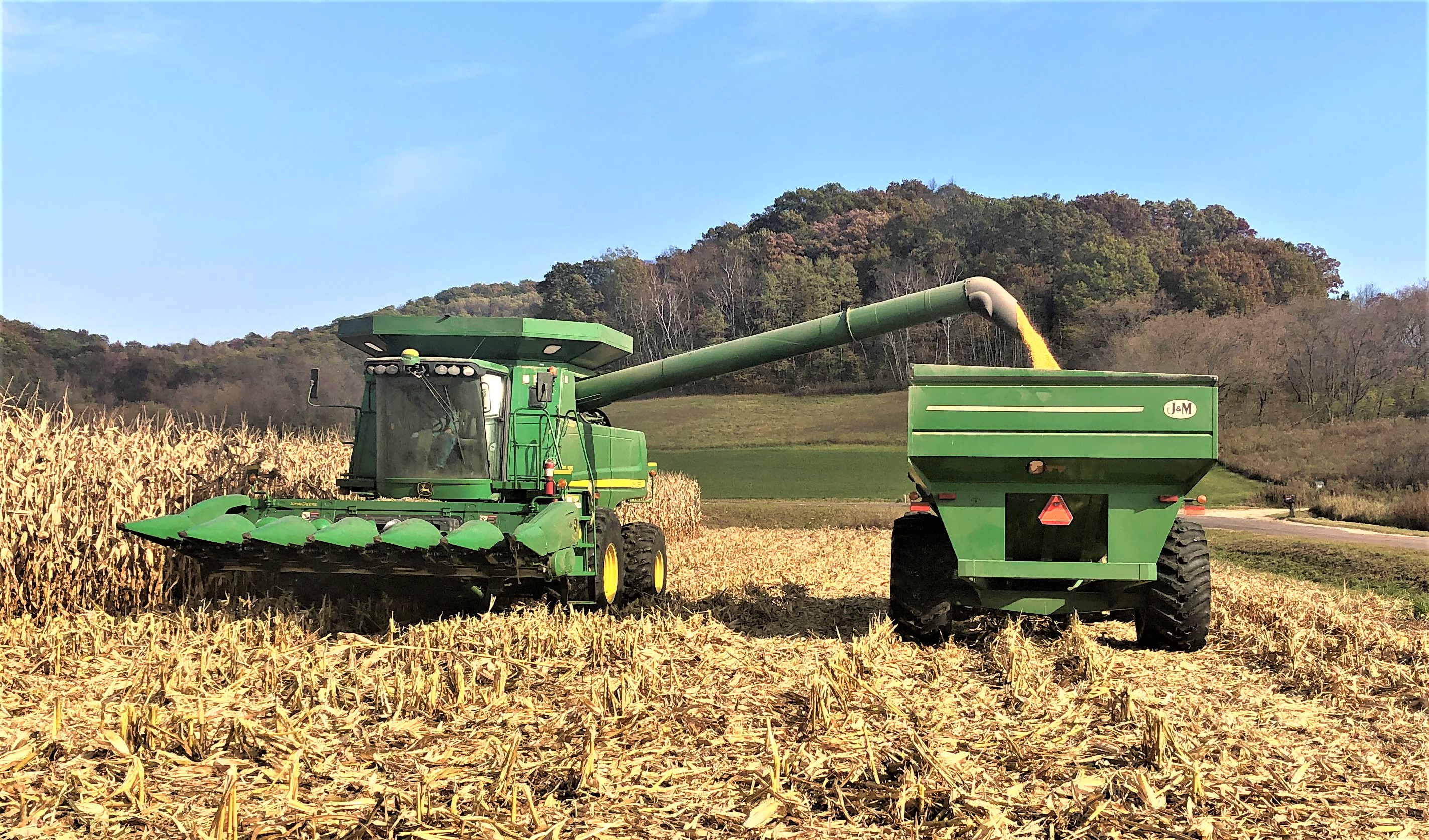
There was an Ag News story a couple of years back about a Mitch Bradan Miller, who died suddenly in September 2021 at age 27. Miller farmed near Haynes (pop. 15) in southwestern North Dakota. In late Fall, farm neighbors brought in 12 huge combines, 5 grain carts, and 30 trucks to harvest 2,000 acres of corn. It’s the right thing to do.

Brothers Clayton and Russell Weis, farming near Burlington, Wisconsin, were working on a combine when the 6,000-pound head fell on them. Clayton was killed instantly, and Russell was rescued after three hours of agony. Russell healed, following three surgeries and 220 stitches. That Fall, 50 farmers, 9 combines, 9 grain carts, and 29 trucks showed up to harvest 280 acres of corn, days before a heavy snowstorm blanketed the countryside. Farm wives put on a dinner feast in a machine shed. Said one farmer, “You just want to do good for a friend.” Another added, “You try to make a bad situation better.” It’s the right thing to do.

On Monday, May 4, 1964, five tornadoes swept across Wisconsin. At about supper time, one of those mowed a path through Oak Grove Ridge. Oak Grove Ridge is northwest of Seneca, in the heart of Crawford County. I was home on the Scheckel farm, my day off from my electronics technician job at WKBT-TV in La Crosse. I was 22 years old at the time. One of my siblings spotted the funnel. We got up from the supper table and went outside. We all watched the tornado pass in a northeast direction several miles from the Scheckel farm. We could clearly see debris caught up in the whirling vortex.

Late that night the word went out across Oak Grove Ridge. The farm of Clifford and Edna Larsen was completely destroyed, every building leveled. By the mercy of God, the family of four escaped injuries by huddling in the basement. The Ken and Mary Ducharme farm received considerable damage. Their house had been raised up and set down, at an angle, three feet from where it should be. God also looked after the DuCharme family. Three family members found shelter in the basement and two hunched beneath heavy machinery.

Farm neighbors responded the next day, called to action by long-time Seneca Town Chair Earl Burns. Dozens went to the Larsen place, and many to the DuCharme farm. I opted for the DuCharme farmstead. I had been there before.

The three Scheckel boys, Phillip, Bob, and me, were often hired out to area farmers to help with the hay crop or silo filling. The Scheckel family put up “loose hay,” but Ken DuCharme had an Allis Chalmer Roto Baler that made those small round bales. The tractor and baler had to stop frequently, so that twine could be wrapped around each hay bale. Mr. DuCharme furnished me with two hay hooks, with the idea of plunging each hay hook on the end of the small round bale, lifting, and loading the bale onto a wagon. I believe I earned 75 cents an hour. Together, we cleared several fields of hay bales. The bales were elevatored into the barn.

The day after the tornado, I was one of about 20 men and boys that loaded debris onto wagons on the DuCharme farm. The tractor-pulled wagons motored down Hobbs Hollow Road and the rubble was plunged into a ditch. Neighbor farm women set up an outdoor make-shift kitchen and served a noontime meal. Farm boys and girls delivered drinking water. Some supplied lemonade.

Unfortunately, both farmsteads have disappeared over the years, the land rented out to other farmers. I liked to think that I did a very tiny bit to help ease the burden on these two unfortunate farm families. It’s the right thing to do.


Posted in Uncategorized | Leave a comment

Work is a Blessing

We were in the woods every winter cutting down trees when I was a young lad in the 1940s and 1950s on the 238-acre farm outside of Seneca in the heart of Crawford County. After morning chores and breakfast, Dolly and Prince were hitched to a sleigh wagon, two runner blades in the front and two in the back, loaded with axes, cant hooks, hammer mall, wedges, crosscut saw, and away we go would to the woods, Dad, my two brothers, Phillip and Bob, and me. That’s a two-man crosscut saw I’m talking about, no chainsaw on the Scheckel farm.

Dad showed us how to make a notch on the side of the tree we wanted the tree to fall. We would pick a spot that was as clear of other trees as we could make it. We didn’t want a tree “hung up” in another tree. That could be dangerous. When the tree started to fall, Phillip, Bob, and I would yell “timber” to warn anybody that was nearby. Of course, there wasn’t anyone except the four of us and Browser, the dog, and we made sure he was out of the way. We did not have hardhats or any protective steel-toed shoes. We boys took great delight if the tree fell where we chose. A big tree would yield a log or two, fence posts, and firewood.

As soon as the tree was down, two of us attacked the top of the tree with axes, cutting off the ends and stacking the brush. Two others would use the crosscut saw to cut logs and fence posts. Long limbs about 10 to 12 feet were stacked up or loaded up on the wagon. These would be taken to the farmstead to await the “buzz” saw and cut up to burn in the basement furnace.

We’d take a breather now and then, deep in the woods and sit on tree stumps and drink water from quart jars that we brought along. Sometimes we packed a few sandwiches.

Dad would tell a few stories of his past. A man was working in the woods with him when he was a boy. They were felling trees and a dead limb hit him on the head. The man got a bad bruise but kept right on working. At noon, they went home to eat dinner. The man laid down on the couch to rest awhile and died. Dad thought that a blood clot had gone to his brain.

Dad talked about the importance of paying your debts, honesty, and frugality. More than a few times, he would pontificate, “Boys, work is a blessing.”  We would think, “Yah, bullshit.” But of course, Dad was right. We boys just didn’t see it at the time.

There’s that wonderful scene in Season 3 Episode 8 of the original 1978-1990 All Creatures Great and Small television program airing on February 16, 1980. The Yorkshire vet, James Herriott, and his partner, Siegfreid Farnon, are attending Dolly, an ageing horse belonging to an elderly milkman, Herbie Hinchcliffe.

Herbie and Dolly have been delivering bottled milk to the Darrowby townsfolks for decades. Dolly has come up lame and can barely stand or walk. The vets deliver the sad news to Mr. Hinchcliffe, who can’t afford another horse and must now suspend his milk route. Both milkman and horse are out of work. Siegfried turns to James and loudly exclaims, “James, we are the lucky ones, apace, apace, work, work, oh, she wears a beautiful face.”

The value of human labor goes back to Biblical times. In Genesis 3:19,  God said to Adam, “Ye shall earn thy bread by the sweat of thy brow.”

Paul’s second letter to the Thessalonians says that when we do authentic work of whatever kind, we participate in God’s ongoing creation and providence. We should see our daily labor, however humble, as part of God’s plan to bring us joy. Paul knew about hard physical labor. Paul was a tentmaker, not easy work, and lots of drudgery.

Work affirms our dignity and self-worth. It is a social activity that draws us together in a common enterprise. Work produces something of value for others to consume. In a real sense, work is a form of prayer.

Posted in Uncategorized | 1 Comment