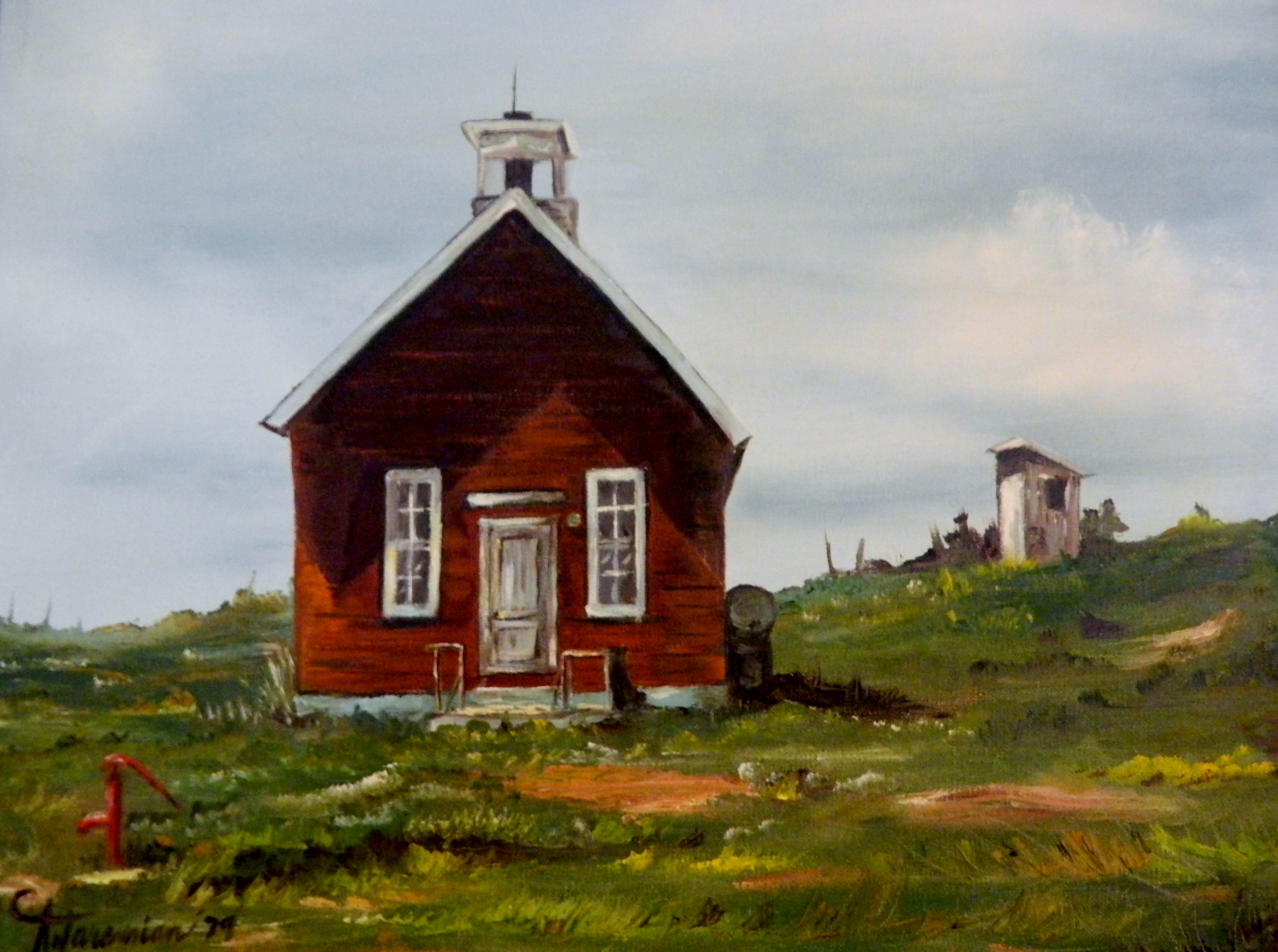
Haying Season in Crawford County Part 7

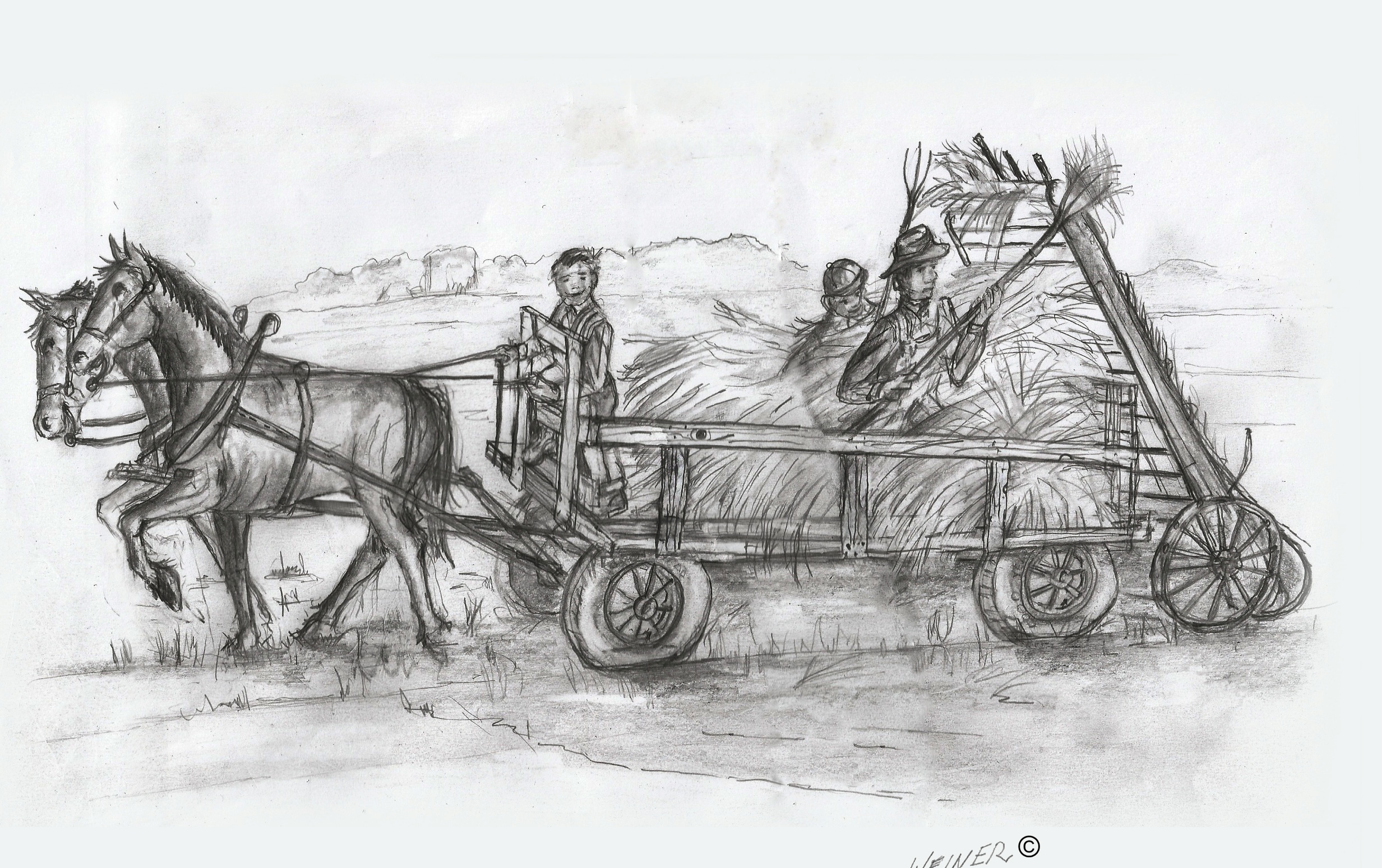
We’re putting up loose hay in the 1940s and 1950s on the Scheckel farm outside Seneca in the middle of Crawford County, Wisconsin.
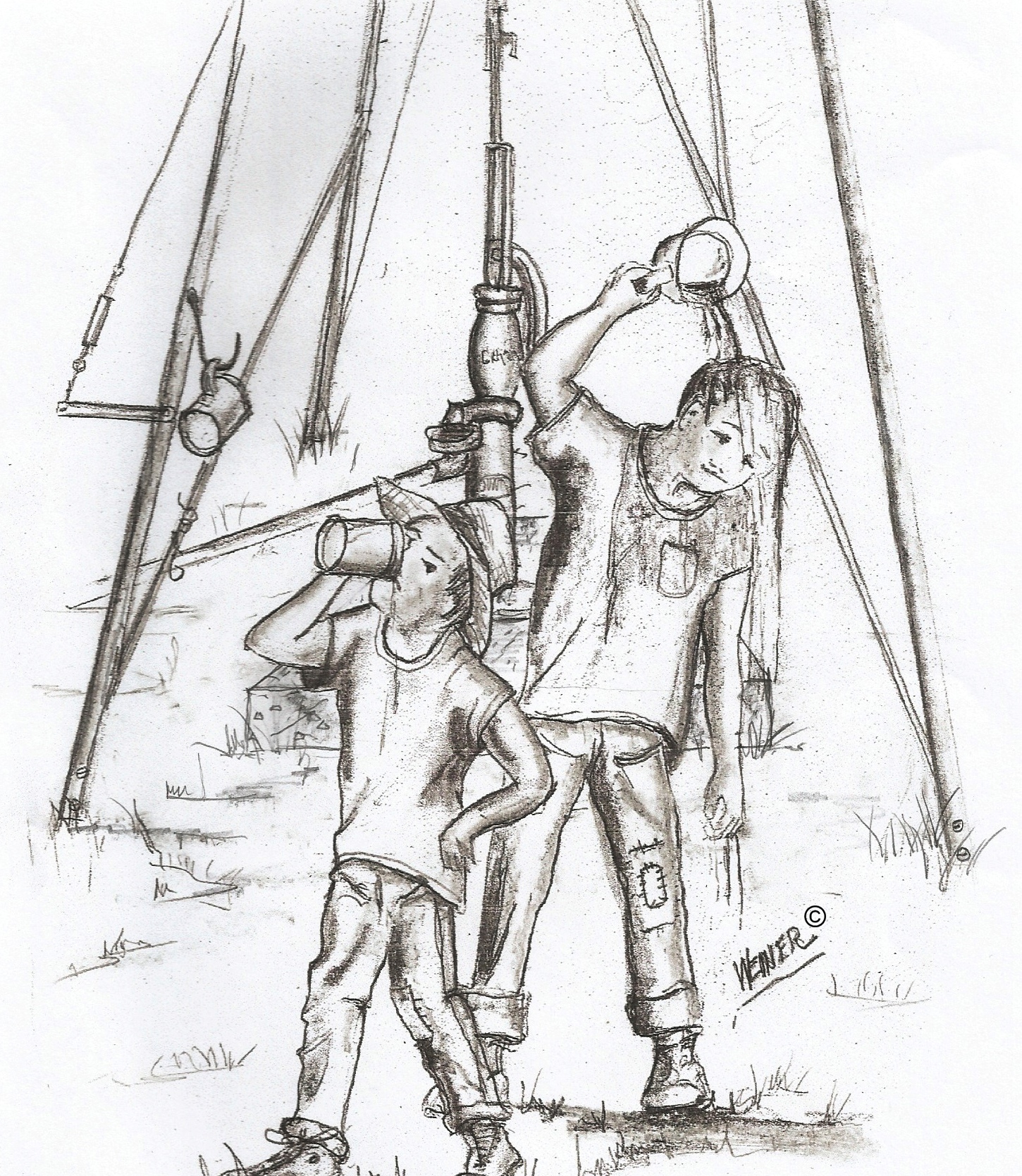
Between loads of hay, it was off to the windmill to get a cold drink of water. Cold pure water coming up from 200 feet down right out of Mother Earth. Man, that was a good drink. Several tin cups were hung on spikes attached to the legs of the windmill. Unhook the cup, remove the pipe from the well head, and fill the cup with cold water. Even let some run down your neck and back. You were already wet from sweat.

Haying season seemed to run all summer. It didn’t of course, it just seemed to. It was in spurts. First crop lasted two weeks, then cutting oats, second crop hay followed by threshing oats and wheat.

The end of any haying day was not the end of the working day. There were still chores to attend to. Feed the chickens, gather eggs, slop the hogs, milk cows, tend to the bull, curry the horses and put them out to pasture.

Getting hay in on time was a high priority for any farmer. No farmer wanted their hay crop to get rained on. The loss of food value is severe as precious nutrients are leached out.

While haying is tons of work and toil in hot weather, there is some joy to behold in the effort. The aroma from a field of drying and curing hay is a joyful odor. It is the sugar contained in those grass, alfalfa, clover, and timothy plants that brings out the pleasing smell.

Riding from field to barn atop a full load of loose hay was a joyful experience.  A boy can feel like he’s on top of the world. What a fantastic view in every direction. A straw hat kept the sun off our face and neck. The blowing wind dried the sweat. With that load of hay coming out of the field, riding up high, a kid could think he was king of the hill, a “on top of the world feeling”.

There was another benefit to haying; watching that haymow get fuller and fuller day after day. Sometimes in the spring, we ran out of hay for the milk cows. The barn was empty and Dad had to buy hay. We always bought baled hay. I know he didn’t want to do that. Dad didn’t like spending money on anything, let alone hay.

But he had to occasionally. Barn was empty of loose hay, pastures were not ready in late March and early April, so search the newspapers for ads for baled hay.

I kept my eye on the barn filling, always aware of how full it was getting. When the mow got full, the trolley and fork that brought the new load of hay off the wagon could barely move, because it was dragging on the hay in the mow. We filled bin 3 as full as we could, dropping the hay in bin 2 and mowing or throwing it over into bin 3 so the hay was close to touching the track. Right up there in the apex. Then we would drop hay in bin 1, and mow hay back into bin 2 so it was full, working out way to bin 1, which would be the last bin to be filled.

Now the trip mechanism on the track could be unbolted, turned around, and made so the trolley ran in the opposite direction, so we could fill the bin above the horse barn. Sometimes that space got full, so the space where the hay wagon drove in was filled, then hay was put in the small barn.

A full barn meant a stable barn. Mom and Dad worried when the barn was near empty, vulnerable to the wicked storms that moved across southwestern Wisconsin. Some of those winds were fierce and an empty barn could be blown down. It would happen to neighbors of people we knew. When the barn was getting full, a feeling of relief because a full barn of hay is more stable than an Army tank.

I think even the horses had a sense of what was going on here. I just imagined they knew that their sweat equity was paying off. That they were harvesting the food they would chow down in the winter.

The horses chewed grass in the pasture after working hours. Often the horses were led to the water tank next to the cow corral and half way from the barn to the hog house. Turned out to pasture, they would go down on all four legs, roll around in the dust. Sometimes we would curry comb the horsed. The curry comb was a brush that comb through the horse’s coat, especially important in the areas where the collar rested on the huge beasts.



Posted in Uncategorized | Leave a comment

Haying Season in Crawford County Part 6

We’re putting up loose hay in the 1940s and 1950s on the Scheckel farm outside Seneca in the middle of Crawford County, Wisconsin. When Dad deemed the load was full, the hay loader was unhooked from the hay wagon, and off to the big barn we would go. The load of hay was backed into the barn and the task of unloading began.

Most farmers who put up loose hay (not baled) had a mechanical hay carrier to lift the loose hay from the wagon and deliver it into the barn’s haymow. A trolley ran on a track that was fastened to the very apex of the inside of the building, just under the highest part of the roof.  This track and trolley ran the length of the haymow.

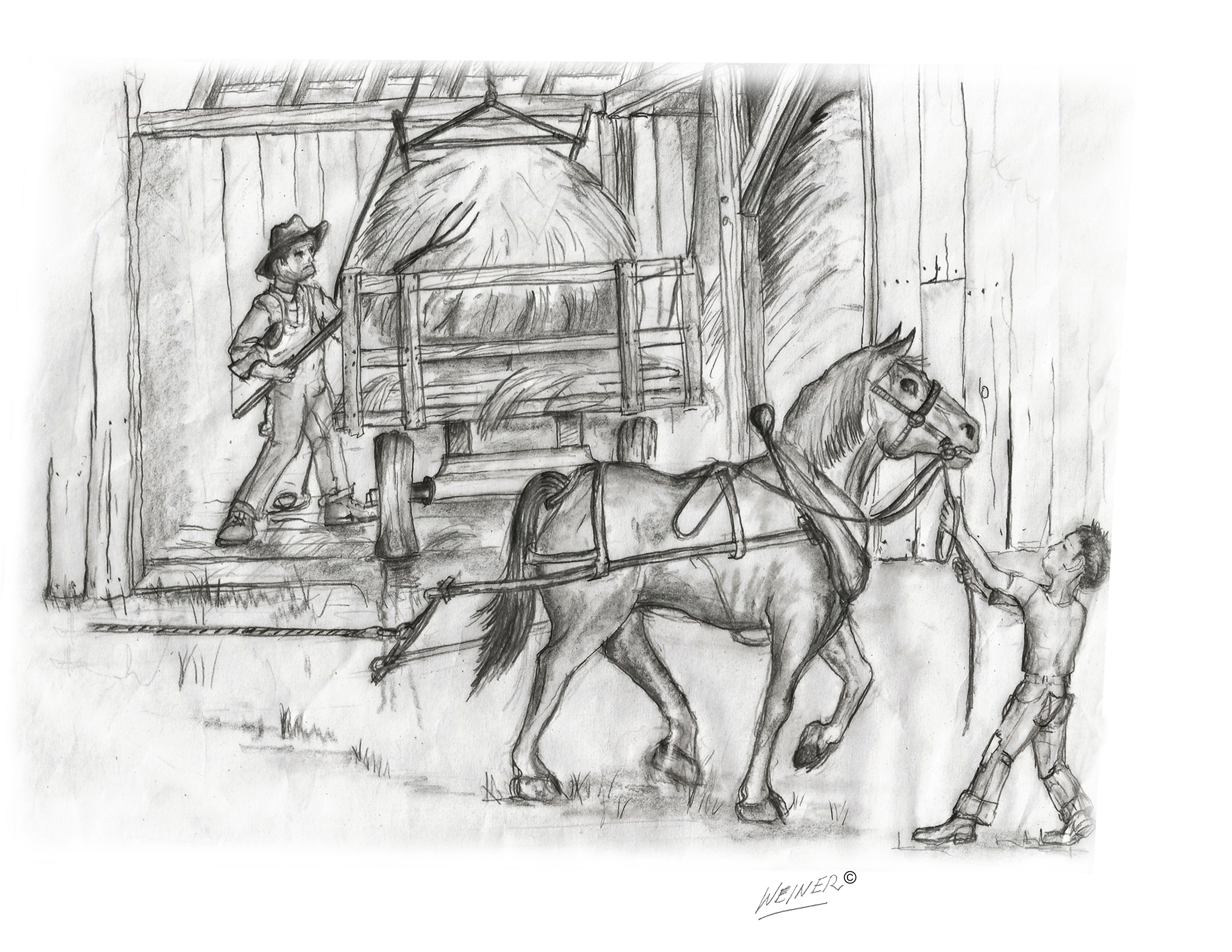
The trolley would be positioned over the hay load. A trip mechanism bolted on the track above the load, would release a double harpoon hayfork, and hayfork would be lowered by pulley and rope, onto the load of hay. The tines of the hayfork were about 30 inches long and spaced about 20 inches apart. Each tine had a little built in sliding bar to operate a “gripper” at the end of each tine. lever or finger that opened and closed.  When this mechanism was set, the hay was kept in place and could be released by a trip rope. Dad would push the harpoon fork into the load of hay. Then he would pull up on the tine trip arm to set the grippers, one at a time.

The hay rope was a one-inch diameter manila rope 150 feet long that ran along the track, through a series of heavy pulleys: one at the end of the barn, one on the cell near the corner of the barn, and one base of the barn anchored by a push. The rope was attached to a single tree pulled by one horse. Dolly was the chosen horse. She was gentle, slow but strong, and glistened black when she sweated.

Dad would yell out “Ok, go”. We led Dolly by a rope attached to the halter. “Gippy up” Slack was taken up and Dolly would lean into the load. The rope tightened. The pulleys strained. Straight up went the harpoon fork with its load of hay. When the hayfork reached the trolley, a locking mechanism attached the pulley carrying the hayfork and the trolley was released from its center position and free to travel down the track. The fork load of hay would be delivered to bin 1, bin 2, or bin 3 in the haymow.

Two or three of us mowed the hay. We would designate which bin to drop the hay. Dad held onto the quarter inch trip rope as it threaded through his hands, Dad would tug on the small trip rope and the load of hay fell into the correct bin with a swoosh and a breeze and hay dust. Dad would yell “Whoa”, the kid leading the horse would stop the forward movement of Dolly. Tension on the rope eased. The horse was turned around, with another kid pulled the rope back so it would be in place for the next load.

Dad pulled the trolley back to the position above the load of hay, the hayfork would lower and Dad would stick into the load, set the lever, and the process was repeated until all the hay was unloaded. I’m guessing it took about 6 lifts to unload the entire wagon.

When we were 6 or 7 years old, our job was to pull the rope back.  When you reached ages 10 or 11, you could lead the horse. When 13 or 14, you were in the hay mow with a 3 tine pitch fork, throwing the hay to the side of the barn. That was the hardest job of all. It might be 70 or 80 degrees outside, but up in the hayloft, you could easily add another 20 degrees, and not exaggerate. This was hard, dirty, sweaty work.


Posted in Uncategorized | Leave a comment

Haying season in Crawford County Part 5

We’re continuing our story of haying in the 1940s and 1950s on the Scheckel farm outside Seneca in the middle of Crawford County, Wisconsin. Like all farm machinery of the time, frequent greasing was necessary. The grease gun was a constant companion. You filled the grease gun from a big 5-gallon pail of grease, unthreading the body from the head, sticking the open end body down into the grease, and pulling the small handle in the back. The gun filled with grease by suction.

A hay mower might have 3 or 4 zerts. A zerk is a grease fitting, or grease nipple, The patent for the Zerk fitting was awarded to Oscar U. Zerk in 1929. The grease gun fitted over the nipple, the handle was pumped three or four times, or until you saw grease oozing out of the bearing area.

Oscar U. Zerk was born in Vienna, Austria in 1878, came in America in 1946, but lived in Kenosha, Wisconsin. Quite the inventor, he held patents on quick-freezing ice cube trays, special brakes on trolley cars, and over 300 other inventions. Zerk was very much in the news in Feb 1954, when robbers broke into his mansion “Dunmovin” tied him to a chair, stole dozens of valuable paintings, valued at $200,000 and escaped in Zerk’s own car.

A year later, a career criminal, Nick Montos, was arrested in Chicago, and given 7 years for the robbery. He spent a good amount of time in Alcatraz, died in Nov 2008, age 92, oldest criminal in Massachusetts history.  Zerk died at age 90 and is buried in historic Green Ridge Cemetery in Kenosha.

The ideal conditions are to cut the hay, let it lay 3 days, rake it and harvest it before it rains. Well, that’s the ideal, but every farmer knows he’s at the whim of God and His Divine Providence.

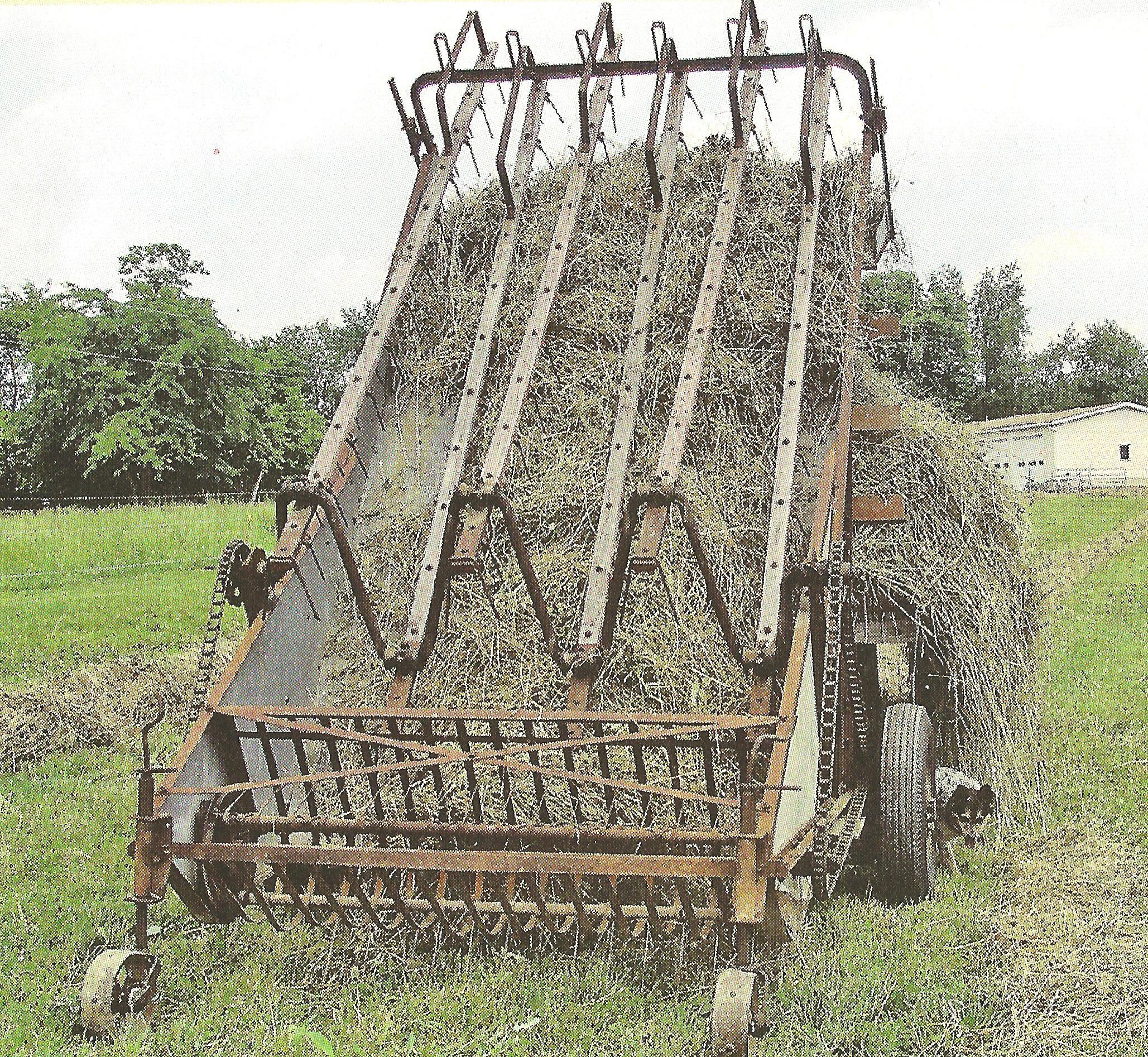
Dad had a wooden hay loader in my early years on the farm. Later, he bought a lighter metal New Idea hay loader. What an exquisite piece of equipment. Standing about 10 feet off the ground and about 6 feet wide, the horses straddled the windrow of hay. The big wheels of the hay loader drove the mechanical parts.  A wheel driven chain on the left side turned the rotary rake, and drove 6 rows of tines, 3 offset from the other 3, that raised the hay up a sloping chute and into the hay wagon.

Several times around the field to get a full load. If short-handed on help, the reins were draped over the front boards of the hake rack. The Scheckel boy handling the hay in the front of the wagon could both drive the horses and help with the load. The horses knew where they were going. They were smart enough to straddle the windrow of hay. The only time they needed “steering” was at the end of the row or a ninety degree turn. I suspect they could pretty much do that also.

Putting up hay with a team of horses was quiet affair, no motors or engines. Horses don’t make much noise. Putting up hay loose, not baled, one could hear songbirds, notice hawks soaring overhead, searching for mice, crows cawing in the distance woods. Putting up hay loose was a chance to admire the patchwork of fields, woods, and neighboring farmsteads.

That is the view I have of haying as I look back at it now. That was not my view at the time. In the 1940’ and 1950’s, haying was back breaking, dirty, dusty, and sweaty toil.

Occasionally, a snake would come up the hay loader and onto the wagon. Oh, that was great excitement. The Scheckel boys did not like snakes. We took every opportunity to kill them. Typically, they were garter snakes and black snakes or what we called bull snakes. Those snakes were quite harmless and we were told they ate a lot of field mice. But I always considered snakes to be one of God’s mistakes.


Posted in Uncategorized | Leave a comment

Haying season in Crawford County Part 4

We’re continuing our story of haying in the 1940s and 1950s on the Scheckel farm outside Seneca in the middle of Crawford County, Wisconsin. Once in a while, a chicken would be a fatality to hay mowing. It happened when cutting hay close to the farm buildings.

We had, for the most part, what would be called “free range hickens”. No enclosure or chicken pens. Chickens could go as far as they wanted. Of course, most chickens stayed fairly close to the chicken house. Even chickens know where their next meal can be found.

Some chickens would be in the tall hay and along comes the deadly sickle. The driver can’t see those chickens out there in the deep foliage five or six feet away. Sure enough, the chicken’s leg or two are cut off.

A city slicker might think that a chicken losing its legs is a bad thing. Well, it is for the chicken, but not to the farmer, his wife, and nine children. No, that chicken meant a good Sunday dinner!

Out comes the ax, onto a chopping block goes the doomed bird, one swift chop, and off goes the head of the chicken. Into a boiling pot of water, scalding the feathers, and the feathers are quickly removed. Mom butchers that chicken. But the next time we saw that chicken it was on the plate at Sunday noon.

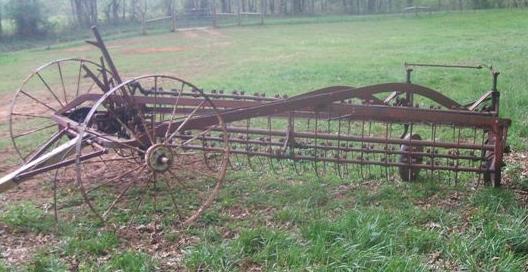
Three or four days after cutting, hay should be ready for the barn. The Scheckel family put up “loose hay”. Oh, the neighbors had a baler, but not on the Scheckel farm. Dad had a McCormick Deering “side rake” to put the hay in windows.

In 1940, Sears Roebuck was offering side delivery rakes for less than $100, with $8.00 down. Our rake was pulled by two horses. Raking started after the dew was burned off by the summer sun. That might be about 10 o’clock in the morning. Dolly and Prince were hitched to the rake. Raking was done by about noontime.

Our McC-D rake had 2 large 3-4 foot steel wheels in front, 4 bars of tines that spun on a reel that was at an angle to direction of travel. The tumbling tines would gently kick and roll the hay into straight narrow rows, ready for hay wagon and hay loader. A smaller caster wheel turned in the back.

The driver saw up quite high, unlike the hay mower. I like raking hay. I had a good view, breeze blowing, straw hat to keep the sun off, the wonderful smell of cured hay. Horses, whether mowing or raking, moved at about 2 to 3 miles per hour.

Our hay mower cut a 5 foot swath. With a five-foot sickle bar, we would rake two of the five foot swaths into a single window with the side rake.

If the dry was not sufficiently dry, or “too green” as was the saying, heat would build up in the hay mow. A farmer could lose his barn to fire. Seems every summer, we heard of at least one barn in Crawford County going up in flames. The Scheckels put up hay that was “green” a few times. You could go up in the haymow a few hours or a day later, press your hand down in the hay and feel the heat. If that happened, Dad or Mom would take a buckle of salt and sprinkle it on the hay. The salt would absorb the moisture and prevent heat buildup.

We would occasionally run across moldy hay in the winter time when throwing hay down the chutes. The grayish color and musty smell is a dead give-away that months earlier, too much heat had built up in that area.


Posted in Uncategorized | 2 Comments

Haying season in Crawford County Part 3

We’re continuing our story of haying in the 1940s and 1950s on the Scheckel farm outside Seneca in the middle of Crawford County, Wisconsin. Harnessing horses was not easy work. I was small, horses were big. I was always afraid I would get stepped on. I frequently watched Dad harness Dolly and Prince. He did it so smoothly, so quickly, like clockwork. Well, I guess if a person harnessed horse all their life, dozens and dozens of times a year, it would be a fairly routine event. Dad always harnessed on the left side of the horse.

The collar was placed over the horse’s head, the leather strap on top of the collar adjusted to make sure the collar was not too tight. Next, Dad would reach for the harness hanging from the pegs on the wall behind the horses. Slung the harness atop the horse, and slide the hames into the slots on the collar. Straightened out all the straps, the breaching that went over the tail, and pulled the tail free of the strap.  The breaching, the big strap around the rump, is the piece of the harness the horse push against when backing up an implement.

The belly band ran under the horse, and Dad snapped the reins into the hames.  A yoke strap was attached to each side of the horse’s collar. The bottom of the yoke strap had a snap fastener. When hitched to an implement, the snap fastener attached to the neck yoke, a 3 foot  wooden bar that is fastened to the horse drawn implement tongue. That neck yoke is suspended from the collar of the harnesses.

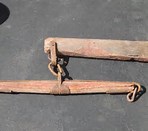
The “tugs” were thick leather straps attached to the hames and collar and running back on both sides of the horse. A length of chain is attached to each end of the tug strap. The chain is used to hitch the horse to a singletree. The singletree is a wooden 3 to 4 foot piece to which the tugs of the horse harness are fasted. The center of the singletree is attached to a doubletree.

A doubletree is a wooden swinging crossbar, to which smaller singletree bars are attached. Doubletrees are used when 2 horses are hitched side by side to pull a wagon or other farm machinery.

The neck yoke wooden bar had a big 4-inch medal ring into which the tongue of the implement would fit. A metal stop prevented the metal ring from sliding back too bar, and it was used for the horses to push against to back up any implement or wagon.

The bridle was put on last. The bridle had those blinders, or cups, that prevented the horse from seeing to the side. I always figured those blinders were used to prevent the horse from being startled by anything happening to the side. But I’m not so sure they are not used to keep dust and debris from irritating or blinding the horse.

Once the bridle was put on, the rope attached to the bridle would be tied to the hole in the stall. The horse is now ready to go to work. The team of horses were attached together, reins brought down off the hames and it was off to the fields.

It is haying season, so out to the hay field to the waiting mower. One horse walks over the tongue of the mower. When both horses are in place, the mower tongue is lifted and placed in the big round ring attached to the yoke. The chains from the tug straps are attached to the single trees.

Hop aboard the mover with reins in hand. Sit on the metal butt-shaped seat. It seems that all farm machinery had the same kind of seat. Give the reins a ripple back on the horse’s back, along with the words “giddy up” and away you go.

In my mind’s eye I can see that sickle moving back and forth. Hear the steady rapid chit-chit-chit sound, hay stalks falling back, horse heads bobbing slightly up and down, and maintaining a steady gait.

The smell of fresh cut hay, birds ahead rising up, meadowlarks running off with their fake broken wing, wind whipping the tops of the hay fields in undulating waves. Those sights and sounds stay with a farm boy forever.


Posted in Uncategorized | Leave a comment

Haying season in Crawford County Part 2

We’re continuing our story of haying in the 1940s and 1950s on the Scheckel farm outside Seneca in the middle of Crawford County, Wisconsin. On an early June morning, with dew still on the grass, my brother Bob goes out to the fields where the cows grazed overnight. That’s the same field that Dolly, the bigger black horse, and the reddish Prince, will be grazing. Slowly approaching with a sugar cube or a small apple in his outstretched hand, Bob has the halter slung over his shoulder.

The halter has a nose band and a head strap that buckles around the horse’s head. A six foot long quarter inch rope attaches to the halter. The halter allows the horse to be tied or led.

Dolly and Prince advance slowly or stand their ground. They know the routine. You can imagine what they’re thinking, “I get my sugar cube, but I got to work all day”. The halter slides over the horse’s head, buckled, and with attached rope, the horses are headed to the barn for harnessing.

Harnessing horses is an art form, and Dad was good at it. Horse harnesses were stored on pegs behind the horses and against the wall of the horse barn. The horse barn was an alcove inside the Big Barn.

First the collar was placed over the horse’s neck. Two horns, or hames, stuck out the top of the collar. Coiled up reins could be hung on these hames. I didn’t know that when I was a little tyke. For me, those hames were places to hang onto when Dad lifted us kids up and sat us down on the horse to ride out to the field or to ride home from field to house for noon dinner or the end of the work day.

The bridle would go on next. The halter has no bit and bridles used a bit in the horse’s mouth. The sides of a horse’s mouth is very sensitive, so pulling on the reins pulls on the bit, which pulls the horse’s head from side to side. This is how the horse is controlled. The reins connected to either side of the bit. This is how the horse is “steered”. The farmer drove the horses with the reins.

The reins were black leather straps that extended from the bridle back to the driver. There were supporting rings to carry the reins over the horse’s back, so they won’t get tangled. When two horses were used as a team to do farm work, which was most often the case, the outside rein from each horse went back to the driver, and a short bridging strap or rope connected to the inside of the bits. In this way, the farmer drove two horses with only two reins.

The collar was everything. Made of leather and stuffed with straw, the collar fit over the horse’s head. All the weight that is pulled is applied to the collar. A good fitting collar was important. If the fit is bad, the horse developed sores.


Posted in Uncategorized | Leave a comment

Haying season in Crawford County part 1


Genesis 3:19 “by sweat of thy brow, thou shalt eat thy bread”

Haying season on the Scheckel farm outside of Seneca in Crawford County in the 1940s and 1950s started in early June and just seemed to last all summer and going into early September. In between first crop and second crop, we cut and shocked oats. After second crop, threshing was done. After threshing, we often put up a third crop of hay.

The Scheckels put up hay loose, as the expression goes. No baler on the Scheckel farm. Cut the hay down, let it cure for a few days, and bring in the side-rake to windrow the hay, then the hay loader and wagon moved in. It was hard, dirty, back breaking work, in often hot and or humid weather. Today, only the Amish put up hay this old-fashioned way. As kids we simply didn’t know any better. We went with the flow.

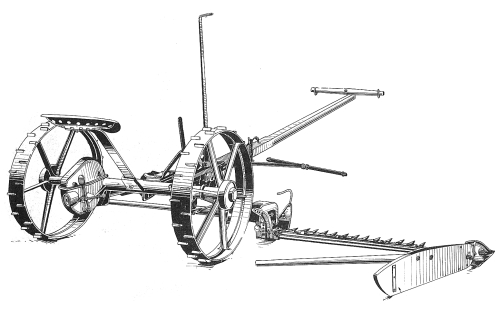
Dad had a No. 9 McCormick-Deering Enclosed Steel Gear Mower. The No. 9 was advertised to “take less power to pull and last a lifetime”. The sickle ran faster than the older type mowers. These mowers were made from 1939 to 1951. They had a 5-foot sickle bar.

Farm machinery is very utilitarian, especially early farm machinery. There are no frills and everything and every part has a purpose. At the end of sickle bar was a board, set at an angle, with a stick attached. The angled board and attached stick had the sole purpose of throwing the end hay back onto the swath. This technique created a distinct separation between the standing uncut hay and the newly mowed hay.

This method prevented the sickle bar from getting clogged with the hay cut in the previous round. Also, this distinct separation helped when raking the hay into windows.

Timing was everything in haying season. Ideally, cut the hay close to full maturity, the clover, alfalfa, timothy, and grass. Having clear, cloudless, sunny, dry days, with a breeze, provided the best conditions for drying and curing of hay. Curing would take two or three days. Then the side rake comes through and puts the hay into windrows, followed by the hay loader and wagon.

Continued next week.


Posted in Uncategorized | Leave a comment

 End of the year Picnic-part 2

We continue our account of the end-of-the-school year picnic at the one-room Oak Grove School in Crawford County in the 1940s and 1950s. After the pot luck lunch, the younger kids are involved in sack races or three-legged race. A young mother, older sister, or high school student was in charge. Camelia Rosenbaum performed that duty for several years.

Competitors in the sack race hop into a gunny sack. Gunny sacks were burlap sacks made from jute or hemp plants, Oats and wheat for planting came in gunny sacks.  Potatoes were sold in gunny sacks. Strong, durable, breathable, as the fabric was not close woven.  Every farmer had a plentiful supply.

All the sixth, seventh, and eighth grade kids get on the designed line, the finish line about 60 feet away. Most were girls. The boys played softball. The sack race is held on the north side of the school, opposite the softball diamond where the older boys and men are battling. Sixty feet is about all there is between Sutton’s corn field and the road.

Camelia: “Get ready, set, go”, and off they went. Parents and kids cheering. One kid took one step, fell down, got up, two more steps, fell down again. One kid made it halfway. RuthAnn Mahan and Mary Lou Rosenbaum are in a dead heat. Each gets a small cheering section. “Come on, Mary Ann”.  “Go, Mary Lou”, Mary Lou is ahead but looks around, then trips and falls. RuthAnn wins and gets a candy bar prize.

Next, the smaller kids sack race. Each kid climbs into a gunny sack. The sack goes over the head of small of the wee ones. The little kids sack race is the best show in town. They’re all falling down, getting up, struggling on. The youngest Kozelka kids starts crying. She’s out of the race. One of the Lucy twins win. All get a sucker to lip as a prize.

Next, the three-legged race. Great fun and lots of excitement. Two team members pair up based on height. Stand next to each other, and the left leg on one kid is bound to the right leg of their partner with a short piece of binder twine.

Cooperation was key to winning, not speed. Winners in this short 40-foot sprint were those that did not fall over. We loved this game. Usually had about 6 pairs running a race.

Time for the mid-afternoon picnic break. That meant ice cream and cake. It was up to the teacher to buy the ice cream. We didn’t get ice cream at Oak Grove School except at picnic time. No refrigerator or freezer. Teacher brought the ice cream to school the Sunday morning of the picnic packed in dry ice. We kids loved playing with the dry ice as much as eating the ice cream. Put it dry ice down the back of another kid and watch ‘em scream.

Along about 4 o’clock it was pack up time. Mothers tried to get rid of food that had not been eaten.  Women gather up the dishes, silverware, and cups. Families piled into their cars. All the Scheckel kids and Dad and Mom got into the black Chevy and headed southeast on Oak Grove Ridge road. I took one backward look at the receding school house, knowing that this lone structure would be a very quiet place for 3 months. The grass and weeds would grow 2 to 3 feet high. But we knew we would be back. What a wonderful place, that lone building on Oak Grove Ridge in Seneca township in the middle of Crawford County, Wisconsin.


Posted in Uncategorized | Leave a comment

End of the Year Picnic at Oak Grove School

School ended in mid May, and the way the school year should end, with a picnic. The school picnic was the last of the Big Three of social life at Oak Grove School; the Basket Social in October, the Christmas Program, and the May End-of-Year Picnic.

            Cars pulled in about eleven o’clock in the morning. Late enough for everyone to have gone to church and early enough that the pot luck lunch (we called it dinner) would be ready by noon. Cars parked out on the side of the road. Cars couldn’t park on school ground as much of the school grounds taken up by softball field that was sure to be used.

            The women did all the work, as they usually do. They set up some long tables inside the school. Hot food dishes, some in electric cookers,        potato salad, beans, hot dogs, homemade bread, crackers, and pickles.

There was a grand assortment of desserts, pies, cakes, tarts, brownies. The call was made, “dinner is ready” and the men start through the line, both sides of the table, then the kids, then the women. Women hang back, helping, making last minute adjustments, providing items forgotten.

A short program that honors the eighth grade graduates. They will be going on to Seneca High School. Most will complete high school, a few will drop out at age 16. Compulsory education in Wisconsin was age 16 at the time. Some are needed on the farm.

The games begin. Boys and men will play softball. No choosing of sides, like we kids going to school. Somebody says, “Me, Junior, Phillip, Bill, will be on one team, and Lawrence, Virgil, Bob, Donald you be on the other team. Some of the younger men, single or married, some in high school, some drop-outs go with one team of the other, glancing around, silently counting to see which team doesn’t have enough players or too many players. They would try to keep the teams somewhat even in numbers.

Players move to whatever position on the field is not covered. This is very informal softball, no hard rivalry here. Don’t even keep score. A long fly ball home run over into Mickelson cow pasture is oohed and aahed and cheered by both sides. Some of those young farmers have built up powerful muscles over the years.

The older men sit and talk farming, perhaps a smattering of national or international politics. “I hear the Mezera farm on Dixon Ridge is for sale, how much they’re asking?” Two or three opinions or prices via gossip.

“Andy Petersen raised his gas price to 19 cents a gallon, can you believe that, pretty soon a man can’t make a living on the farm, I’m keeping my horses.” There are nods of agreement. Andy Petersen delivered tractor gas to farmers all over Crawford County.

“Those damn Russians aren’t getting out of Europe like they said they would. There’s trouble ahead with those Commies.” A few amens follow.

The talk continues; a new tractor, fences need fixing, how do the crops look, anyone put up hay yet, a neighbor turned 95 last week a result of a couple shots of whiskey every night, it is generally agreed, the Lutheran Church is getting a new pastor and the hope is that his sermons will tighten up a bit, less than the 20 minutes they have been having.


Posted in Uncategorized | Leave a comment

The Science Lab on LYNXX24

Source: The Science Lab on LYNXX24

Posted in Uncategorized | Leave a comment