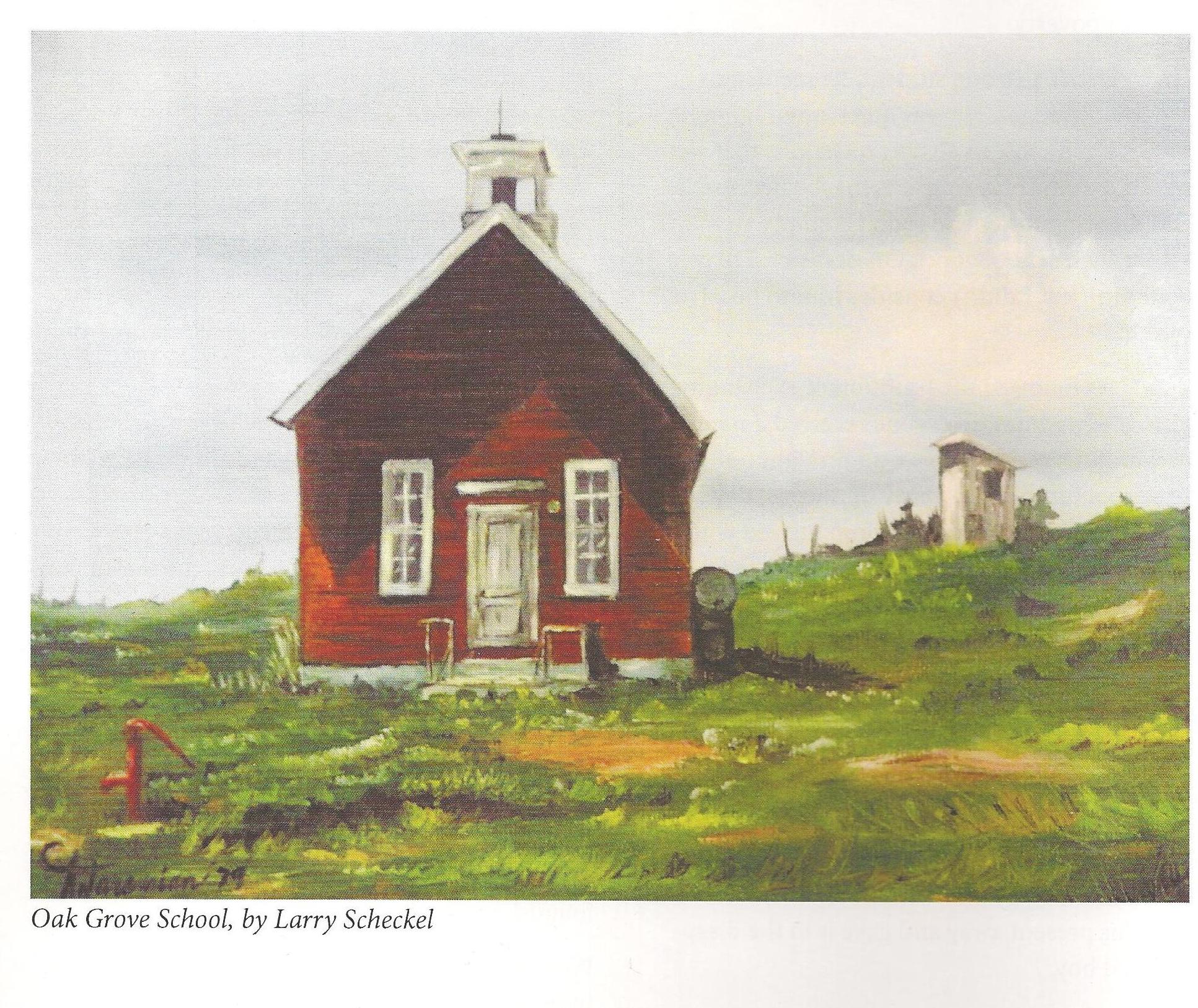
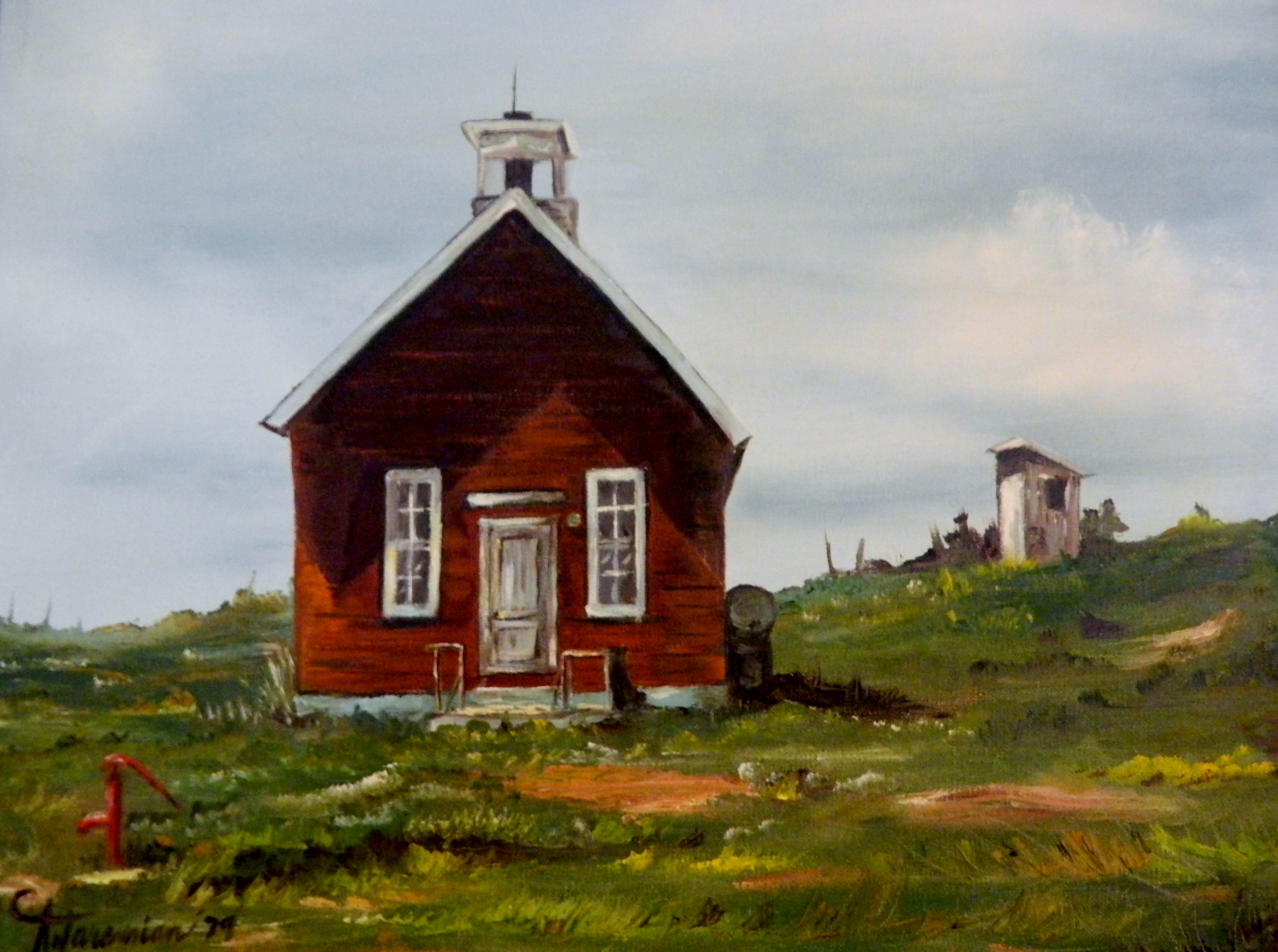
The Haying Season part 4

One of the all-time great smells of this world is hay that is drying or curing. I have often thought that if someone could make a perfume or ester of curing hay, they would make a mint.  There is no better odor on planet Earth than alfalfa, clover, timothy,
and grass lying in the sun waiting for farmer to bring it into the barn.

Three or four days after cutting, hay should be ready to put in the  barn. The Scheckel family out on Oak Grove Ridge near Seneca in Crawford County put up loose hay in the 1940s and 1950s. No baler for the Scheckel family.

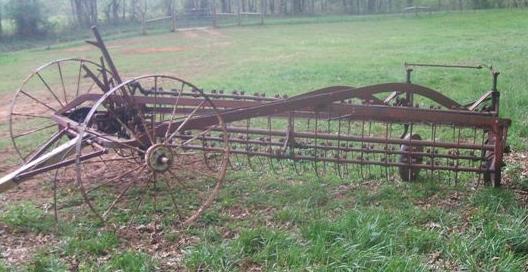
Dad had a McCormick-Deering side rake. Sears Roebuck was offering side delivery rakes for less than $100, with $8.00 down in 1940. The rake was not a large or heavy piece of equipment and a team of two horses could pull it easily.

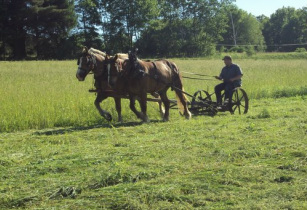
Raking started after the dew was burned off by the summer sun. That might be about 10 o’clock in the morning. Dolly and Prince were hitched to the rake. Raking was done by about noontime.

Our McC-D rake had 2 large 3-4 foot steel wheels in front, 4 bars of tines that spun on a reel that was at an angle to direction of travel. The tumbling tines would gently kick and roll the hay into straight narrow rows, ready for the hay wagon and hay loader. A smaller caster wheel turned in the back. The driver saw up quite high, unlike the hay mower. I like raking hay. I had a good view, breeze blowing, straw hat to keep the sun off, the wonderful smell of cured hay. Horses, whether mowing or raking, moved at about 2 to 2 ½ miles per hour.

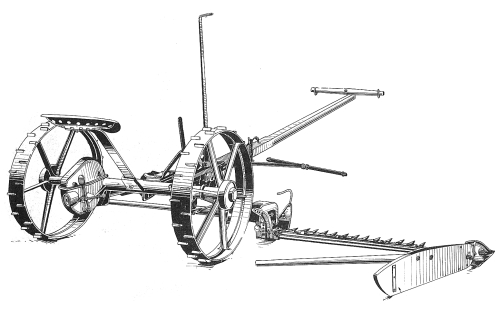
Our hay mower cut a 5-foot swath. With a five foot sickle bar, we would rake two of the five foot swaths into a single window with the side rake.

When was the hay was cured, it ready for raking into windrows. We wanted about 30-35% moisture content. We did not own a moisture gauge. Dad, being an experienced farmer, could pick up a handful of hay in his hand, and know when it was ready. No moisture meter needed.

If the hay was not sufficiently dry, or “too green” as was the saying, heat would build up in the hay mow. A farmer could lose his barn to fire. Seems every summer, we heard of at least one barn in Crawford County going up in flames. The Scheckels put up hay that was “green” a few times. You could go up in the haymow a few hours or a day later, press your hand down in the hay and feel the heat. If that happened, Dad or Mom would take a buckle of salt and sprinkle it on the hay. The salt would absorb the moisture and prevent heat buildup.


Posted in Uncategorized | Leave a comment

The Haying Season part 2

via The Haying Season part 2

Posted in Uncategorized | Leave a comment

The Haying Season part 2

The last week of May started the haying season for the Scheckel family out on Oak Grove Ridge in the heart of Crawford County outside Seneca in the 1940s and 1950s. The hay was cut using horses, raked into windrows using horses, and hauled into the barn using horses.

Harnessing horses is an art form, and Dad was good at it. Horse harnesses were stored on pegs behind the horses and against the wall of the horse barn, an alcove inside the Big Barn.

First the collar, made of leather and stuffed with straw, was placed over the horse’s neck.  All the weight that is pulled by the horse is applied to the collar. A good fitting collar was important. If the fit is bad, the horse developed sores.

Next, Dad would reach for the harness. He slung the harness atop the horse, and slid the hames into the slots on the collar. I didn’t know that when I was a little tyke. For me, those hames were places to hang onto when Dad lifted us kids up and sat us down on the horse to ride out to the field or to ride home for noon dinner or the end of the work day.

The breaching, the big strap around the rump, went over the tail. The breaching is the piece of the harness the horse pushes against when backing up an implement.

The bridle would go on next by first placing a bit in the horse’s mouth. The sides of a horse’s mouth are very sensitive, so pulling on the reins pulls on the bit, which pulls the horse’s head from side to side. The reins connected to either side of the bit. This is how the horse is “steered”. The farmer drove the horses with the reins.

The reins were black leather straps that extended from the bridle back to the driver. There were supporting rings to carry the reins over the horse’s back, so they won’t get tangled.

The belly band ran under the horse, and Dad snapped the reins into the hames.  A yoke strap was attached to each side of the horse’s collar. The bottom of the yoke strap had a snap fastener. When hitched to an implement, the snap fastener attached to the neck yoke, a 3-foot  wooden bar that is fastened to the horse drawn implement tongue. That neck yoke is suspended from the collar of the harnesses.

The “tugs” are thick leather straps attached to the hames and collar and running back on both sides of the horse. A length of chain is attached to each end of the tug strap. The chain is used to hitch the horse to a singletree. The singletree is a wooden 3 to 4 ft piece to which the tugs of the horse harness are fasted. The center of the singletree is attached to a doubletree.

A doubletree is a wooden swinging crossbar, to which smaller singletree bars are attached. Doubletrees are used when 2 horses are hitched side by side to pull a wagon or other farm machinery.

The neck yoke wooden bar had a big 4-inch medal ring into which the tongue of the implement would fit. A metal stop prevented the metal ring from sliding back too bar, and it was used for the horses to push against to back up any implement or wagon. The horses were now ready to go to work.


Posted in Uncategorized | Leave a comment

The Haying Season part 1

School was out by May 20 for the 28 kids at Oak Grove School in the hill country of Crawford County outside Seneca in the 1940s and 1950s. It might have been vacation time for the “town” kids, but just the opposite for farm kids. It was time to go to work….and work all summer ‘till Sept 6 or so. Then vacation would start for us. That’s the way we looked at it.

It was haying time and we could see it coming on the mile-long walk to and from school. The clue was the fields of standing green hay; clover, alfalfa, and timothy. Over 2 feet high and undulating to and fro in the breezes that swept over the ridges and valleys of the Driftless Area.            The Scheckel fields were keep clean of white weed and yellow rocket. Every few weeks five or six of us formed a line, separated by 10 feet or so, and moved through the hay fields, plucking the hated weed.

The Scheckel family “put up hay loose”, as the expression goes. No hay baler on the Scheckel farm. We would cut the hay down, let it dry and  cure for a few days, and bring into a windrow with the side-rake Then the hay loader and wagon moved through the field, both pulled by horses.

Horse barns have a unique smell. Not a bad scent, mine you, just different. If you want a really bad aroma, walk over to the pig house. The horse barn whiff is a combination of horse mature, urine, oats, hay, sweat, and oiled leather. Those dried horse droppings made good missiles (horse apples) for brothers to throw at each other.

Prince, Dolly, and Lightning each had they own stall with a bin in front for loose hay and an elevated box off to the side for oats and corn. Using a halter, the horses were lead to the watering tank for a drink.

Dad had a No. 9 McCormick-Deering Enclosed Steel Gear Mower. The No. 9 was advertised to “take less power to pull and last a lifetime.” These No. 9 mowers, with a 5 foot sickle bar, were made from 1939 to 1951. The sickle bar bore serrated triangular knives that moved back and forth horizontally. Guard teeth in front of the blades helped hold stalks upright and protected the sickle bar teeth.  Getting the mower ready meant putting grease in the zerks and checking for loose sickle blades.


Posted in Uncategorized | Leave a comment

Life After Retirement

via Life After Retirement

Posted in Uncategorized | Leave a comment

Life After Retirement

I do believe most everyone looks to retirement with some trepidation. What will life be like after decades of routine, where the agenda and rhythm of life is dictated by one’s job or profession.

It’s coming up on 8 years since Ann and I retired after teaching a total of 70 years at Tomah High School. Eight good years, with travel, grandkids, church work, pinochle club. Hobbies of jogging, bicycling, flying RC planes (when I don’t wreck them), crossword puzzles.

We have four books out there, three science books and a memoir book of growing up on a farm in Crawford County in southwestern Wisconsin, attending a one-room country school, Seneca Seasons: A Farm Boy Remembers.

The Seneca Seasons book is what they call a niche book, of most interest to those who lived and grew up in the time frame of the 1940s and 1950s. We go out and do a lot of book talks concerning the book and that era, a PowerPoint of about 300 slides, stories of the farm, school, Church, and family. Some of the slides are the 51 sketches by artist Fred Weiner.

Folks often come up to us after our talk and say things like “I remember things just like the way you described.” Many of them attended a one-room country school, some taught in such a school. That makes sense because if you lived in rural Wisconsin in that time period, you would have many shared memories. We’ve presented Seneca Seasons talks to many libraries, senior centers, Sons of Norway, and church groups.

With a background in science teaching, we do about 25 programs a year for schools, Museums, Boys and Girls Clubs, Boy Scouts, and Girl Scouts. These are gee whiz, high interest, kid participation, Mr. Wizard type, demonstrations with brief explanations of the principles involved. We’ve done these programs for groups as few as 10 and as many as 600.

The current physics teacher at Tomah High School is Oakley Moser, a former student of mine. He is very good at his job, a Kohl Award recipient, and science department chair. We do programs together at the Deke Slayton Museum, the Parenting Club at Winnebago Park, and our latest venture, a monthly 5-minute Science Lab television program for LYNXX-24.

We have another venture. Ann and I traveled through Israel in October of last year, 2017. It was a marvelous trip through the Holy Land, and we put together a PowerPoint of that trip that we’ve presented to Church groups in our area. It has been well received and no rocks have been thrown at us!

Jerusalem, the Old City, Via Dolorosa (Stations of the Cross) Mount of Olives, Gethsemane, tomb of David, the Western Wall, Bethlehem, Nazareth, the Dead Sea, Megiddo, Masada, Sea of Galilee, Church of the Annunciation, Capernaum, Mount of Beatitudes, Sea of Galilee, Haifa, and Tel Aviv. We discuss the political situation, the West Bank, and the views of three major religions.

Retirement has been very rewarding for us thus far. Health is everything and we been blessed with good health (knock on wood). We continue to write a weekly science column for The Tomah Journal newspaper, a monthly account of Knights of Columbus, and periodic pieces for The Country Today agricultural newspaper, The Catholic Life magazine, Monroe County Herald, and a number of monthlies.


Posted in Uncategorized | Leave a comment

Walking Home from School to the Scheckel Farm-Part 4

via Walking Home from School to the Scheckel Farm-Part 4

Posted in Uncategorized | Leave a comment

Walking Home from School to the Scheckel Farm-Part 4

The last farm on the trek home from school was the Bernier farm, purchased or rented by the Powers.  Alan and Frieda did not have any children that I remember, but took that Tom Wills boy in.  Both the Powers are buried in the Dickson cemetery at the top of Lynxville Hill. Their tombstones state Allan Powers (1905-1989) and Freda (1911-?)

Once we passed the Bernier farm, we were on the edge of the Scheckel property.  We walked the long slope to the bench where stood the lone oak tree and a view of the back of our barns and granary and up the final small slope to the farmstead. We were home.

When I was seven or eight years old, to walk that mile seemed like an eternity. Once home it was time to change into farm clothes, Take off the school clothes, hang them on a clothes tree, put on the older blue jeans and shirt, then fix a slice of bread with jelly and peanut butter, have a glass of milk, and then out to do the chores.

It was the Kozelka kids that we walked with most of the way to school and back. Gloria Kozelka was called “morning glory” after the obnoxious weeds that grew in the cornfields and wrapped around the cornstalks. Morning glories had beautiful flowers that closed up at night and opened in the morning sunlight.  Numerous times Phillip, Bob and I were sent to the cornfields to pull the morning glories up by the roots.

There was no known relationship between Gloria and morning glories. We just couldn’t come up with a better name.  It seemed like we all had nicknames for each other.  One of the boys we called “squeak”, which he resented big time.  When you’re a kid, you tend not to think how cruel a nickname can be.  We also knew nothing of political, ethnic or religious correctness. That would come much later in life.

We called Nancy Kozelka “Nancy Goat”, a really bad play on “nanny goat”.  She was tall and athletic.  Calling her “Nancy Goat” would invoke her wrath. Nancy was pleasant most of the time, but she had a quick temper. Oh, could she ever hit a softball!  When we chose teams for noontime Oak Grove School softball, Nancy was always the first girl chosen, and many times ahead of a good many of the boys.

Jimmy Kozelka was a neat kid, but a little rough around the edges. He was small in stature, but a gutsy lad. Jimmy would eat dirt on a dare or swallow a worm if asked. If young Jimmy didn’t want to do something, the teacher permitted him to sit out on the front steps of the school. Jimmie’s siblings allowed that teacher was “spoiling him”.

Ruth Ann Kozelka got influenza meningitis in third grade and missed most of the school year. She was held back a year, so she could catch up. We were walking home from school when we heard that Ruth Ann was to repeat third grade. Some of us teased or taunted her about “being dumb” or some such name. It is one of my behaviors that I have regretted to this day.

Gary Kozelka was much like his brother, but always had a smile. Good natured, pliable and pleasant.  Nothing seemed to bother him. Gary enlisted in the Navy and had top-secret clearance to work at Camp David.

These are the kids we walked with to and from school.  Gloria, Nancy, Jimmy, Ruth Ann, Gary and David Kozelka, the Scheckel kids, five or six of us at any one time, and Tom Wills, the import and reject from Madison.  The Kozelka’s had younger kids; Kathy, Susie, Lizzie and Mary, that came later. By the time the younger ones started grade school, I was in high school.

The Kozelkas had a big brown lab dog that answered to Curly. In his prime, Curly walked to and from school each day. Curly hung out around the school building, and truly earned his keep by chasing after and retrieving the softball that was hit over the fence and into the woods.

Curly wore out his welcome when he ate the eggs set out for the Easter Egg hunt. Curly had his fill of eggs, but we kids had our fill of Curly.  He was literally in the dog house from then on!

I look back with great fondness on the Kozelka family. They were a large Catholic farm family like our own Scheckel family. Neither family had television. The Scheckel boys walked up the hill to watch television with the Fradette kids some Sunday nights, and the Kozelka brood walked over to the Ingham farm to watch the Wide World of Disney.


Posted in Uncategorized | Leave a comment

Walking Home from School to the Scheckel Farm-Part 3

Recounting my days walking home from the Oak Grove Ridge one-room country school in the late 1940s and early 1950s outside Seneca in the middle of Crawford County, adistance of one mile to the Scheckel farm.

We trudge along on the gravel road, down the Ingham hill and soon up to the top of the next hill to another commanding view. You can see miles in every direction. A slight descent, around a slight bend and on the right was the Kozelka farm, a small 50-acre job. Not enough to raise and totally support the large Kozelka family, so Mr. Kozelka, or Rudy, as we called him, worked bridge construction.  Rudy was a good man, terrific worker, devoted husband and father.  The Kozelkas attended our St. Patrick’s Church.

Mr. Kozelka worked for Brandon Bros construction and built bridges around the Midwest. He lived until 1970, dying way too young at age 55, and leaving Florence a widow for close to 50 years. Rudy had a heart that was damaged by rheumatic fever when he was young. The Kozelkas had three young girls at home when he died.

Walking home from school was an adventure. The exchange of gossip, reliving lessons learned in the classroom, arguing about nothing, laughing, singing and throwing sticks. We boys would marvel at the hundreds of beer cans in the ditch where garbage was also dumped.

Cockleburs grew along the side of the road. Cockleburs bunch together and cling to your clothes.  They would hook into the clothing and not let go.  We would pull cockleburs off the plants and ball them together. Who could make the biggest ball? Then we would throw them at each other. Hopefully, someone would be wearing a wool sweater. Cockleburs just love wool clothing.  Cockleburs were the forerunner, I’m told, of Velcro fasteners. I sure could have used Velcro on my shoes when I was a little tyke. I had trouble learning how to tie my shoelaces. I wanted to be a pilot when I grew up and I was afraid I couldn’t be a pilot if I never learned to tie my shoes.

My dog Browser would run through the cocklebur plants with me and his coat would pick up cockleburs. That was not much of a problem for Browser, because he was short-haired and cockleburs love long-haired dogs.  Shep was a black and white long-haired dog that we had on the farm when I was about 6 or 7 years old.  Shep got so many cockleburs in his fur that the only way we could rid him of the plant pest was to cut them out with a scissors.


Posted in Uncategorized | Leave a comment

Walking Home from School to the Scheckel Farm-Part 2

via Walking Home from School to the Scheckel Farm-Part 2

Posted in Uncategorized | Leave a comment