Aliens

Our fourth science book was published in late 2018. New ones are coming out in May 2019 and November 2019. In this blog we are returning to some of the early columns of Ask Your Science Teacher,  published in 2009. The columns are updated and revised. Many originally ran in The Tomah Journal at the behest of John Kenny, Publisher. We hope you enjoy them, and please give feedback.

Question:

            Why do people think there are aliens?

Answer:

            Aliens and UFO’s provide endless fodder for television programs and tabloid magazines. People are fascinated by accounts of people who spot strange spacecraft and persons who are abducted by alien creatures. Writing about aliens and UFO’s is always risky because there are people who are passionate true believers, persons who are skeptics, and folks who think it is all a bunch of baloney.        

            First of all, let’s make sure we understand what we mean by UFO’s, or Unidentified Flying Objects. Most everyone has seen strange things in the sky that we can’t identify. It could be a plane, weather balloon, helicopter, clouds, swamp gas or birds. It is flying and we can’t identify it. We could call it an Unidentified Flying Object. But when we hear the term UFO, we usually mean that it is not of Earth origin. Rather, it comes from outer space. So for purposes of discussion, we mean a UFO that is of extra-terrestrial origin.            

Kinds of Encounters

            UFO are usually categorized as to encounters:

Close encounter of the first kind involve sighting a UFO. A close encounter of second kind indicates a visitation in which evidence is left behind. A close encounter of third kind includes sightings of living creatures. Close encounters of the fourth kind are the most terrifying: abductions of humans by aliens.

Most Famous Case

            The Betty and Barney Hill case is probably the most celebrated alien spacecraft story. They will driving on a road in New Hampshire in September, 1961, when they spotted a UFO in the sky. As it came closer, they saw humanoid figures peering out of the windows of the UFO. They sped down the highway for about 40 miles. Their watches had stopped. They drove home. But they later recounted that they arrived home 2 hours after they should have. There had no accounting of the 2 hours.

            Both incurred emotional problems, so they went to a doctor. Under hypnosis, the Hills “relived” their 2-hour abduction and physical examination. They gave vivid descriptions of the aliens and their spacecraft. They revealed details of the medical examinations performed by the aliens. Their story was made into a book “The Interrupted Journey” and a movie “The UFO Incident”.

Evidence

            Most people who claim to have been abducted by aliens and taken aboard a spaceship have recalled their experiences under hypnosis. Scientists Leo Sprinkle, James Harder, and Budd Hopkins have all used regressive hypnosis to try to uncover and understand these bizarre stories of terrifying capture, tissue sampling, medical testing, followed by release.

            They and other specialists have found that the subconscious mind remembers dreams on a par with real life experiences. Parts of the mind can’t tell the difference between dreams and real memories. Answers given under hypnosis are often based on information gained from other sources, such as a person who may have read about UFO’s or abductions. Movies that a person viewed can instill mental images that a person, under hypnosis, recalls as real-life experiences. Comments and questions by the hypnotist can fashion and modify a given response.

            There was a famous experiment testing the reliability of alien and UFO reports conducted in the mid 1970’s. Eight people who had never experienced or reported any alien or UFO encounters were asked to visualize or imagine being taken aboard a UFO. They were asked to visualize that they were given a physical exam. They were given no other details.

            Under hypnosis, these test subjects were asked to describe their “experiences”. Every person could recall details of their “abductions”, including adding colorful details of the UFO spacecraft, the aliens, star charts and descriptions of the aliens. Many of the stories had a great similarity to the accounts of Betty and Barney Hill. This experiment showed that the mind is capable of creating vivid and fascinating accounts of events that never happened.

            In that same vein, we have been hearing plenty of stories in the news lately questioning the reports of some child molestation cases. The controversy is centered on the actions of the therapist or questioner who may be unconsciously planting stories and accounts of events that never took place. The sad fact is that it is difficult to separate reality from pseudo or false memories. A number of television talk shows have featured this problem in which innocent people have been accused of doing some terrible things.

Why Do People Believe?

            Why do some people want to believe in UFO’s and aliens? Polls reveal that half of Americans believe in UFO’s. Roughly 1 in 10 have seen one. I would conjecture that many people want to think that there is more than what we can see, touch, smell or use the senses to detect. They want to feel that there is a power bigger than themselves, that there is more to life than they now experience. They have a powerful urge to believe there is something out there and they are not alone. They have a hunger to feel there is a force greater than themselves that may have power and influence that is beyond what they know. Tales of aliens and UFO’s fill a void in their lives. In many cases they are people who yearn to know the private lifestyles of the rich and famous (or infamous), who buy check-out counter magazines and tabloids. It is little wonder that writers of UFO-ology and alien creatures stories aim their articles to the same audience.

            When we see and hear so many stories in print and on television about aliens and UFO’s, I think it is only natural to say, “Gee, there might something to these things”. People are constantly reminded of this phenomena so it attains a life of its own-sort of a benign ‘big lie’ technique.

What Should We Believe?

            Most UFO’s have perfectly logical explanations. Clouds, aircraft, weather balloons, swamp gas, and deliberate hoaxes such as hot air balloons powered by candles make up a majority of the cases. It is up the UFO/extra-terrestrial alien believer to prove the existence of such things. So far, no credible proof exists that aliens have visited us or are visiting. No specimens, materials, life forms, advanced scientific information have been discovered or found. No face to face meetings with groups of people have taken place. Most of these encounters take place at night when seeing anything is difficult. Some ufologist follow careful scientific procedures, but most do not. They simply do not observe common sense rules of evidence.  Do aliens from outer space and Earth visiting UFO’s exist? There may be, but there is no credible evidence to suggest that we have been or are being visited. The burden of proof is on those who make claims. So far, that proof is lacking.

Posted in Uncategorized | Leave a comment

What is New?

Our latest article was printed in The Country Today agricultural newspaper dated January 16, 2019. It is the 18th column published by The Country Today and is basically excerpts from the book Seneca Seasons: A Farm Boy Remembers. The latest was titled Lunchtime at the one-room country school.

Posted in Uncategorized | Leave a comment

Hog Butchering on the Scheckel Farm…continued

via Hog Butchering on the Scheckel Farm…continued

Posted in Uncategorized | Leave a comment

Hog Butchering on the Scheckel Farm…continued

Continuing our remembering of the annual November hog butchering on the Scheckel farm on Oak Grove Ridge outside Seneca in Crawford County in the 1940s and 1950s. Butchering was a 3 or 4 man operation and farmers often banded together, same as the threshing ring and wood cutting. Dad had 3 sons and I would guess that we three totaled up to about 2 men in terms of getting the job done!

If you read accounts of farm butchering in that time period, you come across articles that say the men did on relish or enjoy it all that much. It’s just a chore that had to be done. Often the work was done with a minimum of talking, ribbing, and bantering that occurred when farmers got together. They knew they were taking life, and it was necessary to sustain their families through the winter.

We tried a rope around the legs of the demised hog and dragged him to the place of butcher. Short pieces of rope were tied to each ends of the single tree and the other ends around the back feet of the hog.

“Pull the rope boys”, Dad yelled out. Phillip, Bob, and I grabbed the block and tackle rope and started pulling and slowly the hog moved more into position under the single tree.  Slowly the back legs raised up, gradually the hog’s rear end raised up, and bit by bit, the work became harder.

There were 3 pulleys on each end of the block and tackle. You had to pull 6 feet of rope to get one foot of lift. This was the same block and tackle we used to stretch fence. We were quite familiar with how it worked.

Soon the whole hog was off the ground. We raised the hog’s head about 4 feet above the ground and positioned the block and tackle over the cast iron barrel of hot water.

“OK, boys, lower him in” commanded Dad, and we unset the block and tackle and slowly lowered the hog into the water. The hog was kept there several minutes. We brought him up a bit and dunked him down into the water again. Dad tested the hair scraping with a knife.

The idea was to soften the hog hair or bristles so they could be scraped off with a knife. If you get all that hair off, your hog should be white, not black and white. I was amazed at that. I discovered that all pigs were white underneath.

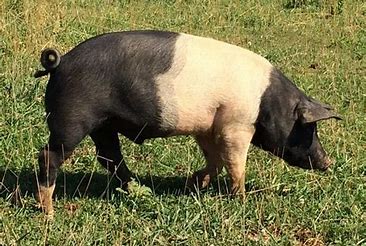
We raised Duroc hogs, which sported a dull reddish color. There was very little white hair or coloring on Durocs. We also had Hampshire hogs. Hampshires were all black, and displayed a white band around the body that covered the front legs.

I do believe we had some Spotted Poland China pigs. Dad bought these as 30 to 40 pound feeder pigs and we fattened them to 200 pounds, ready for market. The color Spotted Poland China was just what the name implies. These hogs were the color equivalent of Holstein cows.

Phillip, Bob, and I argued this one through and through. Were these hogs white with black splotches, or black with white blotches? We didn’t know and had no way of getting a definitive answer, but it did not hold us back from putting forth a conviction, one way or the other.

More on butchering in the next blog.


Posted in Uncategorized | Leave a comment

Butchering time on Oak Grove Ridge

Butchering a hog was a November ritual on the Scheckel farm on Oak Grove Ridge outside Seneca in Crawford County in the 1940s and 1950s. All the crops were done, along with the haying, threshing, and most of the corn shredding. It was butchering time. All that spring and summer, and now deep into the cool autumn, there was one hog that did not get sent off to market at 200 pounds. There was one pig being groomed for first degree murder. The one selected for butchering.

Butchering a hog was an all-day affair. Preparation started early in the morning. Water was heated in the big round black cast iron barrel that was earlier used for making their slop. What a remarkable twist of fate for the condemned hog!

A little lye was added to the water. Dad said it aided in the task of getting rid of the hog hair. A block and tackle hung from a sturdy limb of the big oak tree.  A single tree horse hitch was suspended under the block and tackle.  The boiling cast iron barrel was positioned under the apparatus.

Dad sharpened knives with an emery wheel powered by a foot treadle. A whet stone gave knives a final finish. A wash tub stood nearby to receive the guts from the hog.

Phillip got out the .22 rifle, loaded a single long bullet into the chamber, and put it on “safety”. Dad constantly reminded us to “keep the rifle on “safety” until we’re ready to fire. That way, if you trip, or your head hit a branch, or you’re climbing over a barb wire                                                                                                                                                                                                                                                                                                                                                                                                                                    fence, you’re not going to shoot yourself.”

Dad allowed Phillip to be the executioner. The pig was chased out into an open area in front of the Small Barn and enclosed with portable gates so his movement was restricted.

We don’t know if Phillip closed his eyes, or flinched, or if the hog made a sudden jerk or movement of some sort, but… the gun went off, then the hog took off. That porker was wounded but not fatally. The chase was on.

This could be a scene out of the Three Stooges, the short clips we saw prior to the main featured movie. Five or six kids were pursuing the stricken hog around the farm buildings, yelling and screaming. Oh, what great fun! Fun for us, but not the hog. He stopped long enough for Phillip to get in a second shot. This time, the hog flopped right over on its side. Dad came over and slit the hog’s throat. It was gruesome but fascinating.

More on hog butchering next week.


Posted in Uncategorized | Leave a comment

Winter Coming On

Our first snow of the season came late last week, on Friday, November 9. A light dusting, but enough to turn the countryside and lawns from brown to white. When we were kids growing up on the Oak Grove Ridge farm outside of Seneca, Wisconsin, in Crawford

County in the 1940s and 1950s, it seemed we could always expect a snowfall between the dates of November 8 (sister Teresa’s birthday) and November 13 (brother Bob’s birthday).

Dad listened to radio station WMT out of Cedar Rapids for farm reports and weather forecasts. Chuck Worcester came on at noon with the farm report and livestock markets. I think Dad learned much about farming and livestock, poultry, crops, and farm machinery from listening to the radio.

WMT, 600 on the AM dial, broadcast obituaries. There were tons of Scheckels in the Bellevue, Springbrook, Preston, and Maquoketa area. Once in a while he would hear the passing of someone he knew. Same with my mother. She came from the Lewig family in the area of  Luana, Monona, Alpha, and New Hampton area of Iowa. Both Dad and Mom were born and raised in the northeast corner of Iowa.

Weather forecasts in those days were not very accurate. I recall one forecast in January1953 that said we were to have partly cloudy weather for the next few days. The next day we were shoveling 6 inches of “partly cloudy”.

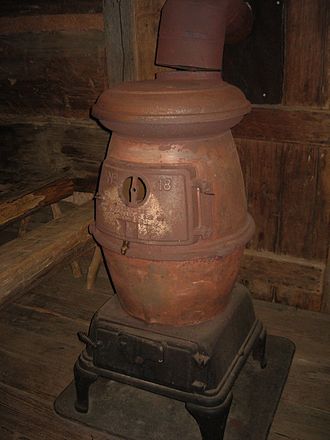
During my first three years at the one-room Oak Grove school, from about 1948 to 1952, we burned wood in the pot-bellied stove. A wood shed stood a few yards from the school. It served as a back stop for our softball field.

I recall seeing the woodshed full of slab pieces that had been hauled from Vedvik’s sawmill on the north edge of Seneca. Every kid had duties at the end of the school day. It was the task of the older boys to haul in sufficient wood for the next day’s fire.


Posted in Uncategorized | Leave a comment

A Reader Writes

via A Reader Writes

Posted in Uncategorized | Leave a comment

A Reader Writes

I received an email this past week and have excerpts below:

“Thank-you for your great book, “Seneca Seasons….” I grew up on a farm in Racine, County. The part that blesses me the most about the book is that you took the time to write it down!!  It’s not that you had such an unusual life…in fact it’s uncanny how similar our farm lives were….but PRAISE GOD, ALLELUIA!!! YOU WROTE IT DOWN!!! You’ve preserved for all posterity our lives on the farm in the 40’s and 50’s and beyond, and in that I wholly rejoice!

My husband and I live back on the farm that I grew up on near Kansasville, WI.  in Racine County. Last June I was at a funeral for Ken Burton, who grew up near Fairview and Seneca. The funeral was in Burlington, WI.   Ken’s wife, Mary, also grew up in that area, she was a Sime, and her nephew was the Ag Teacher at Seneca High School when we bought out there, he too has passed away, way too young.

Anyway, at the funeral, realizing that I was going to be around many people from the Seneca and Mt Sterling area, I started asking people where they were from. So in the course of conversation someone mentioned to me about your book….someone said to me you should really read the book “Seneca Seasons”.   I thought it sounded interesting, but didn’t think about it again until I saw the book section at Johnson’s over Labor Day while we were “at the farm”.  Needless to say, I read almost all of it that week-end. Thanks so much for writing your memoirs.”

The email again indicates the importance of recording our memories by committing them to paper, or tape, or video. Someone once remarked that when we die, a book is lost.


Posted in Uncategorized | Leave a comment

October Skies in Tomah

Very nice article in Farm & Ranch Living magazine Oct/Nov 2018 issue about the Potter Cranberry marsh and harvest in The Way We Live section. It is written in diary form by the sister-brother team of Sandy Potter Nemitz and David Potter, with references to their father, Todd Potter, and Todd’s mother, June Potter. The article is liberally augmented by photos by Jim Wieland.

We have been busy promoting and selling our latest book, Murder in Wisconsin: The Clara Olson Case. This past week,  I took books to Westby’s Dregne’s store and Viroqua’s Market Place, then down to Seneca to deliver 30 books. 
It’s always a beautiful drive down Highway 27, on the spine of Crawford County. From the north and heading south, Rising Sun is the first village.

The Finley grocery store has been closed for decades as has Bernie Hanson’s barber shop and Bill Crowley’s tavern. St. James Church on the outskirts of Rising Sun has also been closed for some time, but the grounds and cemetery are meticulously cared for.

About a mile south, Highway 27 winds past Battle Ridge, the site of Clara Olson’s murder and burial. She was entombed there for over 3 months before her miraculous discovery in early December 1926.
A few miles south takes one to Highway C, the road paralleling Sugar Creek. When I was a boy on the farm our Dad took us down that highway, where a flash flood carried a family of 5 or 6 to their deaths. That would be in the early 1950s. My brother says it was Rush Creek.
I go past Fairview, Utica Lutheran Church, Mt. Sterling, Evergreen Cemetery, and Stony Point road. Clara Olson was a member of the large Chris and Dina Olson family on Stony Point road. Then it’s on to Seneca. The whole venue of the book centers around Rising Sun, Mt. Sterling, and Seneca.
The home of the Seneca High School Indians, Johnson’s One-Stop Shopping Center, Big Gain Feeds, and Greener’s Corner. Greener’s Corner is as close to a Kwik Trip as you will find in those parts. I deliver my books and take Highway E (Dixon Ridge) and drop down into Lynxville. Got it name from, you guessed it, those big cats were found there in the late

Posted in Uncategorized | 1 Comment

An Early Frost

via An Early Frost

Posted in Uncategorized | Leave a comment