What is the Universal Product Code?

The Universal Product Code (UPC), sometimes referred to as a bar code, is a product description code designed to be read by a computerized scanner at the cash register. The UPC permits fast checkout at the point of sale and also gives the store owner an easy method to track sales and monitor inventory.
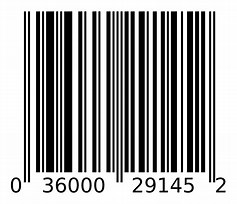
The UPC consists of 12 numbers in groups of “0” s (dark strips) and “1” s (white strips).  The width of the strips matters. A bar is thin if it has only one strip, and thicker if there are two or more strips that are side by side. A big advantage of the UPC is that there is no letters or numbers, only the scannable strip of black bars and white spaces.
The first number is a description of the product. The next five numbers describe the product’s manufacturer. The following five numbers describes the product itself, such as size, weight, color, or some other distinguishing characteristic.

The last number is a check digit that is used to inform the scanner if there is an error in the other numbers. The preceding 11 digits, when added, multiplied, or subtracted in a certain way will equal that twelfth number. If they do not, a mistake is made somewhere, perhaps a wrinkle or fold in the scanned label.

The price is never coded into the bars of the UPC. When the scanner at the checkout counter scans a package, the cash register sends the UPC number to the store’s central point of sale computer to look up the UPC number.  The central computer then sends back the actual price of the item. It is done almost instantly. The price is put into the computer by the operator. That way, stores can decide at what price to sell an item, or the store can put the item on sale.

The end strips are “guard bars”. There are “guard bars” in the middle of the UPC. Numbers on the right side of the middle guard bars are optically the inverse of the numbers on the left. This inversion enables the bar code to be scanned from left-to-right or right-to-left. The scanning software knows if the code is the correct way or backwards or upside down.

The first UPC item ever scanned was at Marsh’s Supermarket in Troy, Ohio on June 26, 1974. It was a 10-pack (50 sticks) of Wrigley’s Juicy Fruit chewing gum and the cash register rang up 67 cents. That 10 pack Juicy Fruit gum is on display at the Smithsonian National Museum of American History in Washington, DC.

UPC scanners use a low wattage laser to read the product label. When those supermarket scanners first came out in the middle to late 1970’s, the word laser was omitted from any advertising. Lasers were associated with death rays and who wants to go to the store to be zapped by a death ray. It does take time for us to accept some new technologies.

When those new NMR (Nuclear Magnetic Resonance) machines appeared a few decades ago, people were reluctant to use them because of the word “nuclear”.  The medical profession changed the name to MRI (Magnetic Resonance Imaging) and they became acceptable.


Posted in Uncategorized | Leave a comment

Raising Hogs on the Scheckel Farm

We raised a lot of hogs on the Scheckel farm outside of Seneca in the heart of Crawford County  We had a hog pen section on the west end of the small barn. Then we built a brand-new hog house next to the corn crib that we had constructed the year before. It had eight farrowing pens, four on each side with an aisle down the middle.

I was ten years old (1952) when we built the hog house. Dad and my brothers, Phillip, Bob,  and I cut the logs on our farm, and hauled them to Jake Vedvik’s saw mill in Seneca, where they were made into lumber. Three big logs on a Gehl rubber-tired wagon, pulled by the Massey Harris ’44 tractor hauled the logs to town. Several weeks later, we took the tractor and wagon and picked up the sawed lumber. Some were two-by-fours for uprights and rafters. Some 1-x-12 boards for siding and a few were four-by-six timbers used for sills.

The whole family worked on building the hog house. It was constructed between crop harvests. We dug the footers, smoothed out the ground, and put up the forms to pour the concrete before the first hay crop. The concrete pour was accomplished after the first hay crop, but before cutting and shocking oats. We built the walls and rafters after we finished threshing. We tackled the roofing, shingling, and siding after the second hay crop. Continued……


Posted in Uncategorized | Leave a comment

Thomas Jefferson Inventions

The third president of the United States was a busy and creative genius. Jefferson was an esteemed politician, statesman, farmer, writer, educator, and architect. He loved making things. “Nature intended me for the tranquil pursuits of science, by rendering them my supreme delight”, he wrote.

A steward of the soil, Jefferson made a huge improvement on the moldboard of the plow. The wooden plowshares of the time only dug down two or three inches into the soil. His improvement of the Dutch moldboard, based on a mathematical design, could dig down six inches. The plow also turned the soil over better which helped prevent erosion. He never patented the improvements he made to the plow. Later steel plows were based on Jefferson’s design.

While serving as George Washington’s Secretary of State from 1790 to 1793, Jefferson needed a means of secretly communicating with his colleagues. Correspondence was frequently intercepted by foreign governments and read.  Jefferson devised a wheel cipher that had 26 cylindrical wooden pieces, that looks like large Oreo cookies, and threaded onto an iron rod. The letters of the alphabet were written in random order on the edge of each wheel. Turning these wheels, words could be scrambled and unscrambled. Variations of this code device were used by governments all the way up to WWII.

Jefferson devised a rotating stand that held 5 books. The book rests could be folded to make a box that would attach to a base. This ingenious book stand has been copied by libraries worldwide.

Jefferson’s Great Clock can be seen at Monticello, Virginia. It’s powered by cannonballs that were left over from the Revolutionary War. The cannonball weights hang from both sides of the doorway. The days of the week can be read from markings on the wall. The great clock face can be seen from both inside and outside the house.

To service the Great Clock, Jefferson devised a folding ladder that could also be used to prune trees. This kind of ladder is still used in many libraries to reach up to high book shelves.

John Isaac Hawkins made a “polygraph” machine consisting of two connecting pens that moved synchronously to produce an exact and immediate copy of anything he wrote. Jefferson acquired one of the machines in 1804 and used it up to his death in 1826. He had one installed in the now White House and one at his Monticello home. Jefferson made several improvements on the machine. (The term “polygraph” is used today to mean lie detector. Hawkins and Jefferson machines should really be called pantographs).

The gifted visionary made a mechanical dumb waiter which permitted servants to send wine bottles up from the cellar.

Jefferson produced a sundial that was shaped like a globe. The original was lost but reproductions are based on his 1816 letter to architect Benjamin Henry Latrobe.

In 1804, Jefferson had glass doors installed between the hall and the parlor in his home. A mechanism, with two wheels joined by a chain in a figure eight arrangement, and hidden under the floor, allowed both doors to move when one was opened or closed.

Thomas Jefferson also invented the swivel chair, a pedometer, and a hemp-treating machine.

Posted in Uncategorized | Leave a comment

Raising Pigs on the Scheckel Farm continued…..

This chapter’s opening quote from Jesus Sermon on the Mount implies that truth or knowledge, which is the pearls, should not be put in front of people, meaning swine, who do not appreciate their value. This Bible quote gives pigs a bad reputation, a reputation that, I believe, is undeserved.

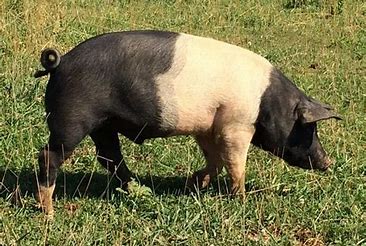
I developed an abiding affection for pigs on our farm. A pig is actually a very clean animal. They will eat almost anything, but then so did the Scheckel children! Yes, they’re natural foragers, and they root for worms and grubs because that’s their nature. Traditionally, they were fed table leftovers and unappealing slop, which was largely the waste product of milk, the whey. So even their food “slop” has a bad reputation. If you go to a restaurant and do not have a good meal, one might say, “They serve slop there.” Pigs can be messy eaters, devouring their food from low troughs, and voraciously gorging their meal.

Pigs like to stay clean, and won’t lie down in their manure if they can avoid it. You can’t say the same about cows or sheep or chickens. But pigs are penned up in sties or pig pens and are not free to roam like cattle and sheep. Yes, pigs make their own farm pond if given a chance. Pigs have no sweat glands, so they like to wallow in the mud and water. It keeps them cool.


Posted in Uncategorized | Leave a comment

How are the Northern Lights formed? 

The scientific name for the Northern Lights is Aurora Borealis and they have their origin in the Sun. Solar activity causes a huge ejection of particles. The ions and atoms take 2 or 3 days to get to the Earth, where they get caught in the Earth’s magnetic field.  The flow of charged particles is termed the solar wind. These charged particles flow along the lines of the magnetic field in both polar regions of the Earth. The collisions with oxygen and nitrogen atoms produce the dazzling light displays.

The vivid colors produced by the Northern Lights is very much akin to the colors formed in those neon type advertising signs we see in bars, barbershops, and stores.  The physics is the same. Atoms are energized. Electrons going around the nucleus are made to go to orbits further away from the nucleus. When the electrons go back to their normal orbit, the atom gives up its energy by emitting a little bit of visible light.

Collisions with oxygen yields green, the most common of all the aurora colors. Nitrogen gives red colors. The next most prominent color is a mixture of light green and red, pure red, then yellow, a mixture of red and green. Then lastly there is pure blue.

The best time to observe northern lights is from 9:00 PM to 1:00 AM and best months are March, April, August, and September. The closer an observer is to the pole regions, the better the view. People living in Alaska and Greenland find the Northern Lights are visible most nights of the year.

The earliest accounts of the Aurora Borealis date back to 600 BC and appear on Babylonian clay tablets. The most spectacular display in modern times was on September 2, 1859, and seen over the entire Earth and was recorded in ship’s logs.  The New York and Boston newspapers reported at the time that the Northern Lights were so brilliant that newspapers could be read at one o’clock in the morning.

Our good planet Earth has an atmosphere and magnetic field to protect us from those particles emanating from the sun. The moon has neither an atmosphere nor a magnetic field. Astronauts working on the surface of the moon would be in grave danger when a big solar flare occurs.

Astronauts in the International Space Station are sometimes alerted to violent solar activity. In December, 2006 a huge flare made the astronauts move to a more protected module inside the ISS. The Northern lights can damage the electrical power grid on Earth and satellites in space.


Posted in Uncategorized | Leave a comment

When the Moon is a thin crescent, why can see the rest of the Moon dimly lit.

The phenomenon is called Earthshine. This event is present anytime the moon is not a Full Moon, but is most noticeable when the Moon is a thin crescent, or what might be termed a “fingernail moon”.

This event can be seen at First and Third Quarter when the Moon appears to be “half full”. It can also be observed in the Gibbous phases, when the Moon looks like it is about three-fourth full. But again, it is most noticeable at crescent phase.

When you are looking at the thin crescent Moon in the evening, the Sun is located in the general direction you are facing, but below the horizon. Light from the Sun strikes the Earth, and some of the light reflects from the surface of the Earth, strikes the Moon, and reflects back to our eye.

So the side of the Moon that is dimly lit is seen by light from the Sun that has reflected off the Earth. That thin sliver of the Moon is much brighter because it is lit directly by sunlight.  The dimmer portion is lit indirectly by light that has first hit the Earth. The Moon, of course, does not generate any light of its own.

As the Earth travels around the Sun, the tilt of the Earth on its axis points toward the Sun in summer and away from the Sun in the winter. This is what gives us our seasons.

But this tilt also changes how we see the Moon travel across the night sky. In the winter, the Moon sets north of west and moves almost straight down to the horizon. When this happens, the Moon seems to be lit from the bottom and you see a “U” shaped Moon. People have described this as the “horns” of the Moon that point upward.

During the summer months, the Moon sets south of west and follows a more slanted path down to the horizon. The Moon appears to be lit more on the side, and not the bottom.

Albedo is a term used to describe the reflectivity of a surface such as the Moon or planet. A perfect reflection from a white surface is rated as a 1. No reflection from a perfectly black body yields an albedo of  0.

The Moon’s average albedo is .12.  The Earth’s average albedo is .3. The albedo for Venus is .75. Venus has those dense, carbon dioxide clouds made up of sulfuric acid. Those clouds reflect a lot of light.

The greatest  albedo, the highest reflectivity,  in our solar system is a moon of Saturn, called Enceladus. It has an albedo of .99, meaning that it reflects almost all the light that hits it.

Enceladus is one big ice ball and may have liquid water under its surface. This moon of Saturn was discovered by astronomer William Herschel in 1789. This was the same year that America held its first presidential election. George Washington was elected on January 7 and sworn into office on April 30.


Posted in Uncategorized | Leave a comment

Raising pig…continued

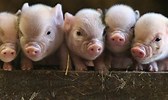
We boys helped Dad notch the pig’s ears. He had a system, and I remember that the right ear notch marked which litter the pig came from. The left ear notches designated the pig’s number in that litter. Notching pig’s ears was easy work and quite enjoyable. There are few animals cuter than a baby pig, with its soft bristles and pink nose. They have a delightful squeal.

Phillip, Bob, and I would catch the piglets, hand them to Dad, and he would put the notches in. Then Dad would hand the pig back, and the process continued until all the young stock had their markings.

When pigs were put out to pasture, they tended to rut. They would tear up the sod, seeking grubs or minerals. It was their natural instinct to root up the earth. They would root under a fence and escape from the pasture. I witnessed an area in the hog pasture where the pigs were rooting and it looked like artillery landed there. We had to “ring the pigs.”

My first job in “ringing the pigs” was to place the wire rings into the special pliers used to hold the nose rings. The ring was C-shaped, with two sharp bends. Phillip would catch a pig and hold it. Dad would put a ring in its nose and hand the pliers to me. I put the ring into the notches of the pliers, and Dad put another ring in the pig’s nose. Usually two rings per pig.

When you’re eight years old, you do a lot of foolish things. I did the dumbest thing ever while “ringing pigs.” I was alone in the hog barn waiting for Dad to return from the garage. Phillip and Bob were gone, so I had nothing to do until Dad returned.

I placed one of those rings in the pliers and brought it up to my nose. I squeezed the pliers together just a little bit, to see how it would feel to a pig. Only I didn’t intend to put the ring in my nose. I only wanted to squeeze a little bit and then stop.

Well, I didn’t stop squeezing the pliers soon enough, and I ended up with a ring clinging to my nose, just a bit, but enough for me to bleed and scream a lot.

Just then Dad entered the hog pens through the sliding door, and saw me with a ring in my nose, bleeding and crying. He started to laugh but held it back. He grabbed a wire cutter and cut the copper nose ring into two pieces. Thankfully, the ring fell from my nose.

Dad told me to go to the house to get a bandage, which didn’t help because the bleeding came from inside my nose. I wasn’t really hurting, but I was embarrassed beyond belief. What I feared most was that Dad would tell Mom, which he probably did. But more important, I didn’t want him to tell my brothers and sisters. That would have hurt more than the physical pain.


Posted in Uncategorized | Leave a comment

How much do milk cans weigh?

Those milk cans are 10 gallons. Water weighs a tad over 8 pounds a gallon, 8.35 pounds per gallon to be more exact.

Because milk is mostly water, a gallon of milk weighs about the same as a gallon of water. There are 2 pints in a quart and there are 4 quarts in a gallon. So that makes 8 pints in a gallon. Now a gallon of water weighs 8 pounds and there are 8 pints in a gallon, so that makes a pint of water or a pint of milk weigh one pound.

There is a memory device that can be useful: “a pint is a pound the world around”.

Ten gallons of milk inside the milk can at 8 pounds per gallon puts us at 80 pounds. The can itself weighs about 8 pounds. To answer the question, those 10-gallon milk cans weigh about 88 pounds. Little wonder that those old-time farmers had back problems!

Ten-gallon milk cans were standard on farms for decades, until bulk tanks and pipeline milking machines came along.  There was a milk plant or creamery within reach of most every farmer so he could take his 10-gallon milk cans there twice a day. Before rural electrification, most farmers did not have a means of cooling milk cans. The Amish still use the 10 gallon can.

There were two handles on the side with a compression lid.  Some lids were umbrella flat tops drooping down over around the edges. Others had plug covers, with a depression handle. Cans were 25 inches tall and 13 inches in diameter.  Antique stores sell them and they fetch an outrageous price on eBay and Amazon.com.

When I was a little tyke on that hill farm on Oak Grove Ridge in the middle of Crawford County, my Dad bought milk cans from Montgomery Ward for $3.90, lid included.

You will see 10-gallon milk cans at Cracker Barrel Restaurant and Old Country Store. Also, the Machine Shed Restaurant chain places them around for display. Some people will have paintings done on the milk can. Others will use the milk can as a stand for flower pots.


Posted in Uncategorized | Leave a comment

Raising Pigs on the Oak Grove Farm

The Scheckels were considered diversified farmers because our income came from our wide variety of animals: milking cows, chickens, beef cattle, and hogs. Hogs were an important source of revenue for us. We raised over 150 hogs a year. My brothers and I had a lot of fun tending the hogs, especially when they were first born, during “farrowing.” Piglets are so soft and vulnerable, with their little pink nose and wiggly tail.

Farrowing is the process in which a sow gives birth to baby pigs. Farrowing was a time of concern for Dad and Mom. Each sow had her own pen. Some sows would have a litter of six or seven piglets, but many would have ten or 12. The number was announced at the breakfast or supper table. There was constant worry that momma sow would lie on her babies and crush them. The pen was designed to prevent that from happening, but it didn’t always work.

Often, a piglet did not get a “spigot,” or a mother’s teat. Perhaps the piglet got pushed aside by the other pigs. Mom or Dad would wrap the piglet in a towel, put it in a box, and bring it in the house and place the box by the furnace register. At other times, the baby pig stayed in the warm basement.

All the kids would gather around the box with straw in the bottom and a sickly newborn pig. We would touch the pig and feel its soft nose and carefully examine the eyes and eyelashes.

Mom got some warm milk and a spoon and held the mouth open and poured warm milk into the pig’s mouth. The piglet might stay in the house for a day or two, and then be returned to its mother.


Posted in Uncategorized | Leave a comment

Why are manhole covers round?

The subject took on a life of its own when Microsoft began asking this question in job interviews. The inquiry was meant to test the prospective employee’s psychological make-up, poise, and ability to think on one’s feet, rather than elicit a correct answer.

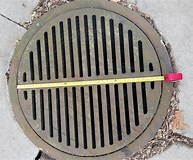
A round manhole cover can’t fall through its circular opening. On round manholes, there is a “lip” holding up the cover, which means that the underlying hole is smaller than the cover. A square, rectangular, or oval manhole cover could fall in if it is inserted diagonally in the hole.

There are other reasons. Manhole covers are round because manholes are round. Manhole tubes are round because that is the shape that is the strongest against the compression of earth around it, plus round is the shape that is the most efficient in materials used.

Even more reasons. Round castings are easy to machine compared to square or rectangular castings. Manhole covers are heavy, weighing in at over 50 pounds, and round manhole covers are easy to roll. Rolling is easier on the back than carrying.

Also, round manhole covers don’t have to be aligned in any special way when replaced by workman or if accidently dislodged by traffic.

Manhole covers around the Midwest, including here in Tomah, are made by the Neenah Foundry Company in Neenah, Wisconsin, over in the Fox River Valley. Neenah Foundry has been making manhole covers since 1872.

Manhole covers go back to the time of Christ. The Romans used square sewer grates made of lime sandstone. Triangular manhole covers are found in Bermuda and a few in New Hampshire and San Francisco.

Manhole covers are heavy enough so that cars can pass over them without any problem. But very low modern racing cars create enough vacuum to lift a manhole cover off the ground.

It is the classical Bernoulli Effect of a fast air flow creating a low pressure. The higher pressure beneath the cover is enough to lift it straight up. That scenario came true in Montreal in 1990 during the World Sportscar Championship Race. A Porsche lifted a manhole cover, which struck another Porsche behind it. The trailing Porsche caught on fire and the race had to stop.

Manhole cover theft is a serious problem in India and China. When night descends, scavengers will scour the streets for manhole covers, take them up, and sell them to scrap iron dealers.  Manhole cover theft in Tomah has not been a problem. It does require a special tool, a pick, to get them out.

Concerning questions asked by Microsoft management in job interviews. Here are a few more. How do you measure 4 gallons of water using only 3 and 5 gallon jugs?  How many gas stations are there in the United States? How many golf balls can fit in a school bus?


Posted in Uncategorized | Leave a comment