First Robin in Tomah 2021

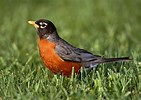
We saw our first robin on Thursday March 11, 2021. She was strutting around in the back yard, picking at the dead grass, and no doubt getting ready to build a nest. It is one of the first signs of Spring, along with more hours of daylight, winds coming out of the South, the ice on Lake Tomah getting grayer each day, and the buds on the maple trees swelling. We also noticed the return of the mourning doves.
An annual ritual at our house: Get the Spree (small motorcycle) running, pack a pruning cutter, and motor on Fairgrounds Road (Hwy CM) that runs on the south side of Lake Tomah to cut some pussy willows, bring them home and set them in a vase of water. The 6 sedum plants on the north side of the house are poking through.

I harken back to the days on the farm in the late ‘40s and early ‘50s. The long, long “V” formation of honking geese heading north into Canada was a good sign of Spring. The Scheckel farm was smack in the middle of the Mississippi River flyway.

The barn swallows would appear. They were graceful flyers. They started building their mud nests clinging to the rafters in the Small Barn. The meadowlarks were seen in the fields. And although they stayed around all winter, the cardinals started singing, which they did not do all winter. Well, I could understand why. Who feels like singing when you’re freezing your feathery fanny?
Posted in Uncategorized | Leave a comment

Country School Days 1946

Our newest book, Country School Days: True Tales of a Wisconsin One-Room School is being edited and we hope to publish by late Fall of this year, 2021.

The main focus is the one-room Oak Grove School that the Scheckel children attended. My tenure was from 1948-1956. To get info, I am viewing microfilms of The Courier-Press newspaper published in Prairie du Chien.

At that time, the goings-on of every community were sent in and printed in the Courier-Press; Steuben, Wauzeka, Seneca, Eastman, Mt. Sterling, Gays Mills, Steuben, Lynxville, Niland Ridge, Ducharme Ridge, to name a few. It was a litany of who visited who, what family went shopping, who came back from serving in the military, and babies brought back from the hospital.

Looking at the Seneca entry from March 19, 1946. “The wood chopping bee sponsored by members of St. Patrick’s parish on the Dave Boland Jr. farm last Thursday, proved to be a successful undertaking: 40 men took part in the work and many cords of wood were the result. Eleven ladies served an abundant lunch of hotdog sandwiches, cheese, and piping hot coffee.”

We could see the Dave Boland farm from our Scheckel farm. Unusual in that they had all white buildings and sat on a high point in Crawford County. In the summer, the Sun rose over the tops of the Dave Boland farmstead on the northeastern horizon.

Life is filled with triumphs and tragedies, and we all experience both. From a February 24, 1946 Seneca column, “A pre-nuptial show was held, in the gym Sunday afternoon in honor of Maxine Monahan of Soldiers Grove and Ed Cody Jr. A pleasant afternoon was enjoyed by friends and neighbors and many useful gifts were received by the bride to be.”

Another entry from the March 16, 1946 Courier-Press, “Mr. and Mrs. Ed Cody Jr. returned from their wedding trip last Wednesday. They will operate the Cody farm.”

From an entry a few years later, “Mary Delores Cody was born on March 6, 1947 at Saint Ann’s Hospital in La Crosse, WI. She was the first-born child of Edward Henry and Maxine Marie Monahan Cody. In September of 1953, she enrolled in First Grade at Stoney Point School, near Seneca, WI and was a member of the first-grade catechism class of St. Patrick’s parish. On Friday, Nov. 13, 1953 at about 3:15 p.m. she ran in front of the farm truck her father was driving and was struck by the rear dual wheels. Delores loved people and she will always be remembered for her vivacious friendliness.”

Another entry, “Richard Homuth has bought the lot from M.B. Dagnon where the Neil Tollefson Hotel was located and will build a house there when possible.” Dick Homuth was the very successful and well-liked agriculture teacher at Seneca High School.

Posted in Uncategorized | Leave a comment

Why do birds sing? 

It won’t be long before the first robins show up. Those are the dumb ones. The smart robins stay down in Missouri an extra few weeks. The overriding reason birds sing at dawn is to stake out their territory. They are saying “I made it through the night, and I’m still here”. At dawn, the air is generally calmer and there are fewer distracting sounds. Sound carries better in the cool, dense, still air. It has been shown that a bird song in the wee morning hours is 20 times more effective than the same song at noon. One hour before sunrise is prime time for bird singing.

Bird chorus is most prominent at dawn. The singing starts at different times for different species of birds. We’ve all heard robins sing at three o’clock or four o’clock in the morning. Biologists believe that the robin knows that it has a better chance of being heard when there is little competition around. Nightingales and wrens follow the same pattern.

Bird singing is louder and more frequent in the mating season. Birds are attempting to attract a mate. Females tend to lay eggs in the morning. It stands to reason that males will try to attract mates just before egg laying.

An additional school of thought supposes that the low light level in the predawn hours is a bad time for foraging for food, so perhaps it’s a good time to sing. Most bird singing in the awakening hours is done by males. That does not hold true for robins. Female robins can belt out a tune with the best of the males. It is the same for many female owls.

As the breeding season comes to a close, morning singing dies off a bit. Much time is needed for housekeeping, so there is less time for singing. Some birds prefer to warble away at dusk, rather than dawn. The sparrows are very vocal in the early evening hours.

We humans learn to talk by listening to other humans talk. It is nearly impossible for someone born deaf to know what most sounds should sound like. It is somewhat different for birds. Young birds do develop singing from birth, but they refine their songs by listening to adult birds. Birds have a special sound-producing organ called a syrinx. It is equivalent to the human voice box. Air from the bird’s lungs passes over the membranes in the syrinx. The membranes vibrate and produce the sound.

A few birds sing when flying. But they are in the minority. While most of us can walk and chew gum at the same time, birds have to alight to sing. The starling is an amazing character. Starlings will mimic sounds they have heard, including car horns, police sirens, and telephone rings. They will work pieces of those songs into their singing.

A bird joke: What do you get when you run over a robin with your lawnmower? Shredded Tweet


Posted in Uncategorized | Leave a comment

A Passage from Seneca Seasons

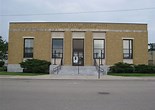
Another favorite outing was to the post office in Prairie du Chien. Each of us Scheckel kids had a piggy bank. Mine was a metal Malta Dextrose can that was originally a baby food can with a slit on top to drop in the coins. The Malta Dextrose can was fitted with a key attached to the side. We frequently would take our piggy bank out and count the money. Twice a year Dad would take us boys with our piggy banks to make a deposit.

Out of the car we would tumble and climb the many steps to the post office. Postal savings paid 2 percent interest. Each of us had a little booklet with a record of deposits and withdrawals. Of course, the only column we filled was the one for deposits. No need to withdraw any money. Our folks would not allow us to take money out. The whole idea was to establish a habit of savings.

Inside the impressive stone post office building we would troop. One by one, Phillip, Bob and I would take our little piggy bank to the teller who was standing behind steel bars. We handed him our bank and booklet. He would take the money and count it out. He then recorded the amount in the booklet and returned the Malta Dextrose can and booklet. I remember one time my savings for the year was $3.39.

But the biggest adventure at the post office was not depositing our money with the federal government. We wanted to look at the pictures of the criminals wanted for various crimes. Wanted posters were stapled on cork boards all along one wall. We were especially thrilled by the big headline on the top of one poster: “Wanted for Murder.” The poster would display his picture, as well as statistics about birth date, age, crimes committed, method of operation, and reward.

These hombres were really bad dudes. They looked mean and rough, as though they would rather shoot you dead as look at you. No one smiled in these pictures. We tried to find the baddest guy there. They all had a number they were holding with five or six digits. All had a front photo and side photo.

Phillip commented, “Here’s one wanted for three murders.”

“Murder, extortion, kidnapping,” I added. “What is extortion?” I asked Dad.

“It’s when a person takes money that doesn’t belong to him.”

That sounded like robbery to me, but I didn’t pursue the subject any further. <Insert Sketch 19 Wanted posters>

Visiting the Post Office Prairie du Chien, WI was an adventure. The wanted posters held our attention.


Bob found one person wanted for murder, weapons violations, interstate something or other, and the man had been in three different prisons and escaped once or twice.

“Dad,” Bob asked, “why didn’t they keep ’em when they had ’em the first time?”

Dad had no answer for that question.

We would have kept searching those wanted posters for hours if we were allowed. But Dad had us move on. No need for the Scheckel boys to be gawkers, you understand.

Posted in Uncategorized | Leave a comment

Which came first, chicken or egg?

Every generation has argued this question. It is an ancient dilemma going back to the time of Aristotle (350 BC) and Plutarch (100 AD). Aristotle took the easy way out, concluding that both the chicken and the egg must have always existed. Aristotle, like Plato, believed that everything on Earth first had its being in spirit.

In science and engineering, the situation is known as circular reference, in which  a parameter must be known to calculate the parameter itself. In other words, one must know something to calculate that same something. This concept shows up in the Colebrook Equation that is used to calculate fluid flow in a pipe. It also comes into play in the Van der Waals Equation used to determine forces between particles in fluids.

The chicken and egg idea calls to mind the question of how life and the universe began. It often leads to the pointlessness of identifying the first cause. The question can be stated as “Which came first, X that can’t come without Y, or Y that can’t come without X?”

Stephen Hawking, the famous astrophysicist, often called the successor to Albert Einstein, has argued that the egg came before the chicken. A literal interpretation of the Bible would put the chicken before the egg. To quote Genesis; “And God blessed them, saying, be fruitful, and multiply, and fill the water in the seas, and let fowl multiply in the earth”.

In Hinduism and Buddhism, there is a belief in the wheel of time, that there is no first in eternity.  Time is cyclical. There is no creation, so neither the egg nor the chicken came first.

Here is another argument. Chickens came about from non-chickens through small changes, or mutations, in the DNA. Prior to the first true chicken, there were non-chickens. The DNA changes came about in cells housed in the egg. So the egg came first.

In July 2010, British scientists, using a supercomputer (HECToR), claimed to have come up with the final and definitive answer. They identified the protein, ovocledidin-17, that is required to speed up the production of eggshell within the chicken. In 24 hours, an egg is ready to be laid. An egg cannot be produced without the chicken. So that settles it, once and for all. The chicken came first.

That’s my answer and I’m sticking to it !


Posted in Uncategorized | Leave a comment

Going to Town continued

When we were little tykes, Mom cut our hair with a hand-operated hair clipper. Later we went to Seneca and Mt. Sterling for haircuts. Tommy Johnson was the regular barber in Mt. Sterling, and he also cut hair two days a week in Seneca. Haircuts were 50 cents. Tommy was getting up into his eighties and about to retire.

Bernard Hanson cut hair in Rising Sun, a tiny barber shop next to Bill and Cecilia Crowley’s tavern. Dad got his hair cut first, then would go talk politics and farming with Bill Crowley and the locals. Phillip, Bob, and I got our haircuts in turn and then would go over to Crowley’s one by one. It was a swell arrangement. Hanson raised his prices from 50 cents a haircut to 75 cents a trim. Dad thought that was terrible: a 50 percent increase in his prices.

Once the shopping was done in Seneca, Dad went into Sullivan’s Bar and had a tap beer. He would normally leave us boys in the car to finish our ice cream cone. I think the longest we ever waited is 15 minutes. If it was longer, Dad would come out to the car and had us to come in and sit at one of the stools. They were fun because the tops spun around and you could sit there twist back and forth and twirl round and round. Dad bought us a soft drink in a glass. Sully opened one bottle of pop and poured it in three beer glasses and gave it to Phillip, Bob and me.

Sully’s had one of those Hamm’s beer light shades that shimmered. It had a canoe on a stream with the Hamm’s beer bear, “From the Land of Sky Blue Waters.” Sully also had an old black and white television set mounted close to the ceiling, up in the far corner.

Television was quite a novelty in those days. We didn’t have television on the Scheckel farm. Periodically, one of the Hamm’s beer commercials would run on TV. In one memorable 30-second commercial, a beaver gnawed a tree, just a log, no tree limbs, the tree fell over and the Hamm’s bear jumped aboard the log. The bear floated down the river on a log, with a big Hamm’s logo engraved in the side, and the bear did some fancy log rolling. A goose flew overhead and handed the bear a sign. The bear unfolded the sign and it read: “Hamms, the beer refreshing.” A female and male voice would then sing “From the Land of Sky Blue Waters” accompanied with beating drums.


Posted in Uncategorized | Leave a comment

What happens to your brain and your body when you are sleeping?

We spend about one-third of our lives sleeping. A lot of things are happening to us when we sleep. Body functions slow down. Heart rate is less. Breathing slows down. The amount of acid in the stomach decreases. The kidneys continue to filter waste, but at a lesser rate.

There are five stages of sleep. The first four are regarded as quiet phases. Blood flow to the brain is much less. Blood is diverted to the muscles. Our brain cycles through the stages in approximately 90-minute intervals. The last stage is REM (rapid eye movement).

During the REM stage, there is a high level of brain activity. The eyes move back and forth and up and down, as if we are trying to focus on something. During REM, parts of the brain we use for learning become very active. It is during the REM stage that we dream.

Signals are sent to the motor neurons in the spinal cord. The muscles in the arms and legs become non-active, much like being paralyzed, so that we don’t act on those dreams.

During REM, blood flow to the brain increases to areas we use for memory and emotional experiences.  Blood flow decreases to areas of the brain that are used for complex reasoning and language.

Sleep is a time for healing and for our body to do repairs. People who are don’t get enough sleep have difficulty thinking quickly, remembering details, and have trouble with math problems. Poor sleep patterns are linked to poor health and lower life expectancy. Sleep helps fight infectious diseases. There is evidence that lack of sleep reduces levels of white blood cells. White blood cells help fight infection.

When we are sleeping, a cancer killing protein molecule TNF (tumor necrosis factor) is pumped through our blood stream. If a person is sleep-deprived, those levels are down considerably.

When we are awake, the body used oxygen and food to provide energy. More energy is spent than conserved.  Energy is conserved during sleep, and repair and growth take over. Adrenaline levels drop, but the body produces the protein human growth hormone (HGH).  All the tissues and bones of the body are undergoing growth, maintenance, and repair.

We humans have a built-in body clock called the circadian rhythm. It causes 24 hour changes in many body activities, and governs the daily alternation between sleep and waking. It lets the body know when sleep is coming. The term circadian means “about a day”.

The circadian rhythm regulates all the processes of the body. A network of chemical messengers and nerves are controlled by the circadian clock. Getting regular periods of sleep at night helps the body clock regulate hormone production.

Body temperature falls during the night. By morning, body temperature is about two degrees Fahrenheit lower than in early evening. A person changes sleep position several dozen times during the night. But the muscles remain relaxed.

Sleep apnea is a disorder in which a person has abnormal pauses in breathing. These pauses can last from a few seconds to minutes. Sleep apnea is diagnosed with an overnight sleep test.

Sources:  www.sleepfoundation.org  and  http://www.howstuffwork.com


Posted in Uncategorized | Leave a comment

Going to Town continued 1949

Jule (Jewel) Lamore’s Mobil Station was at the south end of town. Jule was a quiet man who had club feet. That is what we called them. Mom said it happened at birth and there was nothing that could be done about it. He had to get special shoes made, and we kids stared at his feet, even though we were told not to.

When we were in high school, we had religious instruction every Monday night at St. Patrick’s Church. One early evening in 1958, Jewel Larmore’s wife, Gertude Mary, was struck and killed by one of our classmates. She was crossing the street, walking from their Mobil station, when she was struck by a pickup truck. Because it was nighttime and she was dressed in dark clothing, the driver didn’t see her. No blame was assessed, but she was missed by the community.

The town provided a valuable service for the farm that would be unusual these days. We did not have a freezer on the farm. We had a refrigerator and a small compartment inside was a freezer, but it couldn’t hold much. We used it mostly for making ice cubes. For that reason Dad and Mom rented two big bins at Jim Honzel’s locker plant. Located across from Johnson’s Grocery Store, it had a rounded concrete roof. From behind his counter, Honzel greeted people coming through the door. Patrons picked up the keys to their locker, opened a heavy wooden insulated door, and immediately stepped into sub-zero temperatures. Oh, how we loved visiting the locker plant, scurrying along behind Dad, shivering, while picking out the packaged meats, with the names of the cuts ink-stamped on the plain brown wrapping paper. Those frozen cuts of meat were harder than a baseball! We’d pick three or four packages and quickly depart.


Posted in Uncategorized | Leave a comment

How flowers get their color?

  Flowers are bright in color so they can attract bees, birds, and insects to help them reproduce. The bright colors and sweet pollen will coax the bees and birds to land on the plant. Some of the pollen will stick to their feet. When they land on another flower, some of that pollen will be deposited and pollination occurs.

Flowers have male parts, called stamens, that are loaded with pollen. Flowers also have female parts, called stigmas, that are receptive to pollen from another plant of the same kind or species.

Flowers can’t move. They rely on creatures, mostly insects, to move their pollen for them. The flowers produce the sweet sugar nectar that attracts the bees. Fruit trees, as well as flowers, need pollination. Our local Tomah area cranberry growers rely on bees to pollinate the plants in the bogs.

Flowers produce pigments that are easy to make. The pigment anthocyanin  will give reds, pinks, blues, and purples. Carotenoid pigments yield yellows, reds, and oranges. Chlorophyll pigments furnish all the green in the foliage. The pigment instructions are carried in the genes of the plant. The exact color is associated with the pH or acidity of the pigment.

Color is also affected by temperature, climate, soil conditions, growing season, rainfall, winds, and plant nutrition.

The brightly colored flower petals are an advertisement to insects to come over for a visit. That’s what the flower has in mind. We humans soak in the color and simply enjoy the beauty. Flowers evoke feelings of warmth, love, and sympathy.

Some flowers are poisonous. Larkspur, or delphinium, can really upset the stomach if ingested, and can cause severe skin irritation. Larkspur is very bad for cattle.

Lily of the Valley laced the bouquet of Catherine Middleton when she married Prince William in April, 2011. All parts of the Lily of the Valley are poisonous. The red berries, to which children are attracted, are bad news if ingested. Severe abdominal cramps, vomiting, and slowed heart rate can result.

Horticulturist are working on altering flower color. A plant geneticist in Maryland has made a bright blue rose. He extracted a precise among of pigment from one plant and implanted it in another.

Obviously, he does not adhere to the doggerel poem “Roses are red, violets are blue….”


Posted in Uncategorized | Leave a comment

Going to Town-continued

Going To Town  continued 1949 From the book Seneca Seasons: A Farm Boy Remembers.

Dad bought a small sack of candy for us kids and a candy bar for Mom, which he took home for her. We carried the groceries out to the car. Dad turned the car around and parked it on the opposite side of the street. Then we went into Johnson’s Store.

Bob Johnson, a tall, affable man, bought the store in 1937, building a feed mill across the street a few years later. Johnson’s catered to farmers and their needs, and later he opened a grocery, hardware and feed mill combination and billed it as Johnson’s One Stop Shopping Service. The feeling was that “if they don’t have it, you don’t need it.”

Bob Johnson was quite a promoter. He was the dealer in the Seneca area for Doboy Feed, a company headquartered in New Richmond, Wisconsin. As part of his promotions he sponsored a country-western band and comedy group to come to the Seneca gym, and our whole family attended. Some of the jokes must have been a tad on the risqué side, as my mother commented on the way home, “There was no need for all the dirty talk.”

Dad filled up with gas at either of two filling stations, McCullicks Sinclair in the middle of town or Jule Lamore’s Mobil Station. Max McCullick, owner of the Sinclair station, was well liked by teenagers, and many teens hung out there. He had a one-car bay for servicing vehicles. We enjoyed watching cars being raised by a hydraulic lift. The serviceman could change oil and work on tires. Kids could buy soft drinks, candy and ice cream cones.

Dad didn’t buy gas for the farm, though. We had plenty of gas on the farm for the tractor. Turns out the gas used on farm was taxed differently than gas bought at a filling station. Any farmer might have to prove he bought gas for the car at a commercial gas station. So Dad kept all his receipts.


Posted in Uncategorized | Leave a comment