You Don’t Lay, You Don’t Stay

 “You don’t lay, you don’t stay” could well be the warning for a hen on the Scheckel farm in Crawford County outside of Seneca in the 1940s and 1950s. That normal stay was about 18 months.chicken

Baby chicks arrived by mail in March. The new chickens stayed in the brooding chicken coop all summer. After about five or six months, a few eggs appeared as young pullets were starting to become layers. We Scheckel boys always looked for those first small white eggs.

In October, the pullets were transferred from the white brooding house to the permanent red chicken coop. The chicken house or chicken coop was about 200 feet east of the house and slightly downhill.

First, who stays and who is sold? The hens lay eggs all winter, spring and summer, and then sold off as stewing hens in October. A few lucky hens won a reprieve from the cooking oil.  If the bird become tough and refuses to lay its normal one egg per day, it’s off to the stewing pot.

You feel the chicken’s behind. If it is soft and spongy, that hen is a producer and continues to lay eggs. If hard and tough feeling, that bird is not carrying it weight. To track the reprieved birds, we resorted to banding. A round, wooden or plastic colored band was put on one leg of the laying hen. The banded hen stays for another six months.

Secondly, the red hen house needed to be readied. Haul off any manure, scrape the roosting 2 X 4’s clean with a paint scraper, disinfect the walls and roosts with a dark brown smelly liquid, clean the metal feed troughs, put fresh straw in the laying bins, wash out the earthenware crock that held water, and wash the windows.

Transfer day meant catching all the pullets from the brooding house and carrying them by hand to the red hen house. This kidnapping took place after dark, when the chickens supposedly were to “bed” for the night. Mom and Dad would catch the birds quietly as possible. No need to arouse the colony and spread the alarm. Each of us kids would take 2 or 3 chickens by the legs and carry them from the white brooding house to the red chicken coop. I would guess we made about 10 trips each to haul the 500 birds to their new digs.


Posted in Uncategorized | Leave a comment

The Evelyn Hartley Case 

 We’re coming up on the 63rd anniversary of the Evelyn Hartley kidnapping. It was big, big news for the whole state, nation, and even worldwide. La Crosse had no television station at the time. There was no CNN, FOX News, MSNBC, or the 24 hour news cycle that we have today. But reporters from Chicago, New York, and Minneapolis descended upon LaCrosse.evelyn-hartley

            It was also big news for the Scheckel family growing up on the 238 acre farm a few miles northwest of Seneca in the middle of Crawford County.

Evelyn Hartley, a 15 year old Central High School sophomore, was babysitting a 20 month old baby, Janice, at the home of La Crosse State College professor Viggo Rasmusen on the evening of October 24, 1953.

The Rasmussen home was located in the 2400 block of Hoeschler Drive. The Rasmussen family, father Viggo, wife Madeline and older daughter, Rozalyn, were off to see the La Crosse State College Homecoming football game.

Evelyn was expected to call home at 8:30 PM to check in, but she never did. Her father, Richard, also a La Crosse State College professor, tried telephoning the Rasmussen home several times, but there was no answer.

He went to the Rasmussen house to check on his daughter. All the doors were locked, the lights and radio were on, and the baby Janice was asleep in her bed. There was no sign of Evelyn.

The furniture was thrown around, her schoolbooks were scattered, her broken eyeglasses and one of her shoes were on the living room floor. Her other shoe was found in the basement. All the house windows were locked except a basement window on the back side of the house. A stepladder was positioned at that window in the basement. A screen for that window was leaning against the outside of the house. Pry marks were found on several windows but not on the unlocked basement window.

Blood, later found to match Evelyn’s type A, was found inside the house near the basement window. Blood was discovered in several pools outside in the yard. Police indicated that the abductor(s) carried and dragged the young girl through the yard about two blocks to a waiting car on Coulee Drive. That is where police bloodhounds lost the trail.

Thousands of people joined in the search parties. Boy Scout groups fanned out across hills and valleys looking for anything suspicious. Cars were searched and given a “clearance” sticker. All students were given lie detector tests. No parents objected.

Dad brought home a few newspapers that had stories about the Hartley abduction. I read those with interest. We heard Dad and Mom talking about the case. How terrible the parents must feel was the sentiment of my folks. The police had asked the public to check under haystacks, around barns, wooded areas, and any newly dug up areas.

Dad, Phillip, Bob, and I got in the pickup and drove down to the Lynxville area. We searched under the railroad bridges around Cold Springs. We walked up a good part of Kettle Creek, ending only when nightfall was coming on.

My brother Phillip was 13 years old at the time, I was 12, and brother Bob was almost 11. We boys thought it was something we had to do, something we should do. Acting in the public interest, doing important work, even felt like we were doing police work. As we walked along, we discussed what we would do if we encountered this bad man holding a young girl.  We had weapons, short pieces of wood to use as a club. We were prepared!

Over the years, dozens of people confessed to the crime. There were many stories, theories, and sightings. She was an ordinary girl in an ordinary home and someone came in and kidnapped her. She was never seen again.


Posted in Uncategorized | Leave a comment

Shocking Corn

Shocking corn was high on the list of least liked job on the farm for the Scheckel boys on the Oak Grove Ridge farm outside of Seneca in the heart of Crawford County. Dad bought a new McCormick Deering corn binder and kept it in the west wing of the granary.
corn-shocks-2

That McCormick Deering corn binder was a marvelous machine. Ground driven by a big “bull” wheel, it had two of those large prongs that guide the corn stalk into the cutter. When a sufficient number of corn stalks were cut and gathered in the mechanism, the knotter was activated, the sisal twine cut, and the corn bundle would fall over onto a horizontal elevator. When Dad saw that 3 or 4 bundles were lying on the attachment sled, he activated the chain driven device that moved the bundles onto the ground.

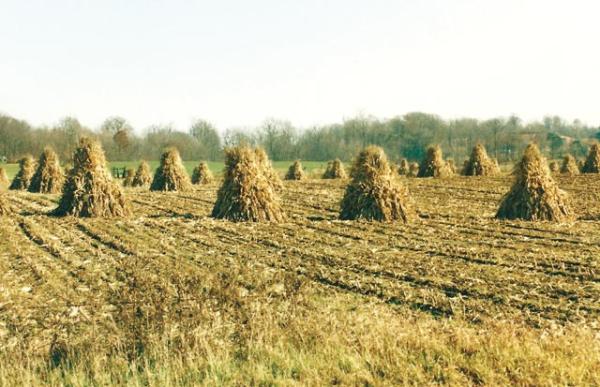
            We had a wooden tripod device, called a shocking horse, made of 2 X 4 lumber. It looked like half a sawhorse, where the top 2 X 4 of the saw horse is about 12 feet long and setting on the ground.  To start each shock, the 12 inch diameter bundles were set upright on both sides of the long tailed 2 X 4 in teepee fashion. The shock was built up with bundles placed around the perimeter in a balanced fashion so as to not push other bundles over. Not too much on one side or the other and not too many on the other. About 15 or 20 bundles made up a shock.

Dad used a Kelly tier’s head mechanism for tying the shock. Dad would hold a rope, with that Kelly metal movable dog mechanism on the end, in his right hand, draped the other end of the rope in his left hand, swung it around and around over his head in lasso fashion, releasing it at just the right time, so that the weighted end of the rope went all the way around the corn shock.

The loose end of the rope was passed through the dog mechanism and the rope pulled tight. The dog mechanism held the rope taut, while binder twine was placed around the shock and tied. After we tied twine around the shock the rope was released.

Shocking corn was no fun, let me tell you. The bundles were heavy for a little kid. Shocking corn early in the morning was best. Corn leaves, or blades were sharp, and would tend to cut our arms and neck and face. The dew seemed take the edge off the sharp blades.

Shocking corn was hard work. But I must admit, seeing a field of row after row of corn shocks is a neat experience.


Posted in Uncategorized | Leave a comment

The Fall Colors

Fall is here. Some say Fall officially starts on September 21, the autumnal equinox. But we all know Fall starts “right after Labor Day.”  Cooler mornings with frost warnings and dark about 7 0’clock.

Remembering back to the farm outside of Seneca in Crawford County in the late 1940s and thru the 1950s. We could see changes coming on as the Scheckel kids walked to the one-room Oak Grove School, about a mile to the north and a tad west. milkweeds

The huge maple tree by our driveway maintained some John Deere green leaves, but you could notice some faded Oliver green. The photosynthesis process was being shut down by the shorter days and cooler temps, and the chlorophyll was being overwhelmed by hidden pigments of anthocyanins and carotene.

The leaves on the big oak tree near our North Field was turning all shades of colors. There was your basic Minneapolis Moline prairie gold, some Farmall reds, Case yellows, and Allis Chalmers Persian golds. We Scheckel boys, Phillip, Bob, and I simply called it Allis Chalmers orange.

The sumac right before the Bernier farm was turning Massey Harris red, sort of a milder, lighter shade of red compared to your darker Farmall red.

The Queen Anne’s Lace along the side of the road maintained its David Brown white, perhaps shading a bit to the 9N Ford gray. We saw that same gray on the lichens growing on the north side of some trees around the farm house. The milkweed pods turned Ford gray, or perhaps Ferguson gray, after splitting open and releasing that fluffy stuff to which the seeds were attached.

We learned about milkweeds in the Ranger Mac Wisconsin School of the Air program on the radio at Oak Grove school. The seeds are carried on the wind, settle in new places, and send up new milkweed plants. A miniature forest of milkweeds grew along the fence row just pass the Bob and Tom Ingham farm. The New Holland blue chicory that grew along the side of the road was diminishing. Yes, Fall is here.


Posted in Uncategorized | Leave a comment

Softball at Oak Grove School

Softball was big at Oak Grove, the one-room country school 2 miles northwest of Seneca in the middle of Crawford County, Wisconsin. I started first grade on September 6, 1948. Two 8th grade boys chose sides. Who got to make the first selection was determined by the bat toss. One boy tossed the bat vertically to the other boy. The bat was caught with one hand by the second boy. Hand over hand on the bat until the boy whose hand was at the top end of the bat got first choice.sk-40-softball-batter

The “better” athletes and usually older boys and girls got picked first down to about third grade. One team took the field, the other team batting. No umpire. “Safe” or “out” calls might be argued, but settled quickly.

The wood shed was the backstop. The playing play was not level, rather tilted. Ran down hill to first base and uphill from second to third. If you overran first base, you went over the bank and tumbled into the gravel road going down into Kettle Hollow.

If some kids had not arrived at school, with only seven or eight kids available, we played workup. Two or three batters kept batting until an out was made. That person moved out to play left field. Every player moved up one space. Left field to center field, center field to right field, right fielder to third base, pitcher became the new hitter, etc.

What about only 4 or 5 players? Well, that’s called 500. A batter at home plate tosses the softball into the air and hits the ball to fielders who try to catch it. A caught fly ball is worth 100 points, a one-bouncer is 75 points, a 2 bounce ball is worth 50 points, and anything else is a grounder with a value of 25 points. Whoever gets to 500 points is now the batter.

We played softball in the rain, with snow on the ground, and when the field was muddy. If conditions were really bad, we played Annie Over. Half the school kids on one side of the school, the other half on the opposite side.

Someone threw the ball over the school roof, caught on the other side, a designated person hiding the ball behind his/her back, someone yells “Annie Over”. Kids run around the school to the opposite side, some going one way, some the other. The person with the ball tries to tag a member of the opposite team. If successful, they become part of your team. Play continues until all the kids are on one team.

Posted in Uncategorized | Leave a comment

Fall Is Coming On

Falling is coming on. You can feel it the air, cooler mornings, gets dark earlier, sumac is turning red, some trees have leaves turning color, especially if they have been stressed.

Remembering back on the farm outside of Seneca in Crawford County in the late 1940s and thru the 1950s. The haying season was finishing by this time of year. If we got a lot of rain, we would get a third crop off some fields. Threshing was done and the oats was in the granary, along with a bin of wheat for the chickens. The corn ears were fleshing out, the silk turning from a yellowish white to a brown color. The walnuts were starting to fall from the trees over on the hill pasture.

When I was a kid on the farm, school started around September 4 or 5, depending on Labor Day. We got a few new clothes before school began. There were always about 3 to 5 Scheckel kids heading one mile northwest on the gravel road to the one-room Oak Grove School.

We each had a lunch paid, sometimes a new one, sometimes one left over from last year, or a hand-me-down from an older sibling heading off in the other direction to High School in Seneca.

We carried a Big Chief tablet, usually red, and new box of crayons, and a couple of pencils. On the way we would join the Kozelka kids.

An apple tree was just off the road over in the Ingham pasture. Holstein cows grazed in that wooded pasture and so did a big Holstein bull. That didn’t stop us from crawling under the fence and fetching a few apples to gnaw on or to throw at each other.

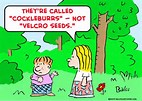
CockleburrsCockleburrs grew along the roadside as did goldenrods, honey suckle, plantain, nettle, ragweed and a bunch we couldn’t identify. Loved those cockleburs. Pull a bunch, wad them up, and toss them as somebody with a wool sweater. Cockleburrs were a forerunner of Velcro, you understand.

            The grass and weeds around the school house had grown tall over the summer. Floyd Sutton mowed a few days before school started. The base paths on the softball diamond were barely discernible. The school grounds looked like a hay field, and would remain that way until 28 pairs of feet tramped over the half acre plot. Melvin Sales had filled the cistern with fresh drinking water, brought over from his farm in a cow tank on a trailer pulled by the 9N Ford tractor. He would do a refill about every 3 months during the school year.

            Teacher rang the school bell at 9 o’clock and everyone dutifully filed in. Seats were assigned. Teacher gave a little benign talk about how the school year was going to run smoothly, talked about duties, emphasizing responsibilities and how everyone was to “get along” with everybody.

We all stoop next to our desk, hand over heart, faced the corner where the 48-star flag hung at an angle right below the portraits of Washington and Lincoln, and recited the Pledge of Allegiance. The school year began.


Posted in Uncategorized | Leave a comment

Going To the Fair

The Crawford County Fair at Gays Mills is winding down today (Sunday). Phillip, Bob, and I, the three Scheckel boys growing up on the farm outside of Seneca in the 1940s and 1950s, always looked forward to the Fair. We usually went on Sunday afternoon.

The most memorable fairs occurred when we reached about the age of 10 or 11.  Dad gave each of us boys 75 cents, and said “Be at the car at 3 o’clock.” Dad made sure we knew where the car was parked. It was a valuable lesson that I never forgot. When you’re in a large parking area, note a marking, a pole, sign, or directions that will get you back to the car.

We were off on our own. And that felt pretty good, knowing that Dad and Mom knew we would take care of ourselves. They were giving us autonomy and authority to run a bit of our own life and to make choices on our own.

Having 75 cents in your pocket in 1954 would be like having $5 to $7 in today’s money and purchasing power. A ride on the Ferris Wheel was 10 cents. Three rides for a quarter. An ice cream cone was about 15 cents.

We walked down the midway, the line of “barkers” and booths. These are the ones that want to separate money from farm kids. I was fascinated by the games of skill and chance. Knock over 2 out of 3 pins with a thrown baseball, and win huge stuffed animals.

The rifle shoot was intriguing. Rows of ducks moved on a conveyer belt, and it you hit a duck, he fell over. The more ducks you hit, the bigger the prize. Our older brother Ed warned us about crooked sights on those rifles.

If you broke balloons with tossed darts, you won a prize. I noticed that balloons didn’t break unless they were squarely hit. Many darts struck balloons near the edge and pushed the balloon out of the way instead of breaking it. Our Mom didn’t raise fools.

Ring the Bell with a large mallet. I watched a big farm boy, sleeves rolled up, and a pack of cigarettes held by the rolled up sleeve. He took that big wooden mallet, brought it down hard on the target and a metal puck went up a fancy pole, on its way to hitting a gong up about 20 feet. He did it on the fourth try, but he needed to buy 3 more tickets. He walked away with a small doll, not the huge stuffed teddy bear he was trying to win for his girlfriend.

There was the basketball toss. The hoop seemed smaller than it should be. A high school jock was trying to win a stuffed animal for his girlfriend. He must have lost ten dollars before giving up.

Ring toss, like an embroidery ring, had to go over a kewpkie doll mounted on a wooden base. But there was a catch; the ring had to go over the entire base, and it looked like it could barely fit.

Guess your weight within 5 pound, and your birth month to within 2 or 3 month, I forgot which. You had a choice. Phillip said that heard that you should ask the person to guess your birth month. People who did the birth month could lie about which month they were born in, so they would win. We figured that even if you won, the prize you got was less than the cost to play, so the carnival guy won every time.

I always tried to figure out which carnival game would be easiest to win at. Phillip, Bob, and I would watch all the games, but were very reluctant to spend any money. The “Ring a Bottle” game looked easy. Got 10 rings for 25 cents, and you had to throw one over the neck of a large bottle. Phillip tossed all 10, all ten bounced off, none went over a bottle. A good quarter lost. We watched other guys purchase 10 rings, toss 10 rings, watch 10 rings bounce off the bottles and collect on the wooden platform.

We wandered through the cattle and horse barns, saw the sheep, swine, and poultry, and toured the 4-H exhibit building. We climbed up on the new tractors and farm machinery lined up along the road.

We rode the tilt-o-world but refuses to lock the bar that would turn you upside down. We bought ice cream cones, keeping track of the coins. I had 75 cents total, and needed to remind myself not to run out of money. I didn’t want to buy something that cost 15 cents, and only have 10 cents left to spend. I had done that one time and it wasn’t something I ever wanted to do again.

The crowds, music of the fairway, exhibits, vendors, the rides, all exciting stuff. Three o’clock came, we found Dad and the car, out to Highway 171, up to Mt. Sterling, thru Seneca, and home in time to do the evening chores.


Posted in Uncategorized | Leave a comment

Threshing Time on the Scheckel Farm

It is 1948 and the threshing crew is at the Scheckel farm, a couple miles northwest of Seneca, in the middle of Crawford County. Older brother Phillip is 7 years old, I am 6, and Bob is 5.

On toward 10 o’clock, the dew has been burned off by the blazing sun. Loads of bundles started arriving from the fields.  There were 6 or 7 wagons coming in, some pulled by a team of horsed, others towed behind a tractor. These were small tractors, typical for the time of the late 1940’s and 1950’s; Farmall H, Ford 8N, Allis Chalmers C., John Deere “Johnny Poppers.”Threshing crew

            A half dozen “rigs”, or wagons, could keep the hungry threshing machine busy. Shutting it down was wasted time, and time was everything. That machine kept going, only to be stopped between loads for a quick greasing of all the zerts and at lunch time, which was usually around 12:30 PM.

Frank Fradette opens the throttle of the big Minneapolis Moline, smoke belching out the 3 foot exhaust pipe atop the machine, wafting off into the clear blue Wisconsin sky. The thresher comes to life, the big claw teeth at the end of the grain bundle tray chute starting to move, as if it were gulping for bundles. The tray chain moves, all the belts and pulleys turning. This beast of a machine is arising from the dead and coming alive.

Joe Bernier, bib overalls, straw hat, red bandana, roll-your-own cigarette, has already driven his team of Percherons and wagon into position, just inches from the feed trough. The thresher is up to speed, and Fradette signals for the first bundles to start down the feeder.

Bundles are thrown in grain heads first, stalk end last, and lengthwise. There are feeder knives attached beneath the claws that cut the binder twine. Uncut twine is bad news, grain is not separated from the stalk, and it can clog the thresher. Twine can get wrapped around shaft bearing and needs to be cut out by hand with a jack knife.

Frank Fradette was paid by the bushel for threshing grain. A few cents a bushel was the rate. Threshed oats went up an elevator on the side of the big machine and the grains dumped in a receiver cup. This receiver was counterbalanced by a weight and when full, the bucket opened and dumped the grain into an auger that took it to a waiting wagon or pick-up. At the same time, the dumping buckle operated a geared counter that kept track of the number of bushels threshed. Two dumping trips of the bucket was one bushel of oats. The counter had 3 “windows” and operated like the counters used to keep track of the amount of electricity used.

The Scheckel boys are told to “stay out of the way”, but we do carry jars of ice-cubed water to the threshing crews. A steady stream of straw arcs across the azure sky, building a straw stack.


Posted in Uncategorized | Leave a comment

Threshing Time

            It was the most exciting day of the whole year, with the possible exception of Christmas Day.  Frank Fradette came up the road from the Bernier farm. pulling the threshing machine with a big orange Minneapolis Moline tractor, and turned into the Scheckel farm yard.

           Threshing machineIt was the middle of the 1940s, and as little kids, 4, 5 and 6 years old, Phillip, Bob, and I were to “stay out of the way.” It was the days of the threshing circuit on Oak Grove Ridge in the middle of Crawford County near Seneca and 12 to 15 farmers moved from farm to farm threshing oats.

The sole purpose of a thresher was to separate the golden kernels of oats from their stalks. The stalks where sent out a big pipe by a powerful blower and the stalks built a straw stack. The oats kernels were hauled to a granary for storage.

That threshing machine was a behemoth of a beast. Threshing machines of that era were about 30 feet long, 8 to 10 feet tall, and about 5 feet wide. No other machine on the farm was that big and when you’re a kid, everything is big!

The thresher went pass the big tree near the house, pass the chicken coop, through the gate that lead to the “sand dunes” field, the thresher placed about 400 feet southeast of the house.

Much activity, we watched from afar. Frank Fradette maneuvered the thresher to the spot designated by my Dad. The direction of the wind determined the orientation of the thresher. Crews did not want the wind blowing the straw, chaff, and debris back onto the thresher. Unhooked the tongue from the tractor. The wheels were dug in, and blocked. The thresher had to be leveled and staked down.  One man went around the machine carrying the grease gun, filling all the zerks. Several other fellows got all the belts out of the cavernous rear compartment where the straw is blown out the pipe.

Frank Fradette drove the big Minneapolis Moline around to face the thresher and the hammer mill belt went on. Seems like it took about a half hour  to get that big contraption ready.

Teams of horses, pulling wagons, arrived, grizzled sun-burned men with old straw hats, bib overalls, and cigarette clinched between chapped lips. Larsen had a Norwegian accent, hard to understand. The bachelor “Ingham boys” Jack, Bob, and Tom brought 2 teams of horses and wagons. Their grandfather, James Ingham, was born in Lancashire, England, came to the United States and settled in the Seneca area in the 1850s. A long row of Ingham graves are in the back left side of St. Patrick’s Cemetery. Dad directed them to the field to start loading the oats bundles.

Other men, horses, tractors, and wagons arrived at the Scheckel farm;  Bernier, Kozelka, Sutton, Sales, Mahan, Rosenbaum, Payne, Aspenson, MacAvery. An early start meant a farmer’s grain could all be threshed in one day.

Phillip, Bob, and I took jars of cold water to the farm men. Jack Ingham walked up. “Boys, it’s goin’ be a hot one today.”

Posted in Uncategorized | Leave a comment

The Summer Gardens

Summer was a busy time on the Scheckel 238-acre farm, in the heart of Crawford County, two miles northwest of Seneca 1940s and 1950s. Putting up loose hay (no bales) seemed to go on all summer, days of cutting and shocking oats and wheat, pulling weeds, fixing fences, threshing grain, cultivating corn, mowing lawn, as well as the daily chores of feeding the hogs and chickens, and milking cows morning and night.

Seared deep in my memory is the task of keeping to up with the garden. Or I should say, 3 big gardens. After Dad plowed and smoothed the ground with the walking plow pulled by Dolly, the gentle big, jet-black horse, the garden was Mom’s domain. She had 9 kids to feed.

Some of those gardens had rows of sweet corn coming up. But we didn’t always wait for the garden sweet corn to get ripe and ready. Phillip, Bob, and I went out into the cornfield and got some field corn for the dinner table.

There was a short “window of opportunity”, perhaps 2 weeks, when the DeKalb ears were tender enough to pass as sweet corn. The kernels didn’t taste quite as good as the real sweet corn, a bit on the chalky side. But it was OK until the authentic sweet corn was ready. Slap enough butter and salt on an ear, and it came up to about 80 percent of the legitimate stuff, I would judge.

The peas were ready. Pick ‘em off the vines and into a “paint can converted into a pea bucket”. Then sit under the maple tree, the one with the rope swing, and shuck the peas. Phillip, Bob, and I, later joined by younger sisters Catharine, Rita, and Diane, were condemned, or I should say, assigned this task until we reached “working in the field” age.

I do believe there were times when more peas went “down the tubes” than ended up in the shucked peas’ bowl. Of course, this was followed by one of the sisters yelling “Ma, Lawrence is eating all the peas”, which was a big lie, because it was only about half of them!

Then there were the strawberries. Tons of them it seemed. Pick the berries from the garden, sit under the trees and remove the tops or hulls. I was more reasonable on the strawberries, I believe. Only ate about one in four or five.

We kept an eye on the carrots. As soon as they displayed any size, they uprooted from the ground and taken to the windmill so the fresh cold water coming up from the deep well could wash off the dirt.

Rhubarb came up every year behind the garage. It did not require any attention, which my kind of garden plant. The celery-like stalks were crisp and had a strong, tart taste. The neighboring Kozelka kids claimed they put sugar on their rhubarb. Not the Scheckel boys, as we preferred to dip the stalk in salt.

We learned by experience not to overindulge in the partaking of the rhubarb. Rhubarb has some strong natural laxative properties. It will keep you on the run, if you get my drift.


Posted in Uncategorized | Leave a comment