Gathering Walnuts

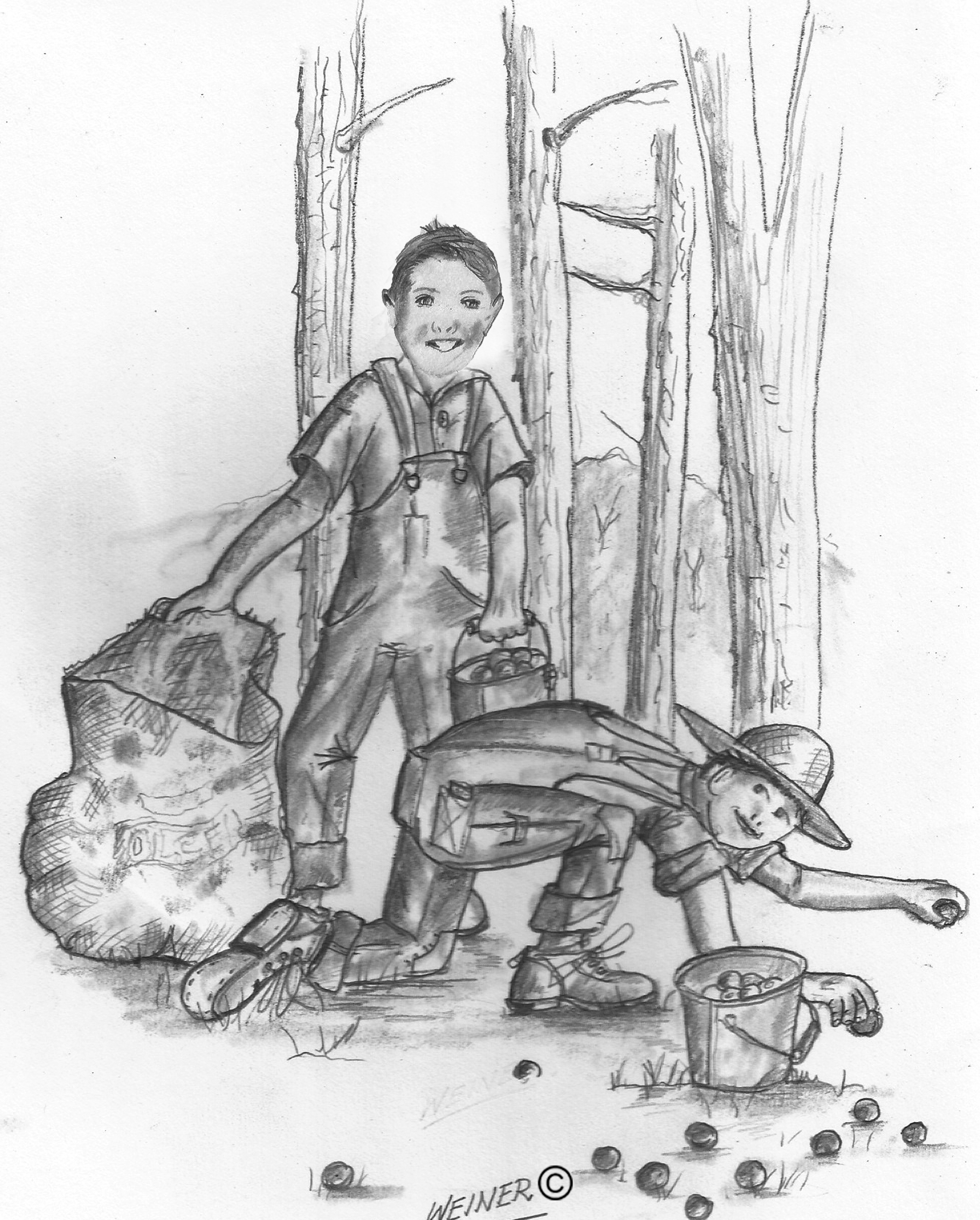
The Scheckel farm on Oak Grove Ridge near Seneca in Crawford County had 10 walnut trees in the hill pasture along ShortCut Road. We always looked forward to the annual gathering of walnuts.

As fall approached, we kept track of the walnuts falling off the trees.  We traveled past the walnut trees several times a week on our way to Seneca.  When it was time, we gathered up milk pails and gunny sacks from the granary, the burlap bags we used for corn and oats.  Off we would go to the hill pasture.
Our hill pasture was special.  We drove our milk cows on the gravel road and pastured them during the day in spring, summer and fall. The hill pasture was just a few feet less than the highest point in Crawford County.  A few years after I left the farm, several agencies, including the Wisconsin State Patrol, built a relay tower on the highest point, which was just a few hundred yards from our property line.

Looking north from our vantage point on the hill pasture, we could see the steeple of Utica Church on Highway 27 north of Mt. Sterling.  The top of the Lansing bridge could be spotted above the terrain to the northwest.   We could see all the way back onto Oak Grove Ridge, the farmlands of Bernier,  Ingham, Suttons, and Fradette. The Payne, McAreavy, and Aspenson farms were fairly close. Further to the east was the Elmer Stove farmstead with its immaculate white buildings and white board fences. They kept their bright red Massey Harris ’44 tractor in spic and span condition.

Phillip, Bob, and I would pick up a bucket full of walnuts, pour them in a gunny sack, and tie off the gunny sack with binder twine. We’d walk home and ask Dad to take the tractor and wagon or the pickup truck to load up the gunny sacks and bring them back to the farm.            When we were old enough to drive, we boys could retrieve them ourselves.  Age did not determine when we could drive a truck or car.  If your feet reached the pedals, you could drive.  Dad and Mom didn’t allow us to drive to town, but we could drive on Oak Grove Ridge Road and on the roads around our farm.  “Fearless Fred” Brockway, Crawford County deputy sheriff,  would not be patrolling on Oak Grove Ridge.

The walnut sacks were unloaded on the cement apron east of the Big Barn.  The walnuts might stay in the sacks for several days until we had time to tend to them.  Then the shucking began.  Walnuts were poured out of the sacks onto the concrete, and beaten with a board, that loosened the shell or peeling around the black/brown walnut. Walnuts were picked off of the broken casings and put in a pail or bucket.  Our hands got really badly stained, almost pitch black.  That stain would not come off in soap and water, so we wore our walnut stained hands for several days as sort of badge of honor. Even went to school with stained hands.

The shucked walnuts were stored in metal tins in the basement.  We cracked walnuts in the wintertime, and put them in fudge candy that we made on the stove. Some went into brownies and cakes.


Posted in Uncategorized | Leave a comment

Threshing Grain Part 5

We continue our story of threshing oats in the mid-1940s on the Scheckel farm near Seneca in the middle of Crawford County, Wisconsin. It is the era of the threshing ring, when farmers banded together to thresh grain, moving from farm to farm over a 2-week season.

Those threshing crews was an opportunity that some neighbors had to visit you and your family at your place. Other times would be the Oak Grove School basket social in the fall, the Christmas program, and the picnic at the end of the year. There would be an occasional wake or funeral.  And farmers learned from each other, gathered information on new crop varieties coming out, cost of new machinery, how to solve a problem with the binder or hay loader. That comradeship and the social aspects were important to farmers in the first half of the twentieth century. It bound them together.

The host farmer was expected to make dinner for the threshing crew. And let me tell you, those farm men could eat! It was impossible task for one woman, so it was expected that several farm women showed up to help.

All the meal preparation was done on wood burning stoves. A few farm families had kerosene ovens. There were no electric stoves or microwave ovens at that time. We’re talking wood burning stoves, indoors, with no air conditioning, and few fans.

Like the men in the field, the women worked as a team. Pies and cakes were prepared ahead of time by the host housewife. Neighbor wives brought food.  Women arrived early, just like the men. A few came by car. Some got there with their husbands, who drove the wagon pulled by horses or tractor. It was a chance for housewives to swap stories, exchange gossip, commiserate, and socialize.  Farm kitchens were a bee hive of activity.

Those threshing dinners were feasts!  There might be as many as 20 or 30 men to feed. Usually the food was laid out on tables in the front yard, close to the house. The threshing machine was shut down. The thresher men unhitched the teams from the wagons, drove them to the water tank, or secured buckets of water. The bridle was removed and replaced by a halter. A six foot rope was attached to the halter and the other end tethered to a fence post, wagon, or tree. Farmers tried to provide shade for their team. Horses were fed a pail of grain and a few bunches of hay. Men tended to the horses before joining the lunch line.

There was a table set up with a washbasin, soap, towel for the farmers to “clean up” before the meal would commence. As little kids, it was our job to set up the washbasin, carry buckets of clean water, stacks of towels, and bars of soap.

The sweat-drenched farmers came by, rolled up their sleeves, bent over the wash basin, and with both hands scooped up water and splashed across the face. The lower face being sunburned and upper face whitened as the sun seldom reached the top half of a farmer’s head.

A bar of soap, washcloth in hand, and a slathering of water and soap on each arm, and a reach for the big towel. Some of the grime is removed, just enough to be presentable for noon dinner.

As I look back at it now, I think no self-respecting housewife is going to be outdone by a neighboring housewife. It was unthinkable that your meal should be less than the feast provided the previous day from the farmhouse down the road.

And what a feast it was! Chicken was the staple meat, perhaps roast beef, maybe ham. There would be heaping bowls of mashed potatoes, along with gravy, stuffing, carrots, peas, homemade bread, and dinner rolls. Cole slaw, pickles, and beets were spread out.  Milk, coffee, lemonade and water for drinks. For dessert, pie was top dog.  Several choices on pies; apple, chocolate, peach, mincemeat. These pies were already cut when out on the table. Big pieces, too, not those dinky slices you see in restaurants today. There would be some cakes, pastries, and cookies. Ice cream was a rarity.

These feasts were beyond description. And always, housewives would be imploring, “come get more seconds”. Food was served buffet style. Farmers would grab a china or ceramic plate, utensils, go down the line, and scoop up whatever food and whatever quantity of food they desired.

Farmers would eat sitting on the grass, some chairs provided, propped up against a tree. Some farmers set out planks supported by two large pieces of firewood. Eat and talk, swap story, tell tall tales, and good ribbing jokes. What great fellowship! Some would go back for more food. No one went hungry.

Excerpt from book Seneca Seasons: A Farm Boy Remembers


Posted in Uncategorized | Leave a comment

Threshing Oats Part 4

We continue our story of threshing oats in the mid-1940s on the Scheckel farm near Seneca in the middle of Crawford County, Wisconsin. It is the era of the threshing ring, when farmers banded together to thresh grain, moving from farm to farm over a 2-week season.

Every farmer has pride, and wants to be well thought of by his neighbors. A farmer could not hide his operation from fellow farmers. The threshing crews walked his fields, witnessed the gullies, sand dunes, reddish or yellowish soil where the blackened topsoil had been washed away. Neighbor farmers observed the corn fields, with the corn about four feet high at threshing time, and observed how weedy his crops were. There was no Roundup Ready Corn in those days and weeds were the bane of farmers.

A farmer’s whole operation was open for casual inspection; his barns and silos, his cattle, horses, harnesses, machinery, the condition of his fences, buildings, the house, lawn, and gardens. Everyone knew who had good, strong, healthy teams of horses and who had the nags that could barely do a day’s work.

You could judge a man and his farm. Nobody ever said anything, at least not out in the open, certainly not around threshing time. Those conversations and remarks might be made over a beer at Sullivan’s tavern in Seneca, or Caya’s in Lynxville, or Slama’s in Eastman.

But everyone knew who the “good” farmers were, who took care of their cattle, machinery, farmstead, who were the hard workers and who were the slackers. One and all knew who supported their church and who didn’t, who didn’t even go to church, which of course, was unthinkable. How could you be a farmer, an American, a decent human being and not go to church? That was the thinking of the Scheckel boys.

There were no Porta Potties on farms. Threshing crew farmers were not about to go into the clean farmhouse in their dirty, sweaty, grease-smeared clothes and use the bathroom. Many farms, especially in the early years, did not have indoor plumbing. An outhouse was the “port of call.” The pages of last year’s Sears catalog served as toilet paper.

If a farm had indoor plumbing and no outhouse, thresher crew farmers took care of matters. There was always a nearby woods, or the barn, or the hog house. These matters are best left to the imagination.


Posted in Uncategorized | Leave a comment

Threshing Oats Part 3

Source: Threshing Oats Part 3

Posted in Uncategorized | Leave a comment

Threshing Oats Part 3

We continue our story of threshing oats in the mid-1940s on the Scheckel farm near Seneca in the middle of Crawford County, Wisconsin. It is the era of the threshing ring, when farmers banded together to thresh grain, moving from farm to farm over a 2-week season.

On toward 10 o’clock, with the dew burned off by the blazing sun, the loads of bundles started arriving from the fields.  There were 6 or 7 teams of wagons and horses. Some farmers brought a tractor and wagon. These were small tractors, typical for the time of the late 1940’s and 1950’s. Farmall H, Ford 8N, Allis Chalmers C. John Deere “Johnny Poppers”.

A half dozen wagons, with teams of horses, could keep the hungry threshing machine busy. Shutting it down was wasted time, and time was everything. That machine kept going, only to be stopped between loads for a quick greasing of all the zerts and at lunch time, which was usually around 12:30 PM.

Fradette opens the throttle of the big Minneapolis Moline, smoke belching out the 3-foot exhaust pipe atop the machine, wafting off into the clear blue Wisconsin sky. The thresher comes to life, the big claw teeth at the end of the grain bundle tray chute starting to move, as if it were gulping for bundles. The tray chain moves, all the belts and pulleys turning, as if this beast is arising from the dead and coming alive.

A farmer has already driven his team and wagon into position, just inches from the feed trough. The thresher is up to speed, and Fradette signals for the first bundles to start down the feeder.

Bundles are thrown in grain heads first, stalk end last, and lengthwise. There are feeder knives attached beneath the claws that cut the binder twine. Uncut twine is bad news, grain is not separated from the stalk, and it can clog the thresher, which means shutting the machine down, a waste of valuable time. Time is everything. In addition, twine can get wrapped around shaft bearing and needs to be cut out by hand with a jack knife.

Frank Fradette was paid by the bushel for threshing grain. A few cents a bushel was the rate. Threshed oats went up an elevator on the side of the big machine and the grains dumped in a receiver basket. The basket was counterbalanced by a weight and when full, the buckle opened and dumped the grain into an auger that took it to a waiting wagon or pick-up. At the same time, the dumping buckle operated a geared counter that kept track of the number of bushels threshed. Two dumping trips of the bucket was one bushel of oats. The counter had 3 “windows” and operated like the counters used to keep track of the amount of electricity one used.

Excerpts from Seneca Seasons: A Farm Boy Remembers


Posted in Uncategorized | Leave a comment

Threshing Oats Part 2

We continue our narrative of threshing oats on the Scheckel farm in the 1940s outside of Seneca, in the middle of Crawford Country, Wisconsin. It is early August, 1946 and I am 4 years old.

Much activity, my brothers Phillip age 6 and Bob, almost 3,  watched from afar. Admonitions of “stay out of the way”. Frank Fradette maneuvered the thresher to the spot designated by my Dad. The direction of the wind determined the orientation of the threshed. Crews did not want the wind blowing the straw, chaff, and debris back onto the thresher.                              A farmer unhooked the tongue from the tractor. The wheels were dug in, and blocked. The thresher had to be leveled and staked down.  One man went around the machine carrying the grease gun, filling all the zerks. Several other fellows got all the belts out of the cavernous rear compartment where the straw is blown out the pipe.

The McCormack Deering manufacturer made steps along the side of the thresher, built into one of the side elevators, so a person could climb atop the machine. A person or two could be on top of the thresher. The big straw pipe is stored and transported lying lengthwise across the top of thresher and the end is nestled in a cradle. A strap holds it in place. Gears with handles operated the long straw chute. That always reminded me of those pictures and movies we saw of gunners abroad ships that would steer the guns back and forth and up and down.

The big one-foot diameter pipe was swung around, Another gear would extend the pipe, make it longer. Fradette’s machine could be set, so that during operation, the big chute pipe would slowly oscillate back and forth to provide a semicircular pile of straw, rather than a single mound.

A smaller pipe, about 4 inches in diameter was used to carry the threshed grain to a wagon or pick-up truck. Oats could be loaded from thresher to truck from either side of the machine. The side was dictated by the wind. The grain wagon was placed upwind, of course, so chaff would not blow back onto the wagon.

The grain bundle feeder chute, tucked in during transport from farm to farm, was unlatched, hinged up and fastened into place. The feed chain was inspected, making sure the chain was firmly around the cog gears that drove it.

Frank Fradette drove the big Minneapolis Moline around to face the thresher. The big drive belt from tractor to thresher was installed.  Seems like it took over a half hour to get that big contraption ready.

Other men, horses, tractors, wagons arrived at the farm. An early start meant a farmer’s grain could all be threshed in one day. Some farmers got their instructions from Dad who directed them out to a field to start loading the shocks onto the wagons.

I remember the men and names; Berneir, Kozelka, Ingham, Sutton, Larsen, Sales, Mahan, Rosenbaum, Payne, Aspenson, MacAvery, Stovey. Bib overalls, straw hats, some smoking, some a pipe clenched in teeth, German and Norwegian and English ancestry.

Excerpts from Seneca Seasons: A Farm Boy Remembers


Posted in Uncategorized | Leave a comment

Threshing Oats Part 1

In 1945 Dad and Mom bought our 238-acre farm a few miles northwest of Seneca in the heart of Crawford County, Wisconsin. I was approaching 3 years old. It was known as the Maney farm going way back to the early 1900’s. Pat Maney sold the farm to Fred Becwar in 1936.

It was typical at the time, that if a farmer was selling his farm, he would plant as much corn as possible the last year he owned the farm. Corn was the money crop. Typical also was the practice of rotating crops: corn, oats, and finally, hay. Hay for perhaps 2 or 3 years, then plow it up and go with corn, oats, hay.

In 1945, Dad had to plant a lot of oats, simply because the previous year the land was heavily planted in corn. These were the days of the threshing crews. Our Oak Grove Ridge probably had about 12 or 15 farmers that were on the threshing circuit. Frank Fradette owned the threshing machine. The sole purpose of a thresher was to separate the golden kernels of oats from their stalks. The stalks where sent out a big pipe by a powerful blower and the stalks built a straw stack. The oats kernels were hauled to a granary for storage.

Frank Fradette pulled the threshing machine with a big orange Minneapolis Moline tractor. His father, Louis Fradette, lived over on Shortcut Road pass the Payne farm.  We boys called his “old Louie Fradette”. He owned the blower (or elevator) that took the grain and put it in the granary.

The most exciting day of the whole year, with the possible exception of Christmas Day, was the day the threshing machine and crew came to the Scheckel farm. As little kids, 4 or 5 or 6 years old, our main job was to “stay out of the way”. Those were strict “you’ll be sorry if you don’t” orders from both Dad and Mom.

That threshing machine was a behemoth of a beast. Threshing machines of that era were about 25-30 feet long, 8 to 10 feet tall, and about 4-5 feet wide. No other machine on the farm was that big. When you’re a kid, everything is big!!

Phillip, Bob, and I watched it come up the road from the Bernier farm. It couldn’t have been moving faster than about 5 mph. Threshing machines had steel wheels, and the roadway was gravel. The feeder tray, where the grain bundles are fed, was hinged and tucked under so as to shorten its length.

I was three years old and this is one of my earliest memories of life on the farm. The belching yellow Minneapolis Moline tractor pulled the huge thresher, with my Dad walking along between the tractor and thresher talking to Frank Fradette, who was turned sideways in the tractor seat, alternately looking at my Dad and the pathway ahead.

Thresher and tractor passed the big tree near the house, close to the chicken coop, and through the gate that lead to the “sand dunes” field. The thresher was placed about 400 feet southeast of the house.

Excerpts from Seneca Seasons: A Farm Boy Remembers


Posted in Uncategorized | Leave a comment

Those Lutherans

It has been a busy early August for  Larry and Ann Scheckel here in Tomah. Tuesday, August 8, we had our annual board meeting of the Crawford County Historical Society under the capable leadership of our affable president, Larry Quamme. Other members serving are Dennis Pelock, Sheila Champlin, Jacob Vedvik, Illene Olson, John Swanson, and John Rybarczyk, and Travis Kramer. They all do a great job.

The annual board meeting is held at the Sugar Creek Valley Bible Camp in northern Crawford County.  They have all kinds of programs; swimming, hiking, horseback riding, quilting, crafts, etc. for youngsters, teens, and adults. When we held our meeting on Tuesday, there were about 100 kids enjoying the week at Bible Camp.

Sugar Creek Bible Camp is open to all denominations, but it seems that Lutherans are most prevalent. We’ve had a few connections with Lutherans lately. Last Saturday, Ann and I gave a presentation to the Norwegian Tre Lag Stevne conference at the Radisson Hotel in La Crosse. It was about the rural life, farming, and one-room country schools of the 1940s and 1950s. Wonderful group, warm reception, and invitations to speak to a couple of Sons of Norway groups this Fall.

Then there is our St. Mary’s Cemetery here on the south edge of Tomah. We purchased grave plots decades ago and finally got the stone marker (gravestone) in place this past week. Looks mighty handsome, black granite with white lettering. All that is missing is the “end” date, and we’re in no hurry filling that in. The Catholics in St. Mary’s Cemetery are surrounded on three sides by Lutherans. The only escape is to the East along the highway.

Then there is Church League softball. Tuesday night games, very low key, and both teams meet at home plate, just before the first pitch, to say a prayer. We were playing the Lutherans, and would you believe it; I pulled a right leg calf muscle running from first base to second base. I’m in a leg restraint for 2 to 4 weeks. Can’t blame it on the Lutherans; it was all my doing and the doctor suggested I might look for a sport other than softball.

Twenty years ago, July 20-26, 1997, our son, Pat, and I did the RAGBRAI bicycle ride across Iowa. You dip your rear bike wheel in the Missouri River and seven days later you dip your front bike wheel in the Mississippi River.

There are food stands and meals to purchase all along the route, most provided by local churches. I must say that the best cooks were those Lutherans.


Posted in Uncategorized | Leave a comment

A Memorable Wake in Seneca

When I was growing up on the farm outside of Seneca in the middle of Crawford County, Wisconsin in the 1940s and 1950s, visitations were not held at funeral parlors. They were held in the home of the deceased.

It was the custom in most Northern Europe countries for mourners to keep watch or vigil over their dead until they were buried. This was called a “wake”. It is a misconception that people at a wake are waiting in case the deceased should “wake up”.

The Bernier farm was a quarter mile northwest of the Scheckel farm. The patriarch of the Bernier family was Michael, who died in 1947 when I was five years old. The wake or visitation was held at the Bernier farm house.

The funeral procession the following morning would had all those cars going by our house.  We Scheckel kids had strict orders not to be standing out in the yard gawking as the procession proceeded slowly from the Bernier farm, going south pass our farm and up the hill onto the ridge to Seneca.  We were to stay behind the house and could glimpse the hearse, pallbearer car and the whole entourage of cars from around the edge of the house as it went pass.

There was a memorable wake in Seneca as related in the booklet The History of Seneca Past and Present. “At one wake near Seneca in those early days, a couple of fun-loving Irishmen decided to play a joke on one of the families of the community. There were not many people at the wake house in the early evening and this family had not yet arrived. These two young men removed the corpse from the casket, and one of the men got into it. It was dark when this family arrived and the room was dimly lit with a kerosene lamp. The family viewed the corpse in the semi-darkness and took seats across the room from the casket. As they looked at the casket, what they thought was the corpse, slowly raised up and sat upright in the casket. This family gasped, ran out of the door, and drove the team home at top speed.”


Posted in Uncategorized | Leave a comment

The Wake

I believe most everyone remembers the first time they saw a dead person. It’s usually not a traumatic event, but it is a memorable one. For me it was late January 1951, when I was almost 9 years old.

Our nearest neighbors to the Scheckel farm on Oak Grove Ridge in the heart of Crawford County 2 miles northwest of Seneca were two Irish bachelor brothers, Joe and Bill Bernier. Like the Scheckel family, Joe and Bill attended St. Patrick’s Catholic Church in Seneca.

Joe and Bill often walked the quarter mile up the Oak Grove Ridge road to visit Dad and Mom and to play cards.  Joe always sat in the same rocking car. He was gregarious and talkative, whereas Bill was more quiet and taciturn. He wore a floppy hat and bib overalls.

Joe carried a tin of tobacco and a book of cigarette paper to roll his own cigarettes He would retrieve a bright red tin of Prince Albert tobacco from the bib of his overalls. He would shape the cigarette paper in the form of a trough, hold the trough of cigarette paper between two fingers. Holding the tin horizontally, Joe would tap the top side, moving back along the trough of paper, and carefully fill the cigarette paper with shredded tobacco.

Joe closed the lid on the tobacco can with one hand and while holding the tobacco filled tray in the other, and placed the Prince Albert can back in his bib overalls. Now, this is the only time he stopped talking.

Carefully, Joe Bernier took a hold of both sides of the tobacco tray paper, brought it up to his lips, ran his tongue along the outside, lowered it, and carefully brought the other side of the tobacco paper over the top of the exposed tobacco and gently pressed it against the wetted side.  It made a nice seal. Joe would start talking again.

Joe placed the “roll your own” cigarette in corner of his mouth, jiggling it up and down as he talked and laughed.  He brought out a little box of matches, with one leg crossed over the other, the bottom of his shoe exposed to a striking match head.  He brought the flame up to the end of the  cigarette, took a few inhaling drags, and leaned far back in the chair, held his head back, and the smoke rose to the ceiling. Joe Bernier’s ritual never changed.  Phillip, Bob and I found it fascinating. Joe could blow smoke rings.  We boys would climb up on an adjacent chair and run our hands through the smoke ring.

Then we had to run upstairs to bed.  Dad, Mom, Joe and Bill would play cards, either 500 or euchre.   As we grew a little older, we could stay up a little later, and we would move around the table to see which player had the best hand.

In January 1951, Joe went to see Dr. Farrell at the Beaumont Hospital in Prairie du Chien. Dad and Mom went to see him. Dr. Farrell said it was just the flu, but Mom noticed that Joe’s eye was off to the side. She thought he had a stroke.

Joe was taken to the Frank and Loretta Weber home in Seneca to recover. Loretta was a Bernier, sister to Joe Bernier. The house, along with a small farm, also was owned at one time by Anton and Bessie Laskaskie. Bessie was also a Bernier. Joe died in bed during the night of January 28, 1951, a probable stroke. I believe Joe was around 50 years old.

I recall bits and pieces of the funeral. It was bitter cold. Dad later recalled that it was 30 below zero on January 30, 1951.  I remember going into the Weber house in the evening, lots of people talking in low voices. My brothers, Phillip and Bob, walked over to the casket. It was the first time I saw a deceased in the casket.  I don’t remember anything about the funeral Mass, but I remember seeing the casket being put into the ground, and there was no vault, as we have today, only a wooden casing.

My Dad said that Joe Bernier was the best friend he ever had.

Posted in Uncategorized | Leave a comment