Getting In the Fields

Dad was one of the first farmers on Oak Grove Ridge to get in the fields in the springtime. The frost was not quite out of the ground when my dad started plowing. Seems he was the first to plow the sod under in April, the first to cut hay in late May, and the first to cut grain in July with the grain binder.

When I was growing up, my dad began the transition from horses to tractors. By the time I could help, he would hitch up the old Allis Chalmers U tractor with a two-bottom plow. It was a slow tractor with steel wheels that had chisel-like lugs on the back wheels. I recall walking in the freshly plowed field and seeing ice crystals in the furrows. Frost still hardened the ground, but Dad was turning over the sod to put in an oats crop.

            I remember once walking behind that Allis Chalmers U tractor when I was coming home from the fields for dinner. I was four years old. I can still taste the dust, and feel the dirt and gravel that was kicked up by the steel cleats. I can smell the black smoke streaming from the exhaust pipe. When the tractor went on the gravel road, it would leave indentations in the highway. My tiny feet fit into each cleat-induced pockmark perfectly.

One time that Allis Chalmers U tractor got stuck in the sand hill field. Our fields had names: the long field, the small field, the sinkhole field, the hill field. One field, called sand hill, was close to the house and had twin hills of poor soil or sand. That old Allis Chalmers U tractor was pulling a two-bottom 14-inch plow. The wheel lugs dug down in the sand, and just kept digging deeper and deeper. Finally, Dad had to put timbers and logs across the path of the tractor so that the lugs would catch onto them and pull the tractor forward.

Laying timbers or posts ahead of the wheel lugs didn’t quite do the job on one memorable spring day. The wheel had dug down so deep, that the tractor didn’t have enough power to pull the tractor forward. Dad had to dig out some sand, so that the logs could be placed lower and the tractor did not have to lift as far. After numerous swear words, the tractor and plow were freed from the sand hill field.


Posted in Uncategorized | Leave a comment

Iodine Pills

QUESTION:

Why do they give those iodine tablets to people?

ANSWER:

Iodine tablets protect the thyroid from cancer. The thyroid is the body organ most at risk from excessive amounts of radiation

The thyroid is a butterfly shaped endocrine gland found in the neck near the Adam’s Apple lying against and around the larynx and trachea. It regulates metabolism, physical growth rate, and brain development.

The thyroid can’t distinguish between regular iodine and radioactive iodine

(I-131). The idea is to fill up the thyroid gland with regular good iodine from tablets, and then the thyroid can’t take in much of the bad radioactive iodine. That’s the concept of protection.

Children and unborn babies are the most vulnerable because the cells in their bodies are dividing much faster than adults. There has been a run on potassium iodide pills in Japan. Also along the west coast of the United States.

It may be a good idea to issue iodine tablets in Japan, but not in the United States. The amount of radiation from the damaged Fukushima nuclear reactors that could possibly reach the United States is so low it can barely be measured. Buying potassium iodide tablets in the United States is not a reasonable act. Yet, we see reports of people stocking up on potassium iodide pills along the west coast of the United States.

And there are side effects from potassium iodide that can be serious, including damage to the salivary glands, allergic reactions, and really bad stomach upsets.

Iodide pills do not prevent other cancers. After the two atomic bombs dropped on Japan that ended WWII, numerous children developed leukemia. Iodide pills will not protect other organs in the body.

Iodine pills have to be taken before or immediately after exposure to be any good.  After the 1986 Chernobyl nuclear accident, authorities waited too long, over a week, before issuing iodide pills. They did more harm than good. Radioactive iodide got locked in people’s thyroid.

In some parts of the world, where iodine is lacking, the thyroid gland can become enlarged and a person has a goiter. A goiter is an enlarged swelling of the thyroid and often appears as a large growth in the neck area.

As youngsters in that one room country school in the hill country of Crawford County, we were given a purple “goiter pill” every Friday. The soil around the Great Lakes region does not contain much iodide.

The Morton Salt Company started putting iodine in salt as early as 1924. These days edible salt is sprayed with potassium iodide for as little as one dollar per ton. We get plenty of iodine from our food stuffs, especially from the salt. Restaurants and processed foods in grocery stores are loaded with salt.

By the way, children born in the 1950’s and early 1960’s have elevated levels of Strontium-90 in their bones and teeth. The United States and Soviet Union together tested 422 nuclear bombs in the atmosphere during that period. Much of that radioactive material went high in the atmosphere, circling the Earth several times via the jet stream and finally settling down in fields. Cows ate the grass, kids drank the milk, and the Sr-90 (strontium-90 settled in the bones and teeth. Thankfully, the 1963 Partial Test Ban Treaty put an end to most atmospheric bomb tests.


Posted in Uncategorized | Leave a comment

Horses on the Farm

Even after Dad bought an Allis Chalmers U tractor, he still kept three horses. Tractors didn’t always start in the winter, but there was no problem getting Dolly and Prince to move!
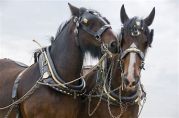
If a horse didn’t do what we wanted, we would say “glue factory” close to its ear. Supposedly, old horses were taken to a factory where their hooves were used to make glue. We also had this idea that horse hooves were used to make Jello. We never knew if any of those stories were true. But that did not stop us from passing them on to the horses.  The horses were essential to the farm. Early in the morning, with dew still on the grass, Bob went out to the fields to find Dolly and Prince. They grazed overnight in the same field as the cows. With the halter slung over his shoulder, Bob slowly approached the horses with a sugar cube or a small apple. “Here, Prince,” he said softly, his hand outstretched. “Here, Dolly.” Dolly and Prince advanced slowly, but sometimes stood their ground. They knew the routine.

The halter slid over the horse’s head. It had a nose band and a strap that buckled around the head, but did not have a bit to put in the horse’s mouth. A six-foot-long quarter-inch rope attached to the halter allowed Bob to lead them to the barn for harnessing.

A really smart horse would have bolted rather than submit to the halter and a full day’s work. But then, maybe these two plow horses were smarter than I thought. Perhaps they knew that if they ran away and were difficult to catch, they’d be hauled off to the glue factory. So who’s to say who was smarter; the horses or the Scheckel boys.

Harnessing horses is an art form, and Dad was good at it. The harnesses were stored on pegs behind the horses against the wall. The horse barn was an alcove inside the Big Barn.

First the collar was placed over the horse’s neck. Two horns, or hames, stuck out the top of the collar. Coiled-up reins could be hung on these hames. I didn’t know that when I was little. For me, those hames were used to hang onto when Dad lifted us up and set us down on the horse to ride to or from the field.

The bridle slipped on next and had a bit that was placed in the horse’s mouth. The reins connected to either side of the bit. The sides of a horse’s mouth are very sensitive, so pulling on the reins tugged on the bit, which yanked the horse’s head from side to side.

The reins were black leather straps that extended from the bridle back to the driver. Supporting rings carried the reins over the horse’s back, preventing them from getting tangled. When two horses worked as a team, which was often the case, the outside rein from each horse went back to the driver, and a short bridging strap or rope connected to the inside of the bits. In this way, the farmer drove two horses with only two reins.

The collar was everything. Made of leather and stuffed with straw, the collar fit over the horse’s head. All the weight from pulling was applied to the collar, so the fit was important. If the fit was bad, the horse developed sores.

Harnessing horses was not easy work. I was small, horses were big. That’s why I was so impressed by my dad, who was an expert at harnessing Dolly and Prince. He always harnessed on the left side of the horse, and I learned to do it that way as well.

The collar was placed over the horse’s head; the leather strap on top of the collar adjusted to make sure the collar was not too tight. Next, Dad would reach for the harness, sling it atop the horse, and slide the hames into the slots on the collar. He straightened out all the straps, then the breaching that went over the tail and pulled the tail free. The breaching, the big strap around the rump, is the piece of the harness the horse pushed against when backing up an implement.

<Insert Fig 2 Lawrence (author) and Phillip are one year apart in age. Bob came along about 18 months later. The three of us grew up together”.>


The belly band ran under the horse, and Dad snapped the reins into the hames. A yoke strap was attached to each side of the horse’s collar. The bottom of the yoke strap had a snap fastener. When hitched to an implement, the snap fastener attached to the neck yoke, a three-foot wooden bar that fastened to the horse-drawn implement tongue. The neck yoke was suspended from the collar of the harness.

The “tugs” were thick leather straps that attached to the hames and collar and ran along both sides of the horse. A length of chain attached to each end of the tug strap. The chain was used to hitch the horse to a singletree. The singletree was a wooden piece, three to four feet long that fastened to the tugs of the horse harness. The center of the singletree attached to a doubletree.

A doubletree was a wooden swinging crossbar that attached to the smaller singletree bars. Doubletrees were used when two horses were hitched side by side to pull a wagon or other farm machinery.

The neck yoke wooden bar had a big four-inch metal ring that fit around the tongue of the implement or wagon. A metal stop prevented the ring from sliding back to the bar, and it was also used for the horses to push against as it backed up any implement.

The bridle was put on last. The bridle had those blinders, or cups, that prevented the horse from seeing to the side. I always figured those blinders were used to prevent the horse from being startled by anything happening to the side. But they could have been used to prevent dust and debris from irritating or blinding the horse.

Once the bridle was put on, the rope attached to the bridle would be tied to the hole in the stall. The horse was ready to work. If the horse was needed immediately, it would be led out of the barn and attached to the appropriate implement.

A team of horses was attached together, the reins were brought down off the hames and the team was either brought to the fields or hitched to a wagon or other farming machinery. They were all set to do a long day of hauling in the farm fields.


Posted in Uncategorized | Leave a comment

Bees Make Honey

QUESTION:

Why do bees make honey?

ANSWER:

Bees make honey to prepare for winter. Honey is the food bees rely on when theweather turns cold. Bees live in highly socialized communities where each bee has its own job. The worker bees go from flower to flower gathering the nectar. A single bee may visit as many as a thousand flowers. Her load arriving back at the hive is about half her weight. Very impressive!

The nectar does not go into the bee’s stomach. It is collected in a special storage sac called the honey crop. As the worker bee swallows the nectar, she adds enzymes to it from special glands. This starts the process of breaking down the complex sucrose into simple sugars, like glucose and fructose.

When the worker bee gets to the hive, she passes the nectar to a hive bee that swallows it again, adding more enzymes. The hive bee puts the nectar into a honeycomb cell.

In its present state, the honey contains too much water. If left untreated, the honey would ferment and spoil. The hive bees fan the stored honey with their wings and cause much of the water to evaporate away. With the aid of air movement and heat, the water turns from liquid to a vapor. Bees figure that eighteen percent water is about right.

When the bees think the honey is ready, they cover the cell with wax to seal it. That’s when the beekeeper comes along and steals the honey.

The flowers also get something out of this deal. Plants use nectar as a way of attracting bees. As the bees gathers nectar, they also transfer pollen grains from one flower to another, thus pollinating other flowers.

Honey is a very stable food source. It resists bacteria, fungi, mold, and a host of other microbes. Honey can be stored for years without refrigeration.

Mention was made of female worker bees. They are not able to reproduce. Worker bees live only six weeks in the summer and four to nine months in winter. They literally work themselves to death. A hive will have about 50,000 worker bees in the busy season. They can sting once, but then they die.

The hive does have some male bees, called drones. They come from eggs that have not been fertilized. The word drone is derived from an old English word “dran” which literally means idler or lazy worker. The drone can’t sting. The sole job of the drone is to mate with the queen bee.

The drone has a barbed sex organ. Mating is followed by death. That’s death of the drone, of course. Hives will have several hundred drones. Come winter, they are of no use and are expelled from the hive.

If you choose to be a bee, be a queen. There is only one queen bee per hive. Queen bees live from three to five years. She mates once with several drone bees and remains fertile for life. The queen bee lays about 1500 eggs per day. Fertilized eggs become female worker bees and unfertilized eggs become the male drone bees.

When the queen dies, the other bees make a new queen by selecting a young larva and feeding it a special royal jelly. This milky substance, made from digested pollen and nectar,  is loaded with vitamin B.  Long live the queen!
 

Posted in Uncategorized | Leave a comment

Springtime on the Scheckel Farm

Phillip preferred riding Prince, a reddish-brown horse that could gallop at full speed. Phillip, too, rode bareback, with just a bridle. Dad bought Prince at a sale north of Mt. Sterling and led him back to our farm by a rope out the car window. I was told that Prince dutifully trotted along the side of the car. That must have been a sight to see!

When we were young, Phillip, Bob, and I would go out at noontime to the fields where Dad was using the horses for farm work and call Dad for dinner. He would unhitch the horses from the machinery so that they could be fed and watered. Dad would reach down, pick us up, and sit us on the horse’s back. I would grasp the brass hames that set atop the horses’ collar and ride back to the farmhouse. What a great thrill to be riding so high. I felt like a king sitting on his throne. Phillip on one horse and me on the other.

My brother Bob was more comfortable around horses than Phillip and me. I was always a little leery for fear that they might step on me. In the summer, the horses were put out in the pasture. If the horses were needed, we had to go out in the field with a bridle, armed with some sweets or sugar. When they were close enough, we slapped the bridle bit in their mouths, and led them back to the barn for harnessing. Bob cut and raked hay with our horses.


Posted in Uncategorized | Leave a comment

Einstein’s Equation

QUESTION:

What does Einstein’s equation, E=mc2  have to do with atomic bombs?

ANSWER:

Not a whole lot, really. Albert Einstein wrote his famous equation as an afterthought to his 1905 Theory of Relativity. He discovered that there is an intimate relationship between mass and energy. Energy is the ability to do work and mass is the weight of something- of how much stuff there is.

Mass and energy are interchangeable aspects of the same thing. Scientists refer to it as mass-energy. The equation tells us that even a tiny bit of mass contains a huge amount of energy. The letter m stands for mass and the letter c is the speed of light. The speed of light is a huge number (186,000 miles per second). Even bigger when squared. Mass multiplied by the square of the speed of light yields an unbelievably large figure. Even a tiny bit of mass holds a tremendous amount of energy.

We don’t see that in everyday life. We don’t see that every gram of water or soil or soap contains the energy to run whole cities. It’s like a rich man who doesn’t spend any money. No one can tell how rich he is.  In everyday life our energy-producing activities are chemical processes. From metabolizing food, to burning wood, or gasoline in an engine, or using coal in a power plant.

Want energy? The name of the game is to lose mass. Chemical processes do cause a loss of mass, but it is so tiny, it can hardly be measured. We don’t get much energy from chemical processes, even dynamite or TNT. A pound (454 grams) of TNT gives a loss of mass of only a half a billionth of a gram.

Nuclear processes are quite different than chemical processes. Nuclear means working with the inner core of an atom, the nucleus, and not the electrons going around the nucleus. Atoms of uranium split into two pieces. The two pieces don’t add up the whole piece.

That seems odd at first and defies common sense thinking. Cut a loaf of bread into two pieces, weigh the two pieces on a scale, and we find the two pieces add up what the whole loaf we started with.

That does not happen at the nuclear level. If an atom of uranium is split, the two pieces together weigh less than the whole uranium atom. About a tenth of one percent of the mass is loss. The loss of mass turns into pure energy. How much energy? Einstein’s  E = m c2  tells us how much. A little bit of mass turns into an enormous quantity of energy.

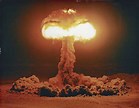
Split a Uranium-235 atom, then particles (neutrons) from that atom split two more atoms, than four more atoms, than eight more atoms, and you have a chain reaction. If that happens in a split second,  it’s an atomic bomb. Slow that chain reaction way down, control it, it’s a nuclear power plant.

However, a nuclear power plant cannot explode like an atomic bomb. The fuel is different. Most reactors use uranium enriched to three percent U-235. An atomic bomb is uranium enriched to ninety percent U-235. The Iran government is accused of trying to do such enrichment.

Einstein’s famous equation is not needed to build an atomic bomb. However, the equation does measure size of the blast.


Posted in Uncategorized | Leave a comment

Spring on the Scheckel Farm

Nature was greening up all around us. Dad talked about hunting ginseng in the woods. The lilacs started blooming. The maples budded, then leafed out. Tulips on the south side of the house poked up through the ground. Our neighbors, John and Mildred Payne, tapped trees for maple syrup. John told us, “There is some little sap in every family tree,” a joke I never got until years later.

Yes, spring had arrived, a very welcome relief from being cooped up months on end in a large family with many kids. A sense of freedom, running through the moist grass with bare feet, the warm sun beating on the turned cheek. What a joyous feeling! Soft, warm winds blew from the south. Gone were those sharp icy blasts from the north. We were ready to break out the horses and start the plowing of this year’s crops.


Horses were being replaced with tractors while I was still a kid, but horses continued to do a lot of our farming. The grain drill for the oats and wheat was big and heavy and required a team of three horses. For many years, that trio consisted of Prince, Dolly and Sam.

Sam was a wild horse and did not play well with our other horses. To take the spunk out of Sam, Dad hitched him with Dolly, a big black horse. With all that extra energy, he had them pull the sled through snow drifts, since it had four large runners attached to a wagon box. I loved riding Dolly using just a bridle. She would simply walk, not run or trot, which suited me just fine. We had no saddle; our horses were workers.


Posted in Uncategorized | Leave a comment

First Interstate Highway

The Lincoln Highway, completed in 1923 after ten years of planning and construction, was the first highway to connect the Atlantic Ocean to the Pacific Ocean.  The Lincoln Highway is over 3,300 miles long goes through the 13 states of New York, New Jersey, Pennsylvania, Ohio, Indiana, Illinois, Iowa, Nebraska, Colorado, Wyoming,  Utah, Nevada, and California.

The Lincoln Highway started in Times Square, New York City,  and ended in Lincoln Park in San Francisco. Along the way, it passed through 128 counties and  700 cities and towns. There were improvements and realignments over the years, and the Lincoln Highway  became known as “The Main Street Across America”.

Most of the Lincoln Highway became known as U.S. Route 30. Out East it became  US Route 1 and out West it was called US Route 40 and US Route 50. The stretch across Nevada is often referred to as “the loneliest road in America”.

Today’s Interstate 80 is the roadway closely paralleling the Lincoln Highway. In Wyoming,  I-80 was poured on top of the Lincoln Highway.

Our modern Interstate system was inspired by President Eisenhower. As an army  lieutenant colonel,  Dwight  D. Eisenhower was part of the 1919 Army Convoy on the Lincoln Highway.  In his report he notes that in Nebraska,  they “covered 30 miles in 10 grueling hours”.  Perhaps it was his 1919 experience combined with his observation of the German autobahn system after WWII,  that inspired him to sign the historic 1956 highway bill, creating the Highway Trust Fund, and authorizing the building of the Interstate system.  President  Eisenhower, from a military standpoint,  recognized the need to quickly move large quantities of men and material across country.

There were two Lincoln Highway routes across the Sierra Nevada Mountains. One goes south of Lake Tahoe following US Route 50 and the other goes north of Lake Tahoe, on US Route 50 Alternate, near Sparks, Reno, Truckee, and I-80 over Donner Pass.

The Donner Party was caught in a 1846 snowstorm on the eastern slopes of the Sierra Nevada Mountains. Of the 87 emigrants, 30 perished and some of the 48 that survived did so by resorting to cannibalism,

Portions of the Lincoln Highway were built on historic roads. Sections follow the Mormon trail. Segments through Indiana are on an ancient Indian trail, the “Great Sauk Trail”.   Some tracts are on the Cherokee Trail, the Overland Trail and the route of the Pony Express.

In June 1863, Robert  E. Lee  took his Army of Northern Virginia across the Potomac River near Hagerstown, Maryland and up into Pennsylvania.  South Mountain, a northern section of the Blue Ridge Mountains,  screened his movements. Major elements of his Confederate Army turned east at Chambersburg, Pennsylvania and moved toward Gettysburg. The Lincoln Highway was built on that Chambersburg Turnpike.

Much history is connected with the Lincoln Highway. In June 2013, the Lincoln Highway Association will celebrate the 100th anniversary with a Centennial Tour, some starting from the East and some from the West, and they will meet on July 1 at Kearney, Nebraska at the Great Platte River Road Museum.


Posted in Uncategorized | Leave a comment

Spring Weather on the Scheckel farm

Weather forecasts in the 1940s and 1950s were not what they are today. For instance, a few years ago, we had school on Monday and a big winter storm was forecast to move into the Tomah area early Wednesday morning. Before we left school on Monday, school had already been canceled for Wednesday. Mind you, we had school the next day, Tuesday. But like clockwork, a blizzard pounded south central Wisconsin starting at 6 AM on Wednesday.

Such accurate forecasting did not happen when I was a kid. I vividly recall the radio weatherman on the noon news on a Saturday saying, “Tomorrow will be partly cloudy.” Sunday morning we had to shovel six inches of white “partly cloudy” out of the way so we could get to the barn to milk the cows.

If the returning robins were no indication that spring had arrived, other creatures gave us clues. The long, long “V” formation of honking geese heading north into Canada was a good sign. The Scheckel farm was smack in the middle of the Mississippi River flyway. Another sign of spring was the morning doves. We seldom saw them around the farm buildings, but we could hear them. Their mournful cooing in the far distance was unmistakable.

Then the barn swallows would appear. They were graceful flyers. They started building their mud nests clinging to the rafters in the Small Barn. The meadowlarks were seen in the fields. And although they stayed around all winter, the cardinals started singing, which they did not do all winter. Well, I could understand why. Who feels like singing when you’re freezing your feathery fanny?


Posted in Uncategorized | Leave a comment

Dial Tone on Cell Phone

Why don’t cell phones have a dial tone?

The dial tone is used to let the telephone user know that a signal is available and that the system is working. If no dial tone, no call can be placed.

Most cell phones have those little bars that tells the owner the signal strength. If the cell phone is out of range of a cell tower, the cell phones usually display something like “network unavailable”  or “no service” on the screen.

Keep in mind that even when you are not using your cell phone, it remains “on”.The cell phone is a receiver, just like a radio receiver,  but with the volume turned down.

The cell phone is listening for any calls that might come in. A cell phone is “off” only when a person turns the power off.

Early telephone systems all had a telephone operator, a real live person. Remember those Andy Griffin shows. Sheriff Andy Taylor would take the earpiece off the hook, and say into the separate mouthpiece, “Sarah, get me Mt. Pilot” or Barney Fife would say “Sarah, ring me Juanita at the Bluebird Diner”.

When telephone operations were automated, the automatic tone indicated the system was ready to be used. The British were the first to use a dial tone. The tone indicated that the telephone exchange was working, the receiver had been taken off the hook, and the telephone receiver is ready to talk into. The dial tone quit when the first number was dialed.

The United States started using dial tones in the late 1940’s.  Widespread use came in the 1950’s. There is a story about President Dwight Eisenhower leaving the White House in 1961. He retired to his farm a tad south of Gettysburg, Pennsylvania. When he picked up his house phone, he didn’t know what that strange noise was. One of his aides had to explain the dial tone to the former President, and also how to use a rotary phone.
Modern dial tones in the U.S. are a blend of two frequencies, tones, or pitches. One is 350 Hz and the other is 440 Hz. In Europe it is a single tone of 425 Hz.
That 440 Hz dial tone has been used by stringed concert musicians to tune their instruments. In music, the A above middle C  is written as  A440.

Touch tone dialing, the current standard in the industry, started in 1963. Each number from 0 to 9, plus the star, pound, and A, B, C, and D buttons use two tones out of a possible eight. The lowest is 697 Hz and the highest is 1209 Hz. For example, when you hit the 6 button, it is a combination of 770 Hz and 1477 Hz that you hear.


Posted in Uncategorized | Leave a comment