Oats and Corn on the Scheckel Farm

Oats and corn were the only two crops we planted on the Scheckel farm in the 1940s and1950s. A grass seed attachment on the oats grain drill sowed alfalfa, timothy, and clover seeds along with the oats. The growing oats acted as a cover crop for the new grass seedlings. In the following year, that field would yield hay from the previous year’s seedlings. We planted wheat, of course, but that was considered a “subdivision” of oats. No soybeans. No farmer planted soybeans on Oak Grove Ridge in the heart of Crawford County in the 1940s and 1950s.

Mother Nature determined how many days were required for sowing, but it usually took a week to ten days. Same with corn planting. No sooner were the oats seeds in the ground, then corn planting would follow. The first green oats seeds poked above the ground as the first few rows of corn were placed in the fertile soil of Crawford County. Once again, as our family had done for generations, we had started the cycle anew that would induce the earth to provide its bounty.

Later when Dad purchased a Massey Harris ’44, he also ordered a set of cultivators. Phillip drove the tractor, and Bob and I road on the swinging drawbar on the back. The cultivators had shields, one on either side of the corn row, that prevented the soil from covering up the corn plant. But occasionally the dirt would fling up over the shield and cover up the plant. Bob and I had to jump off the tractor, uncover the corn plant, then catch up to the tractor and cultivator. Although the job was not strenuous, if it was hot and muggy, the running back and forth was exhausting. The corn fields had to be cultivated two or three times every year, until the corn grew too high to cultivate.

Morning glories grew in certain areas of the corn fields. They were a beautiful but deadly plant. Their white and purple flowers closed up at night and reopened when the sun came up. A morning glory wrapped itself around the corn plant and killed it. My brothers and I had to pull the weeds. It was easy work, but we had to swat away flies and mosquitoes. The heat was oppressive and the sharp corn leaves cut the skin. It was not easy work.


Posted in Uncategorized | Leave a comment

Microwave ovens

QUESTION:

How do microwave ovens cook food?

ANSWER:

Microwave ovens are actually radar sets. Radar was developed prior to WWII in both England and the United States and is credited with giving the British a fighting chance in the Battle of Britain in 1940-41. Those early radar workers sometimes got quite a surprise. When  radar technicians moved in front of a working radar antenna, the candy bars in their pockets would melt.

The heart of a microwave oven is fist-sized vacuum tube called the magnetron. A magnetron is an electronic device  that creates electromagnetic waves by using electricity to heat a filament wire. The resulting electrons are caused to wiggle and emit waves of about 2450 MHz.  Microwaves are exactly like light waves, except you can’t see them. Each wave is about five inches in length and  too long for the eye to detect.  In the microwave oven the beam of waves strikes a fan that distributes the waves evenly throughout the oven.

Most foods that need cooking or heating contain a lot of water. Water molecules are composed of bipolar hydrogen and oxygen atoms. The oxygen atom is slightly negative and the hydrogen atom is slightly positive. When the water molecule is struck by  microwaves, it is made to vibrate wildly and rapidly back and forth, rotating first one way and then another. This rotation happens millions of times each second. All this twisting causes friction that heats up the food.

It’s a different story for the dishes. The molecules in dishes contain very few water molecules, so there are practically no water molecules to twist or rotate and cause friction. Dishes, made of paper, glass, ceramic, and plastics do not contain those polar molecules. Most of the  heat that the dishes get comes from the food that is being heated. So the dishes in a microwave do not get very hot.

The waves from a microwave oven can penetrate to a depth of about two centimeters or one inch. So the amount of microwave radiation reaching the center of a slab of meat from all sides is more than is absorbed by the an outside layer. This is another of saying that microwaves cook from the inside out. The center of a steak can “get done” while the outside is still pinkish. Traditional gas or electric ovens heat by conduction, which means the outer part is cooked first and the interior is cooked last.

Why no metal in a microwave oven? Metals reflect waves, just like mirrors. Remember, microwaves are the same as radar waves used by police and troopers to catch speeders. Those radar waves bounce off my car (I’ve gotten six speeding tickets to prove it) and return to the police radar receiver.

In a microwave oven, the radar waves keep bouncing from metal piece to metal piece, building up to an alarming spark-producing degree. The excess energy bleeds off and ionizes the air. That’s those tiny bluish lightning bolts you see coming off that errant fork!


Posted in Uncategorized | Leave a comment

Planting Corn

Dad’s John Deere 999 corn planter was designed so that the valves could be locked open and the planter could be used as a drill. With this configuration, seeds were planted at regular intervals. The spacing of the hills was determined by the chosen seed plate and the variable drive gears. Thus, the check wire was no longer needed.

My older brother Ed learned about the latest farm techniques in his agriculture classes at Seneca High School. All four Scheckel boys took ag classes and belonged to the FFA (Future Farmers of America). All five Scheckel girls took Home Economics, or Home Ec. No sexism here, that’s just the way it was.

Ed convinced Dad to abandon the up-and-down hill planting, and encouraged him to plow around the hills. When I was about ten years old, a team from an agricultural agency in Prairie du Chien, possibly the Soil Conservation Service, came out to the farm with tripods and transits. They pounded in stakes at periodic intervals, indicating where the plow furrows should be. From then on, we plowed around the hills rather than up and down them.

Ten days or so after the corn was planted, tiny green leaves emerged from the ground. Several days later, a line of green stalks appeared, then one row of corn grew to several. Weeks later, the brown-black soil transformed to an ocean of green.

Of course, we did not welcome every plant showing its brilliant color. When I was little, Dad drove a corn cultivator pulled by Dolly and Prince. He sat on that cultivator seat, straw hat, horse reins tied together and thrown over his back. At the end of each row, Dad had to manually raise the cultivators so that the horses and rig could be turned around and start down a new row.


Posted in Uncategorized | Leave a comment

Lead

QUESTION

Why is lead often considered dangerous to people?

ANSWER

Lead is toxic to everyone, but especially to unborn babies and young children. Lead is a dangerous poison which can be absorbed through the skin, inhaled, or swallowed. It can be absorbed more readily by bodies that are developing and growing, rather than by adults whose bodies are already fully mature.

Lead poisoning causes a wide range of medical problems, including stomach pains, hearing problems, posture difficulties, headaches, decreased intelligence, attention deficit, learning problems, anemia, and behavioral problems. Lead has severe effects on a child’s developing brain.

What makes lead so dangerous? Once it gets inside a person’s system, it is distributed to all parts of the body, just like the other helpful minerals that you want, such as calcium, iron, zinc, potassium, and phosphorus.

In the bloodstream, lead damages red blood cells. Red blood cells carry oxygen to all parts of the body. Damage to red blood cells means a person is anemic. Anemic people are tired all the time,

Most lead ends up in the bones. Bones absorb calcium. Calcium is needed for strong bones and good teeth, plus muscle contraction, and nerve function. Absorbed lead, which you don’t want, is displacing calcium, which you do want.

One of the menacing features of lead toxicity is that lead can reside in a person’s body for decades. No threshold for lead exposure has been found. That is another of saying that most any amount of lead can be harmful.

Where does lead come from? Historically, lead came for lead-lined water pipes. Fortunately, lead pipes used to carry drinking water are banned. Leaded gasoline was banned in the 1970’s. Lead in paint was a big problem. Little kids would gnaw on painted window sills and furniture, and perhaps ingest paint chips.  Lead used in paint was outlawed in the ’70s.

Toys from overseas are a continuing problem. Millions of toys from China were recalled  in 2007 because of lead paint.

An obvious question is: why don’t we get rid of all lead and don’t even mine the stuff? Answer:  lead is valuable and necessary. Lead is used in our car batteries, the lead-acid storage kind. Lead is used in fishing lures, ballast for sailing boats, ammunition, radiation shielding in medical and dental facilities, and glassware. We need lead but must continue to find ways to prevent it from getting into our body.

Wisconsin has a rich tradition in mining lead. In the 1830s, experienced miners from Cornwall, England built their limestone houses in Grant, Iowa, and Lafayette counties. By 1840, over 4,000 miners were mining for lead around Mineral Point and New Diggings in the southwest corner of the state. They dug into the hillside like the furry animal named the badger. That’s why Wisconsin is known as the badger state. Most of the lead ammunition for Union troops in the Civil War came from Wisconsin.


Posted in Uncategorized | Leave a comment

Corn Planting on the Scheckel Farm

Dad had a John Deere 999 corn planter, a cross-checked rows machine that planted corn in a checkerboard pattern with a hill of corn at the intersection of each line. This method allowed the farmer to cultivate the rows in both directions to better keep the weeds down. This was before the time of widespread use of herbicides and weed killers and Roundup Ready Corn seed. Weeds were the bane of the farmer, completing for moisture and soil nutrients.

A long wire with knots or buttons placed every 40 or 42 inches was stretched across the field from one end to the other. A rod is 16.5 feet. Check wire came in 80-rod lengths, which is a quarter mile. That is the length needed to cover a 40-acre cornfield. The buttons on the trip mechanism were typically placed 42 inches apart. A special button was placed every five rods, so it could easily be broken and reconnected. This allowed the wire to be broken at the edge of the field or to avoid any tree obstruction or rock formation along its path.

The wire was stretched across the field and anchored to a stake at each end. Dad’s planter had a seed can for each row. Two horses, Dolly and Prince, pulled the planter. There was a revolving seed plate at the bottom of each seed canister. The seed plate had a series of notches around the plate’s outer circumference that picked up and counted the desired number of seeds per hill.

A group of seeds fell into a valve at the top of the seed tube. A second valve at the boot of the seed tube worked in conjunction with the upper valve. Both valves opened momentarily each time a button on the check wire tripped the mechanism. The groups of seeds on the bottom valve were deposited into the furrow. The group above then fell down the tube where they were caught in the now-closed bottom valve, to await the next check wire trip.

I was fascinated by the system. Dad would pick up the staked wire and move it over as the field was being planted. A steady click, click, click jabbered as the buttons on the wire tripped the seed

Phillip, Bob, and I often carried a jar of water out to the field for Dad. He would climb down over the corn planter, take a drink of water, and place the jug along the fence row. Then Dad would pick Phillip up, put him on his lap, and make one pass across the field and return. Then it was my turn. What a thrill, the steady click, click, click as the knotted wire tripped the seeds to be planted, and the smell of sweaty horses and oiled machinery. The gentle late April breeze blowing, and the sun warming the Wisconsin fields. Then it was Bob’s turn.

Check-row planting was ideal for the flat corn country of Illinois, Iowa, or Nebraska. Check-row planting demanded perfectly square or rectangular fields. At a minimum, the rows had to be straight, with no bends. But in the hill country of southwestern Wisconsin, planting and cultivating up and down hills was not suitable for retaining top-soil.

By 1950 check-row planting was being phased out. Farmers were contour-plowing, plowing around the hills, not up and down. Strip cropping was employed: a strip of corn, then a strip of hay, perhaps a strip of oats.


Posted in Uncategorized | Leave a comment

Jello

QUESTION

Is Jell-O really make from horse hoofs?

ANSWER

Well, that’s we thought on the farm. If one of our 3 horses, Dolly, Prince, or Lightning, was not moving fast enough, that equine would receive the warning “we’ll send you to the Jello-O factory”  or “you’re off to the glue factory”. The horse paid no attention!

Jello-O is a registered trademark of Kraft Foods. Jello-O is about 87 percent sugar and 10 percent gelatin, with a tad of flavoring and coloring. The gelatin, the stuff that causes the wiggling, actually does come from pig skins, cattle bones, and cattle hides. Not to worry- it has all been cleaned up.

The skin, connective tissue, and bones of animals have a fibrous protein named collagen. When the collagen is treated with hot acid (type A) or alkali (type B), collagen turns into gelatin. The collagen is extracted into hot water, boiled down, and purified.

It is colorless, translucent, and brittle when dry. It melts into a liquid when warmed, and then turns into a solid when cooled. There is no collagen in hoofs.

Gelatin is widely used in foodstuffs, theatre lightning equipment, capsules in medicine, glues, photo paper, soft drinks, sandpaper, match heads, cosmetics, playing card, and glossy papers.

Foods that contains lots of gelatin include marshmallows, candies, gummy bears, jams, yogurt, cream cheese, and margarine.

Ammunition manufacturers and gun makers shoot into blocks of gelatin. Ballistic gelatin closely simulates muscle tissue. The shells of paintballs are made of gelatin, same stuff that drug capsules use. Serious swimmers use gelatin in their hair. The colder pool water will not dissolve the gelatin. Ever see those translucent windowpanes in gingerbread houses. They’re made of gelatin. Some athletes claim that gelatin relieves knee joint pain and stiffness.

Jell-O was invented by Pearly B. Waite in Leroy, New York.  Around 1900, immigrants landing  at Ellis Island in New York City were served Jell-O  as a “Welcome to America”  treat. Utah has named Lime Green Jell-O as their official state dessert. Kraft sells Cranberry Jell-O in November and December.


Posted in Uncategorized | Leave a comment

The Grain Drill

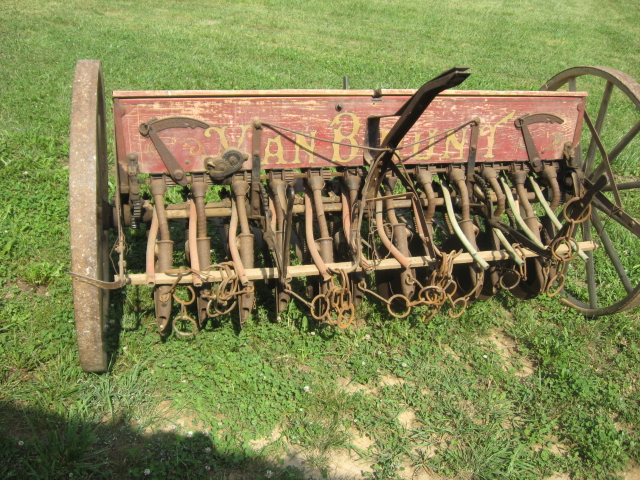
We sowed the oats seeds into the prepared soil with a grain drill. The grain drill was a magnificent piece of machinery that every farmer owned. Couldn’t farm without one! My family owned a seven-foot Van Brunt drill with grass attachment. The grain drill precisely positioned seeds in the soil and then covered them, allowing for a profitable ratio of crop yield.

In 1860, George Van Brunt used a turnip to carve the first model of the force-feed device. The nozzle dragged on the ground and discharged the seed oats into a small gully made by a rotating disc. Chain drags behind the nozzle covered the seed. The seed was placed about one inch under the soil and out of the reach of those scavenging birds.

The Van Brunt machine had dropper tubes so the “person tending it could see whether any of the droppers (or tubes) failed to deliver the grain regularly, all are in plain sight and under the eye of the driver. From its peculiar construction, therefore, a failure to deliver the seed constantly could not occur.” George and Daniel Van Brunt set up their factory in Mayville, Wisconsin. They later moved to Horicon. The business stayed in the Van Brunt family until it was sold to John Deere and the two companies merged in 1911.

The Scheckel seven-foot grain drill needed three horses to pull it. Two horses could do the job, but not easily, especially if they worked all day and had to navigate hills.

Two hinged doors were on top of the grain drill and sprung up so seed oats could be loaded. The seed chutes were made of flexible metal conduit. A seed attachment was mounted on the back wall of the grain drill. Most farmers mixed purchased seed oats with used seed oats from the previous year’s crop. Seed for hay had to be purchased. I recall that the seed mixture of alfalfa, clover and timothy, was made up of very fine tiny seeds and was quite expensive.

Dad would ride on a platform in the back. The seed-dispensing gears were driven by big wooden spoked wheels on each end bounded with steel straps. Meshed gears drove the auger that fed the seed to the tubes. Dad used to open the hinged doors and move the grain from side to side with his hands, to make sure no area of the drill was without seed.

One day while riding on the back with Dad, my brother Bob stuck his hand in either the seed attachment or the main oats seeder just the way Dad did. His fingers got caught and, ouch, bloody stubs. Dad had to make a hasty trip to the hospital in Prairie du Chien. Bob had stubby fingers for years, and Mom blamed Dad. “You got to watch the kids better,” she said a number of times. Dad wouldn’t say a thing. In all my years growing up on the farm, I never ever heard my folks argue.


Posted in Uncategorized | Leave a comment

What is a Jackalope?

A jackalope is an imaginary animal that is supposed to be a cross between a jack rabbit and a pronghorn antelope.

Where did this good-hearted foolishness start? A 1930’s hunting trip for jackrabbits near Douglas, Wyoming. Douglas Herrick and his brother invited a bunch of hunters from out East for a visit. Several days after the hunt, Douglas Herrick looked in a bin of jackrabbit remains and deer antlers, and the idea was born. Why not mount a set of antlers on top of a rabbit? After all, the Herrick brothers had studied taxidermy by mail order as kids. They sold the first jackalope for $10. The New York Times wrote a story about this mythical creature. The legend spread.

Douglas, Wyoming has been named the “Home of the Jackalope”. You can get a season Jackalope Hunting License from the Douglas Chamber of Commerce for $10. It is good for only one day of the year, June 31. Do keep in mind that June has only 30 days! Also a hunter cannot have an IQ greater than 72. A large statue of a jackalope stands in the town square of Douglas, Wyoming, population of about 5,000. The jackalope adorns Douglas’ city fire trucks and park benches.

In 2005, the House side of the Wyoming state legislature passed a bill, by a vote of 45-12 naming the jackalope the “official mythological creature” of Wyoming. The bill was indefinitely postponed in the State senate on March 2, 2005. Those Wyoming folks do have a sense of humor!

Wall Drug in Wall, S.D. has a large jackalope statue. This seven foot jackalope comes with a saddle and tourists are encouraged to have their picture taken astride the giant beast.  A minor league hockey team in Texas is named the Odessa Jackalopes.

President Ronald Reagan had a jackalope mounted on the wall of his California Ranch, Rancho del Cielo, near Santa Barbara in the Santa Ynez Mountain range.  Reagan claimed he caught the brute himself.

The jackalope joins a long line of fairy tale creatures such as the Loch Ness monster, Big Foot, King Kong, vampires, dragons, centaurs, mermaids, and unicorns.


Posted in Uncategorized | Leave a comment

Preparing the Field

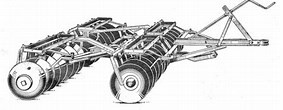
The Scheckels operated a 9 ½-foot Moline tandem disc. Four rows of disc blades were angled so that the rounded discs met the soil sideways. Each blade was about a foot in diameter. There were troughs on top of the disc so that weights could be added. The weights would push the disc blades deeper into the soil. Timbers or rocks were used as weights.

Next step was to drag the field. We owned three sections of Lindsay drag that could be pulled by tractor or horses. The drag had an adjustable pitch. The drag teeth could be set slanting back when transporting from field to field, or the teeth could be set vertically, so they dug down into the soil. While the disc was heavy and needed a tractor or three horses, the drag could be pulled by a team of two horses.

The plow turned the soil over, the disc harrow smoothed the mounds of dirt, and the drag fine-tuned the earth. The ground was now ready for planting. The Earth was ready to receive the seed.

It just seemed we were following the biblical prescription. “And other seed fell into good soil and brought forth grain, growing up and increasing and yielding thirtyfold and sixtyfold and a hundredfold.” Mark 4.8

Posted in Uncategorized | Leave a comment

Eye Color

QUESTION:

Why does the iris in your eye have color?

ANSWER:

The iris is that thin circular colored structure of the eye responsible for controlling the diameter and size of the pupil. The iris manages the amount of light entering the eye and reaching the retina. Muscles attached to the iris expand and contract the opening or aperture at the center of the iris, known as the pupil. The larger the pupil, the more light can enter the eye and reach the retina. It is an automatic process.

Eye color is determined by as many as six genes and is set by the amount, density, and type of pigment in the iris. For example, a green/blue eye color is located on chromosome 19. A brown eye and brown/blue eye color gene is located on chromosome 15.  There are three pigment colors that determine the outward appearance of eye color: brown, yellow, and blue. Eye color is an inherited trait.

The most common eye color is brown, the least common is green. Babies of European ancestry are born with blue eyes.  Melanin, the brown pigment that colors skin, hair, and eyes, has been not been developed yet.

The amount and type of melanin protein is encoded in the genes. If the iris gets a lot of melanin it will appear brown. Less melanin produces green, gray, or light brown. Very little melanin means blue eyes.

Changes in eye color do have medical implications. People with lighter iris color have a  higher degree of age-related macular degeneration. Color change, especially yellowing of the whites of the eye, can indicate jaundice, cirrhosis, hepatitis, or malaria.

Scanning the retina has been an identification technique for several decades. Every person has a unique pattern of blood vessels in the back of the eye. An infrared beam scans the retina and the resulting pattern is compared to the persons’ scan already in the computer.  Iris scanning is relatively new and is unimpeded by glasses or contacts.

There are a number of questionnaires and surveys that purport to link eye color to personality, intelligence, athletic ability, social skills, academic achievement, or compatibility. Like those astrology columns in the newspaper, it is all nonsense.

Sources: http://www.allaboutvision.com/conditions/eye-color


Posted in Uncategorized | Leave a comment