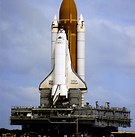
Shuttle Challenger Accident

QUESTION:

How, why, and where did the space shuttle Challenger go down in 1986?

ANSWER:

The Space Shuttle Challenger broke up on Tuesday, January 28, 1986 at 10:38 AM  Tomah time (CST). Launched from Kennedy Spacecraft Center, the 25th Shuttle mission, the vehicle with seven astronauts aboard, disintegrated 73 seconds into launch. It was about  9 miles high and going about  1500 miles per hour. Because it was moving so fast, the crew compartment traveled another 3 miles up before it reached its peak altitude of about 12 miles.
All shuttle flights are launched toward the east out over the Atlantic Ocean. The rotation of the Earth from west to east imparts a speed of close to 1000 mph in the direction the Shuttle is going. It’s like a free “kick in the pants”. The speed needed to get into orbit around the Earth is 17,500 mph, which works out to about 5 miles per second.

What was the cause of the accident? The Shuttle is powered by 3 main engines that are fed liquid hydrogen and liquid oxygen, both stored in a large External Tank. The Shuttle is also powered by two Solid Rocket Boosters (SRB’s), one on each side of and strapped to the External Tank. The fuel is ammonium  perchlorate (oxygen) and aluminum (fuel). It is poured in the casting, much like pouring fudge candy, and hardens. It feels like a pencil eraser.

The SRB’s are about 150 feet long and made in 4 segments, designed so each segment fits on a railroad car and can be railed back to Utah for refilling.

The Shuttle was destroyed after the lowest joint on the right hand SRB failed. The two O rings allowed a breach or opening for extremely hot gases from inside the rocket engine to hit the SRB attachment hardware, then the External Tank.

Two events happened at about the same time. The hydrogen tank, the lower part of the External Tank, ruptured due the hot gases burning through the tank, and the SRB pivoted into the top of the ET.  It was aerodynamic forces that tore the Shuttle apart, not the big explosive fireball we see on TV and in pictures. The SRB’s were remotely destroyed by the Range Safety Officer before they could come back over land and do damage.

A cold weather system has moved through Florida the night before the launch. The cold temperatures made the O rings brittle and not able to seal properly. Even so, the Shuttle might have made it through the 130 seconds needed for the SRB’s to burn, except for the sheer winds at altitude that buffeted the vehicle.

Investigation and analysis after the accident indicated that when Challenger broke apart, the crew compartment remained intact. Several of the emergency oxygen packs had been turned on. Investigations after the accident, showed that the oxygen remaining in the tanks was consistent with the expected usage during the 2 minutes 45 second fall to the ocean.

But the seven astronauts could not have survived the impact with the ocean, hitting the water at over 200 mph. The crew compartment was found 6 weeks after the accident in several hundred feet of water and roughly 20 miles east off the Florida coast. The bodies of all seven crewmembers were found strapped in their seats. They were returned to their families. Scobee and Smith were buried in Arlington National Cemetery, McNair in Lake City, South Carolina, Onizuka in the National Cemetery in Hawaii, Jarvis and Resnick were cremated and ashes scattered over the ocean.

Teacher Christa McAuliffe was interned in Concord, New Hampshire, not far from the classroom in which she taught.




Posted in Uncategorized | Leave a comment

Raising Chickens 1952

Summer 1952 on the Scheckel farm. We had a corn sheller powered by the Massey Harris ’44 tractor, stored and mounted in the small barn. We also had our own hammer mill powered by the Massey Harris ’44. The shelled corn was shoveled into the hammer mill. A rapid rotating series of blades broke up the shelled corn into smaller pieces. The size of ground pieces was determined by the screen inserted into the hammer mill.

It was my job to keep the chickens’ water jar filled. Water had to be carried from the cow tank near the big barn, across the expanse of the corn crib, past the lower end of the garden, and into the chicken coop. That added another 200 feet to my trek, and it often seemed a lot longer.

The young chicks grew fast. The yellow down feathers disappeared and the birds took on a white color as the permanent feathers developed. After several weeks, the heat lamps could be turned off as the chicks got bigger and the weather turned warmer.

We had to debeak our laying hens to prevent the bullies from pecking the weaker chicks. Yes, indeed, that’s where the term “pecking order” comes from. We cut off just the tip of the upper beak with either a sharp knife or a machine that burned the end of the upper beak.


Posted in Uncategorized | Leave a comment

Sunrise and Sunset

QUESTION

December 21 is the shortest day of the year, but why don’t the earliest sunsets or latest sunrises of the year coincide with that date?

ANSWER

The common wisdom is that June 21, the summer solstice, is the longest day of the year and that December 21, the winter solstice,  is the shortest day of the year. And that is true.

To get the shortest possible day (daylight), we want a late sunrise and early sunset. The dates of latest sunrise and earliest sunset depends on latitude. Here’s what happens in Tomah, Wisconsin. The latest sunrise is January 3 at 7:37 AM. The earlier sunset is December 9 at about 4:24 PM.

Up to December 9, the sunrise gets later and sunsets earlier, so the days shorten. From December 9 to December 21, sunsets get later, and sunrises also get later, but advances faster than sunset, so days continue to get shorter.

From December 21, the solstice, to January 3, both sunrise and sunset continue to get later, but sunset advances faster, so the days get longer. After January 3, sunrise is earlier and sunset is later, so each day is longer. December 21 (sometimes December 22) remains the shortest day of the year, with about 9 hours of daylight and 15 hours of darkness.

Why aren’t the latest sunrise and earliest sunset on the same day, namely December 21, the winter solstice?

Two factors are involved. First, the Earth’s axis is tilted 23.5 degrees with respect to its plane of orbit around the sun. Second, the Earth’s orbit around the sun is not a perfect circle, but rather an ellipse or oval shape.  It is the first, the tilt thing, that is most important.

The time of day when the sun gets to its highest point in the sky is called solar noon and the time from one solar noon to the next one is called the solar day. The length of the solar day is not constant through the year. Around the winter and summer solstices (Dec 21 and June 21), it is a tad more than 24 hours and near the spring and fall equinoxes (Mar 21 and Sept 21), it is slightly less than 24 hours.

The length of the solar day is determined mostly by the rotation of the Earth on its axis, and a little bit by its revolution around the sun.

We don’t like to tell time using solar days, because we want every day to be the same, exactly 24 hours. So our clocks don’t run on solar time. Our clocks average out the variations in the solar day, making every day the same length, and so out clocks don’t agree with the solar day.

Solar noon rarely occurs exactly at clock noon. During the winter solstice, solar noon occurs at a slightly later time each day because the solar day is slightly more than 24 hours. When we talk about “earliest sunset”, we mean earliest according to our constantly running clocks. The difference between clock time and solar time create the phenomenon.  If sundials were used to tell time, the latest sunrise and earliest sunset would occur on December 21, the winter solstice. It can get a tad complicated.

There is a table of sunrises and sunsets for an entire year from the US Navy Observatory for any location on Earth at http://www.usno.navy.mil/USNO/astronomical-applications/data-services/rs-one-day-us. Type in Tomah for location.


Posted in Uncategorized | Leave a comment

Chicken Chores

(Summer of 1952 on the Oak Grove Ridge Scheckel farm)

We all had chores. Phillip was responsible for the pigs. Bob tended the cattle. I took care of the chickens. Of course, there was a lot of overlap. If one of us were sick, hurt, or at some sporting event, the other two had to cover.

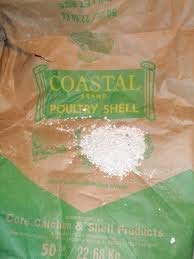
I fed the chickens oyster shells that Dad bought in 50-pound bags. It was intended to make the eggshells stronger. I fed it to the pullets in the brooding house when they started to lay eggs. Oyster shells were not mixed in with the feed, but kept in a separate container.

Regular feed was a combination of cracked corn, wheat, and ground oats. Chicken feed was stored in the granary and had to be hauled to the chicken coop. From the granary, over the gravel driveway, through the gate that kept the chickens out of the yard, across the green lawn in front of the house, pass the garden, through another gate, and a final few feet to the chicken coop. The distance was only 200 feet, but when you’re small and weigh about 80 pounds, carrying pails of feed or water was a big chore. It had to be done. Complaining was useless. In the summer I walked barefoot and dodged the chicken manure in the chicken coop area. Well, most of the time!


Posted in Uncategorized | Leave a comment

Ship Sides

QUESTION:

Why is the right side of a ship called “starboard” and the left side called “port”?

ANSWER:

Vikings ships were maneuvered with a long board on the right side near the back. The word starboard is derived from “steor” for steering and “bord” for board. This steering board was the rudder that controlled the direction of the ship. Thus, the right side became known as the starboard side.

The Viking long boats were loaded from the left side to prevent damage to the steering paddle located on the right or starboard side. “Lade” or “lar” means load and “bord” means side.  Hence the name “larboard” or left side.

But the name starboard and larboard sound much alike and could cause confusion when shouting orders over the wind, weather, and waves. So the British Admiralty demanded that the word port be used in place of larboard. It does make sense, because the boat is loaded while in port and on the port side. The United States Navy officially adopted the term “port” in 1846.

Ships on the seas have greatly enriched our language. A “butt” is a wooden cask holding water and to “scuttle” means to drill a hole or tap a cask. The sailors of old would exchange gossip when they gathered around the “scuttlebutt” for a drink of water.

The French term “m’aidez” means “help me”. This “mayday” call is now the distress call for vessels and people in trouble at sea. It was made official by the International Telecommunications Conference in 1948.

A “clean bill of health” was an official document given to a ship that had left a port in which there was no epidemic or infectious diseases occurring.

Wooden ships had decks made of planks. The space between planks was filled with a packing material called “oakum”, a tarred fiber used for caulking the joints. The joints were sealed with a mixture of pitch and tar. These blackened joints left a quite visible series of lines running the length of the ship and were spaced six to eight inches apart.

Most every Sunday, a warship’s crew was ordered to “fall in” or line up in formation at a designated area based on every crewmember’s job. In order to have a neat alignment, sailors were directed to stand with their toes just touching a particular seam.

These seams were also used for punishment. The captain might order a naughty young sailor or cabin boy to stand with his toes just touching a designated seam for hours at a time, and not talking to anyone.  Older sailors were flogged.  Obviously, this “toe the line” was an admonishment to a miscreant that it just might be easier and more pleasant to conduct himself in the required manner.

Sources: http://www.history.navy.mil and http://www.lore-and-saga.co.uk/html/viking_ships


Posted in Uncategorized | Leave a comment

Radiation Kill

QUESTION

How much radiation is needed to kill a person?

ANSWER

The short answer: A single dose of 5,000 mSv will kill half the people in 30 days. Half will live and half will die. Gives a bizarre and macabre twist to the concept of “half-life”!

The universally accepted unit of radiation today is the sievert, named after Rolf Maximilian Sievert (1896-1966), a Swedish medical physicist who made major contributions in the study of the biological effects of radiation.

The older unit was the REM (Roentgen Equivalent Man), which is still used, and other units include the gray, curie, and becquerel. It can really get confusing.  A sievert (Sv) is 100 REM.

Because of the recent earthquake off Japan and the troubles at the Fukushima nuclear reactors, much interest and concern has been focused on radiation exposure. The millisievert (mSv/year) is the unit we will see most often in the coming weeks and months.  The prefix milli is one-thousandth or .001.

Everything in our environment has some radioactivity; air, water, soil, rocks, trees, our bodies, simply everything.  Yes, our bodies are radioactive! We all have small amounts of Potassium-40, Carbon-14, and Radium-226 in our tissue, blood, and bones.  It’s called background radiation. The natural background radiation varies from place to place but is typically about 2.5 mSv per year.

Health physicists generally agree that a person’s exposure beyond that background radiation of 2.5 mSv should be no more than 1 mSv. Most of the radiation that you and I will be exposed to will come from dental and medical X-rays, CT scans, and flying at high altitude.

Living near a coal power plant will expose a person to more radiation than living near a nuclear power plant. Unless, or course, the nuclear power plant is in Japan. Different story! Coal comes out of the ground, and stuff out of the ground is high in radioactivity.

A dental X-ray is about .01 mSv.  A full body CAT scan is worth about 10 m/Sv. A gastrointestinal series X-ray will rack up about 14 mSv. The medical profession is very careful about limiting radiation exposure from both diagnostic tests and using radiation for cancer treatment. Much progress has been made in the last 100 years.

About 1,000 mSv causes radiation sickness, which means nausea, lack of energy, and some hair loss. Recovery is close to 100 per cent. Same symptoms a person experiences when undergoing treatment for cancer. Keep in mind that 1,000 mSv is 400 times average background radiation.

Certain human activities will increase the dosage. Live in the basement? Radon gas settles in the lowest possible places.  The average in U.S. homes is 2 mSv/year. Smoke 1 pack per day? That’s 9 mSv/year. Flight crew from New York to Tokyo? Add 9 mSv/year.  Remember that the Feds require radiation exposure from licensed activities to be below 1 mSv/year above background radiation. This limit does not apply to radiation received from medical procedures.

The only ones at risk from dying from radiation exposure, even in Japan, are those people working at the reactor, responding to this catastrophic event.


Posted in Uncategorized | Leave a comment

Baby Chicks continued

Bob and I held the boxes in place atop the wagon as we slowly made the journey to the white chicken coop. We paused by the door. Mom opened the door, removed the top box, placed it inside the coop, and set it close to one of the brooder heat lamps. She kept a close watch on the new brood. “Egg money” helped our family survive, so taking care of chickens was an important chore.

The boxes were about three feet square and five inches high. The sides of the boxes had an ample number of half-inch round holes so that the chicks could get fresh air. Each box was partitioned into four cardboard compartments. About ten White Leghorn chicks were in each little compartment. This arrangement of cubicles prevented the chicks from crowding together and smothering each other. The baby chicken boxes had a cardboard lid, much like a shoebox. The lid also was dotted with plenty of air holes.

We would reach in the box and cradle a baby chick in both hands. They were so small and cuddly with their tiny yellow feathers, small black eyes, and beaks that opened and closed. Baby chicks had to be taught how to drink water, so we would dip the chick’s beak into the drinking fountain water. Then we placed them ever so gently under the heat lamp, amid admonitions to “be careful not to squeeze them.”

The chicken coop or brooding house was prepared days in advance. Walls were cleaned, the floor was scraped and disinfected with a smelly brown liquid that was applied with a wide paint brush and sprayer. That stuff was eventually banned. But it did kill lice!

The brooder was a contraption with a four-sided sheet metal hood. A thermometer kept track of the temperature, which had to be held to about 95 degrees Fahrenheit. Mom had to go out to check the temperature almost every hour. Chicks soon develop their own heat, so periodically the thermostat could be turned down or sometimes turned off.

We helped set up glass bubblers for water and small metal trays for chicken feed. Baby chicks needed warmth, water, food, and a quiet brooder house. Sharp, loud noises would frighten them and cause them to bunch up in the corner and smother.

We had two “chicken” buildings. The white brooder house was about 12 feet on each side, mounted on skids, and could be pulled into a new position with a log chain and tractor.


Posted in Uncategorized | Leave a comment

Pencil Color

QUESTION:

Why are pencils yellow?

ANSWER:

The best graphite in the world came from China during the 1890’s. The Chinese associated the color yellow with excellence, royalty, and respect. Manufacturers in the United States and Europe wanted a way to tell people that their pencils were the best. Painting something yellow  was associated with quality. That idea caught on with school buses, also.

The European and American company Koh-I-Noor was the first to paint pencils yellow, and yellow became linked with high quality in the minds of users. Any other color was just inferior.

Graphite, not lead, is used in a lead pencil. High quality graphite became scarce by 1900. Makers started using graphite mixed with a clay binder and baked in a kiln. The same process is used today. Two wooden halves are sawed, grooved in the middle, a graphite stick inserted, and the two halves are glued together.

Joseph Dixon developed a means to mass produce pencils in 1870. He founded the Dixon Ticonderoga Pencil Company.  Today, the Dixon Ticonderoga Wood Cased Black Core #2 pencil, soft, yellow is considered the finest pencil in the world. And yes, they have them at Wal Mart.

Early on, the pencil makers used Red Cedar. It had a real nice aromatic smell and did not splinter when sharpened. Today pencils are made from Incense Cedar (Calocedrus is the genus name) dyed and perfumed to look and smell like Red Cedar.

Other countries use different colors. German pencils are green, blue, and black. France and Italy like dark red or black pencils with yellow lines. Australian pencils are typically red with black bands on one end.

Ben Franklin had pencils for sale in 1729 in his newspaper, the Pennsylvania Gazette. George Washington used a three inch-long pencil when he was surveying the Ohio area in the early 1760’s. Henry David Thoreau’s father had a pencil factory in Concord, New Hampshire. John Steinbeck used 300 pencils to write East of Eden. Johnny Carson played with a pencil when interviewing guests and between guests. The pencil was just a prop. He never wrote anything.  To avoid accidents, both ends of his pencil had erasers.

Getting a new pencil as a kid was a real treat for this writer, attending that one-room country school out on Oak Grove Ridge in the middle of Crawford County. On one occasion, when I was about eight years old, I got a pencil that, when sharpened, showed lead (actually graphite) on one side of the point, but yet a lot of wood on the other side of the point. My dad explained that the pencil maker did not have the lead centered in the middle of the pencil. How could he have figured that out, I wondered?  I thought my dad was just about the smartest man in the world.


Posted in Uncategorized | Leave a comment

Chores on the Farm

The early morning routine varied little from day to day. Dad or Mom called up the stairs to wake us, we put on our farm clothes, and did our chores. Chores took about an hour, which included milking four cows by hand as I got a little older. Then the whole family ate breakfast together. We usually had oatmeal, bread, and sometimes bacon or sausage. We discussed the weather, what was going on in school, and any special chores that had to be done after school. Then we washed up a bit, changed into school clothes, and walked to Oak Grove country school.

For as long as I can remember, my job was to water and feed the chickens. They needed tending in the early morning, some at noon, and always again in the late afternoon. I hauled the feed from the granary, got water from the cow tank, and gathered the eggs.

Oh, did we raise chickens! It was a major source of income for the Scheckel family. Mom and Dad bought baby chicks wherever the price was right, which meant the lowest price. Sometimes they would drive to Oelwein or Cedar Rapids in Iowa and bring them back by car.

They bought the female laying White Leghorn chicks in April and the Cornish Rock roosters in May. The roosters were for slaughter and sold to stores in Prairie du Chien and Viroqua. The baby chicks that came by mail were delivered by the rural mailman from Lynxville. Dad and Mom would receive a postcard a few days before the baby chicks were due to arrive. Delivery during cold weather was a worry, as baby chickens needed to be kept warm.

The big day arrived in late spring. The mailman pulled his Chevy Coupe into the driveway instead of by the mailbox. A rope from the trunk latch hung over the four or five boxes of baby chicks and was tied to the bumper. We gathered around, getting as close as we dared. We giggled at the incessant chirping. We stuck our fingers in the air holes of the boxes.

Mom always scolded, “Back away, kids.” She was in charge of the chickens and didn’t like us hovering.

The boxes were lifted carefully out of the trunk and stacked on our toy wagon. Phillip, Bob, and I argued over who would pull the wagon. Phillip usually won because he was bigger, older, and insisted on first dibs.  To be continued…..


Posted in Uncategorized | Leave a comment

QUESTION: 

Why is there 5,280 feet in a mile?

ANSWER:

We can thank merry olde England for the statute mile of 5,280 feet. It was an act of the English Parliament in 1592 (hence the name statute) that codified the mile.

For purposes of surveying, a mile is 1770 yards or 8 furlongs. Each furlong is 10 chains, each chain is 4 rods. The rod then is 5.5 yards or 16.5 feet.

But it goes back farther than Elizabethan times. The nasty Romans ruled Britain for centuries. The Romans had a measurement knows as “mille pasuum”, meaning a thousand paces. A pace was 2 steps or about 5 feet. Multiply 5 times 1000 and you get 5000 feet.

When the Romans left England in 410 AD to defend the empire around Rome, the remaining Brits were in a quandary. They had their own agricultural unit, the furlong. The furlong was how “long” a distance a horse or oxen could plow a “furrow” before it needed a rest. They figured that was 660 feet.

So  8  furlongs were in a mile, and 660 feet multiplied by 8 gives 5,280 feet in a mile. The English had to decide on the Roman 5000 foot mile or their own 5,280 foot mile . Property deeds at the time were in furlongs and Queen Elizabeth I put her foot down (no pun intended) and demanded that the English Parliament  make 5,280 feet equal to a mile.

These days our country is increasingly  using the nautical mile. It is 6,080 feet and defined as a minute of arc along the meridian of the Earth.

A nautical mile per hour is known as a knot. All aircraft and ships at sea, both civilian and military, are using knots for speed, and not miles per hour. There is about a 15 per cent difference. For example, a speed of 115 mph is the same as 100 knots.

We’re now using metrics in our track and field events. We have the 100 meter, 200 meter, 400 meter, 800 meter, 1600 meter, and 3200 meter running events. The 100 meter dash previously was the 100 yard dash, the 400 meter was 440 yard, the 800 meter used to be the half mile or 880 yard, and the 1600 meter was called the mile.

Posted in Uncategorized | Leave a comment