
We can credit Dr. Hermann Snellen, a Dutch ophthalmologist at the Netherlands
Hospitalfor Eye Patients, with putting the big E on top, in 1862. Snellen was try
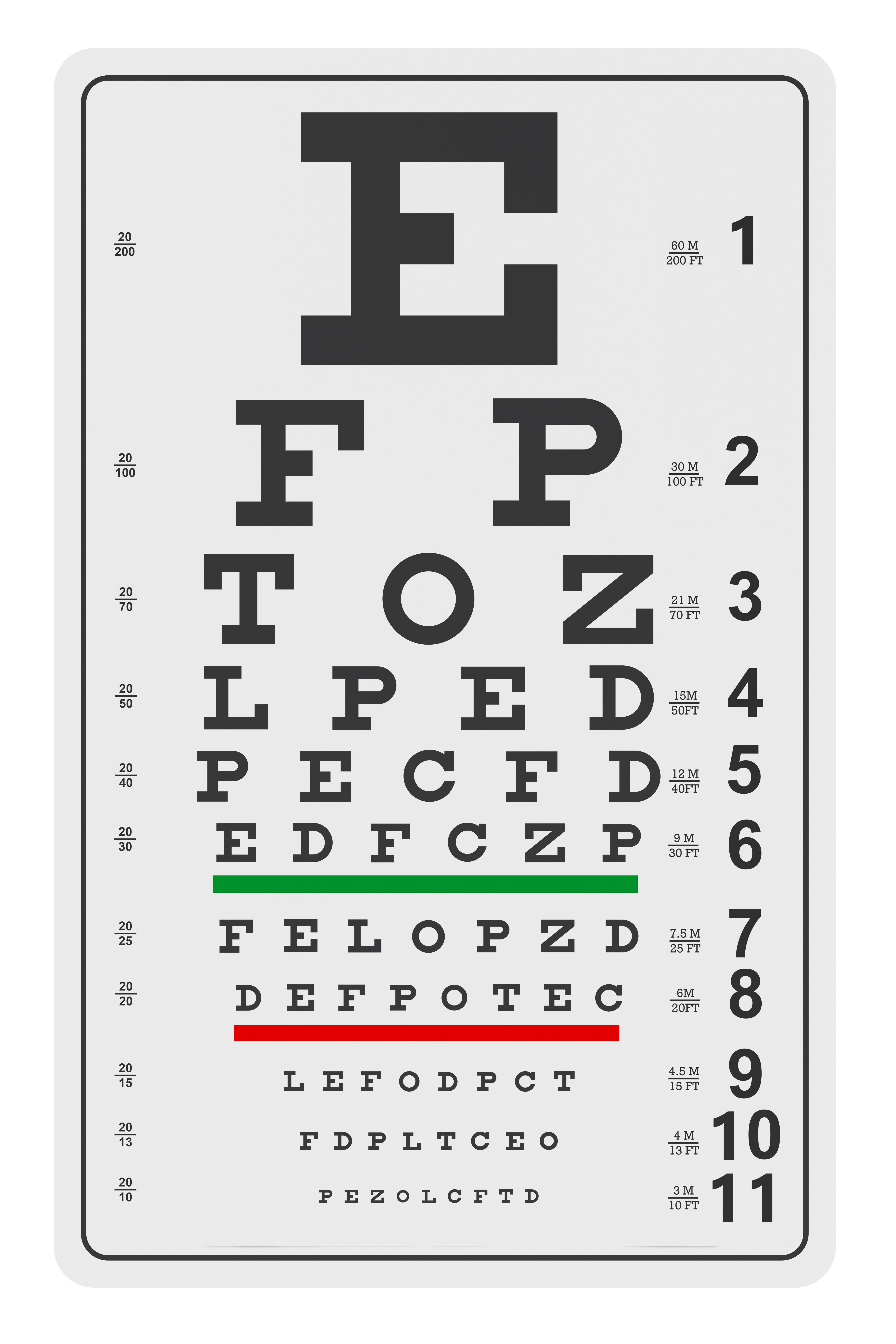
Eye Test Chart. Eye Chart for Eye Exams, Eye Chart, Wall Chart, 3D rendering isolated on white background
ing to come up with a simple and standardized test for visual acuity. In other words, how good is a person’s eyesight.
He examined every letter of the alphabet, but only the letter E had three horizontal limbs separated by equal amounts of white space. There was also a one-to-one ratio between the height of the letter and the width of the letter, i.e. it was square. The gaps and bars were all the same length. In most modern Snellen Eye Charts, the middle bar is shorter. Vision specialists today use a version of the Snellen Eye Chart with 11 lines of letters.
It seems that a lot of research has gone into making letters. Each letter is called an optotype. Optotypes have a special geometry in which the height and width of each letter is five times the thickness of the line. And the thickness of the line is the same thickness as the white space between lines and the thickness of the gap in the letter C.
In a typical eye exam, the patient covers one eye and reads the letters. The smallest row that can be read from 20 feet (6 meters in most countries) demonstrates the visual acuity of the eye.
Snellen specified that a person with “standard vision” should be able to read the letter when it subtends 5 minutes of arc. That’s the angle between the top and bottom of the letter as seen by the test subject. That would be one-twelfth of a degree, as there are 360 degrees in a circle.
A person with normal vision is said to have 20/20 vision. They can read at 20 feet what most people can read at 20 feet. People with 20/10 vision have exceptional vision, because they can read at 20 feet back what most people can read at 10 feet back. And 20/40 vision is not too good, because that person must be 20 feet back whereas most people can read the letters at 40 feet.
The definition of legally blind is now “with your best visual correction, you cannot read any letter on the 20/100 line in your better seeing eye, or you have a visual field diameter of 20 degrees or less in your better eye.”
The Landolt C eye chart is similar with rows of the letter C and the tested person indicates in which direction the gap is facing. The Landolt Chart came out in 1888.
Louise Sloan came up with a widely used modification of the Snellen Chart. Her Sloan chart, debuting in 1959, uses only 10 letters: C, D, H, K, N, O, R, S, V, and Z.
There is a special eye chart for illiterate adults and young children who cannot identify letters. The block letter of E is turned into different orientations or directions. With the “tumbling E” chart, the test subject points in which direction the E is facing.
Eye specialists also have eye scanning devices that closely approximate a prescription for people that are physically unable to respond. That category might include infants, stroke patients, and head injury victims.
The most common vision defects are the well-known nearsightedness (myopia),
farsightedness (hyperopia), astigmatism, and presbyopia. Fortunately, these deficiencies can be corrected with eyeglasses, contacts, or laser surgery.
Sources: Atlantic Eye Institute, American Academy of Ophthalmology.
 Larry Scheckel