
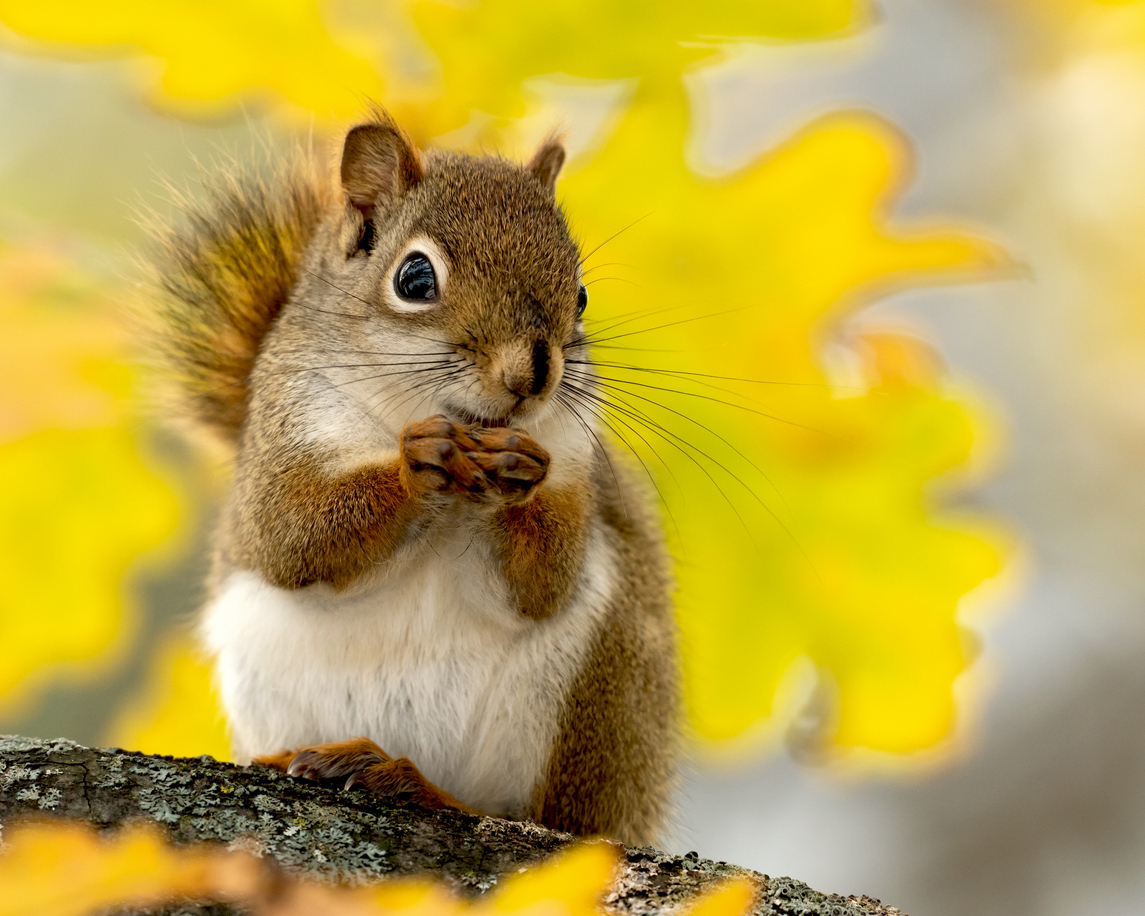
We’ve all witnessed the squirrel’s autumn ritual of scurrying about the lawns and parks, front paws and cheeks full of acorns. They’re preparing for winter. In winter, a squirrel can stay hidden in a tree nest, hole, crevice, or ground burrow for a day or two, but after that they get mighty hungry and need to eat. Tree squirrels don’t hibernate like their ground squirrel cousins. Red squirrels collect nuts and store them in piles. It’s a central location, called a midden, located in a tree cavity, under leaves, or in branch forks of trees. The more numerous gray squirrels bury their nuts in the ground and in various scattered caches around their territory. Spreading the nuts around makes it harder for other animals or naughty squirrels to pilfer their entire food supply.
If a squirrel is scurrying all over the place and hiding nuts everywhere, how does it remember where the food is hidden? There have been two schools of thought on this subject. One theory is that the squirrel uses its sense of smell to find its stock of food. The second theory is that the squirrel has developed a mental picture, using landmarks such as trees. The gray squirrel is a wily creature. It will bury “fake” nuts to trick other squirrels out of finding its stash. Some gray squirrels dig holes and bury nothing, pretending to have buried nuts. Squirrels partly use scent to uncover their buried treasure, and they do steal a nut or two from other squirrels’ caches. However, scent is not totally reliable. When the ground is too dry or covered too deep in snow, scent is of little use. Trying to find nuts through ice is impossible.
Scientists seem to study everything, and a Princeton group published a study in the journal Animal Behavior entitled “Grey Squirrels Remember the Locations of Buried Nuts.” The Princeton study indicates that squirrels use spatial memory to locate stored food. The squirrel goes back more often to its own food supply than to the caches of other squirrels. Squirrels bury their food near landmarks that aid them in remembering where they stored the food. They seem to form a cognitive map of all their storage locations. They also remember the amount of food in their caches, returning first to the cache that has the largest amount. Some squirrels will dig up and rebury nuts to determine if the stored food is still good.
Dr. Peter Smallwood, at the University of Richmond, has studied squirrel behavior for ten years. He says squirrels only find 75 percent of the nuts they bury, whether by smell or memory mapping. That’s a bonus for the woodlands, because those unfound nuts can grow into trees. Dr. Smallwood claims that a gray squirrel prefers to bury red oak acorns, which are rich in fat and sprout in the spring.
The squirrel is more likely to eat a white oak acorn immediately, because it will germinate soon after it hits the ground. The red oak acorn is high in tannin, which isn’t as tasty as the white oak acorn. Mr. Squirrel will leave the red oak acorn for spring eating. Spring is a hard time for squirrels. They’re running out of stored food. They will go for road kills and dumpsters with discarded pizza boxes and chicken bones. If desperate, they will seek out bird eggs and even young nestlings.
 Larry Scheckel